
Door Hangers vs Google Ads: Complete Cost & Results Comparison for Local Businesses (2026)
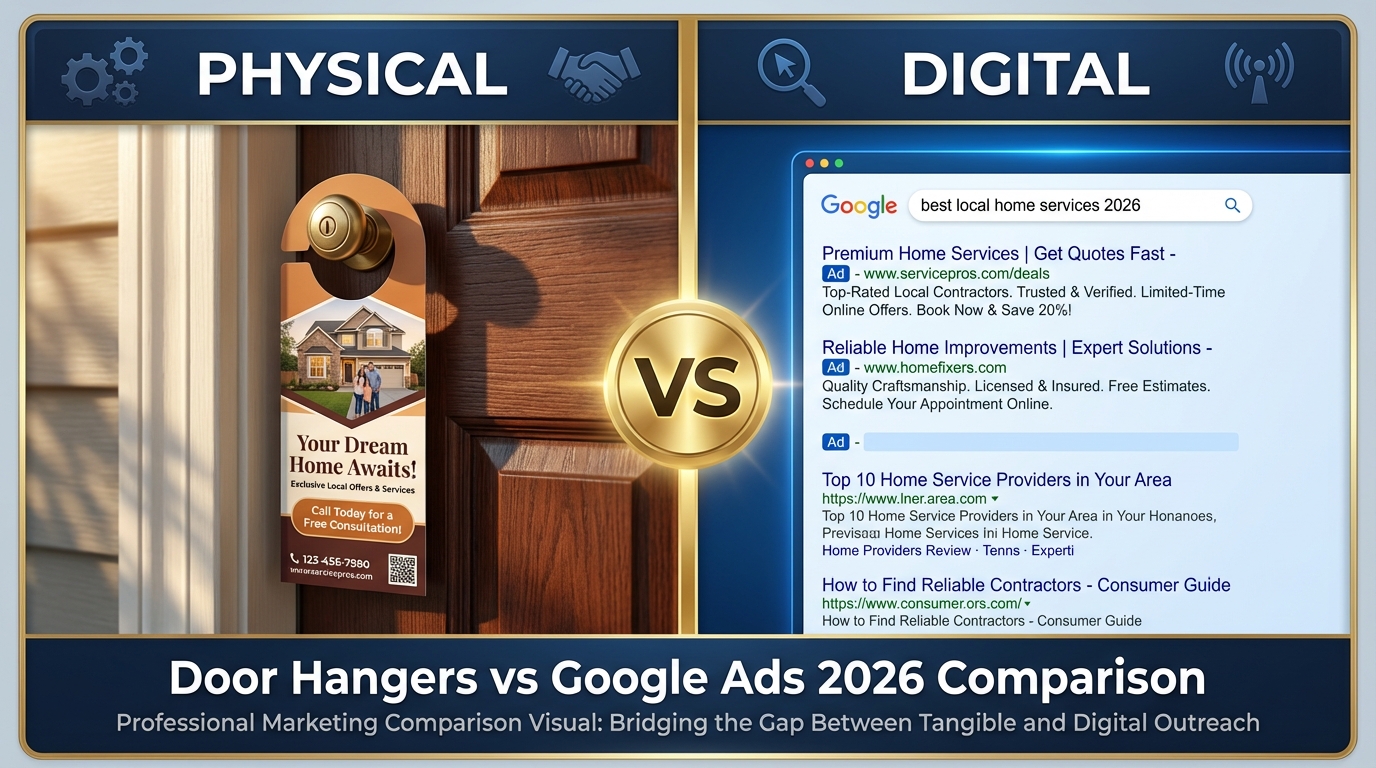
When you’re ready to execute, DTD’s flyer distribution service handles the operational side — thousands of local distributors across all 50 states, Proof of Delivery photos on every campaign, and field supervisors on-site during distribution.
Every local business owner faces the same marketing question: where should I spend my budget to get the most customers? In 2026, the two most common answers are Google Ads and door hanger distribution. Both work. Both have proven track records. But they work in fundamentally different ways, reach audiences at different stages, and cost dramatically different amounts depending on your market.
See our complete guide to door hangers for business across every industry.
This guide provides an honest, balanced comparison of door hanger distribution and Google Ads for local businesses. We will cover costs, targeting, measurability, strengths, weaknesses, and when to use each — including when the smartest strategy is to use both together. At Direct to Door Marketing, we have managed door hanger campaigns for millions of flyers and door hangers since 1995, and many of our most successful clients use door hangers alongside digital channels, not instead of them.
The Core Difference: Interruption vs. Intent Marketing
Before comparing costs and features, it is essential to understand the fundamental difference between these two channels. They operate on opposite sides of the marketing spectrum.
Google Ads: Intent-Based Marketing
Google Ads captures people who are already looking for something. When a homeowner searches “AC repair near me” and clicks your ad, they are in the market right now. This is intent-based marketing — you are paying to be visible at the exact moment a potential customer is searching. The advantage is clear: high purchase intent. The disadvantage is equally clear: you are competing with every other business bidding on that same keyword, and costs rise accordingly.
Door Hangers: Awareness-Based Marketing
Door hanger distribution is awareness-based marketing. You are putting your business in front of every household in a target area, whether they are actively looking for your service today or not. This creates brand awareness, plants a seed for future need, and reaches the large majority of potential customers who are not actively searching at any given moment. Door hanger distribution is the process of physically placing marketing materials on residential door handles to generate local awareness and drive customer action.
Both approaches have value. The question is which one — or which combination — makes the most sense for your business, your market, and your budget.
Cost Comparison: What You Actually Pay Per Household Reached
Cost is where the comparison gets most interesting — and where many business owners are surprised by the numbers.
Google Ads: The Real Cost Per Local Customer
Google Ads pricing is based on cost-per-click (CPC). You pay every time someone clicks your ad, regardless of whether they become a customer. In local markets, CPCs for service-based keywords have risen sharply:
- HVAC keywords: $15–$50+ per click
- Plumbing keywords: $12–$40+ per click
- Dental keywords: $8–$25+ per click
- Restaurant keywords: $1–$5 per click
- Real estate keywords: $5–$20+ per click
- Legal keywords: $30–$100+ per click
When you factor in click-through rates (published industry benchmarks put local search ads in the low single digits) and conversion rates (only a minority of clicks become leads), the actual cost to acquire a customer through Google Ads is often $50–$300+ for service businesses. For competitive industries like HVAC or legal, it can exceed $500 per customer acquisition.
Door Hangers: The Real Cost Per Household Reached
Door hanger distribution is quoted as a flat campaign price for a defined set of households, with no auction and no bid. Every household in your target area receives the piece — there is no algorithm deciding who sees it and who does not. For a 5,000-door campaign, you know the total before the first piece goes out; request a quote for your area to see it.
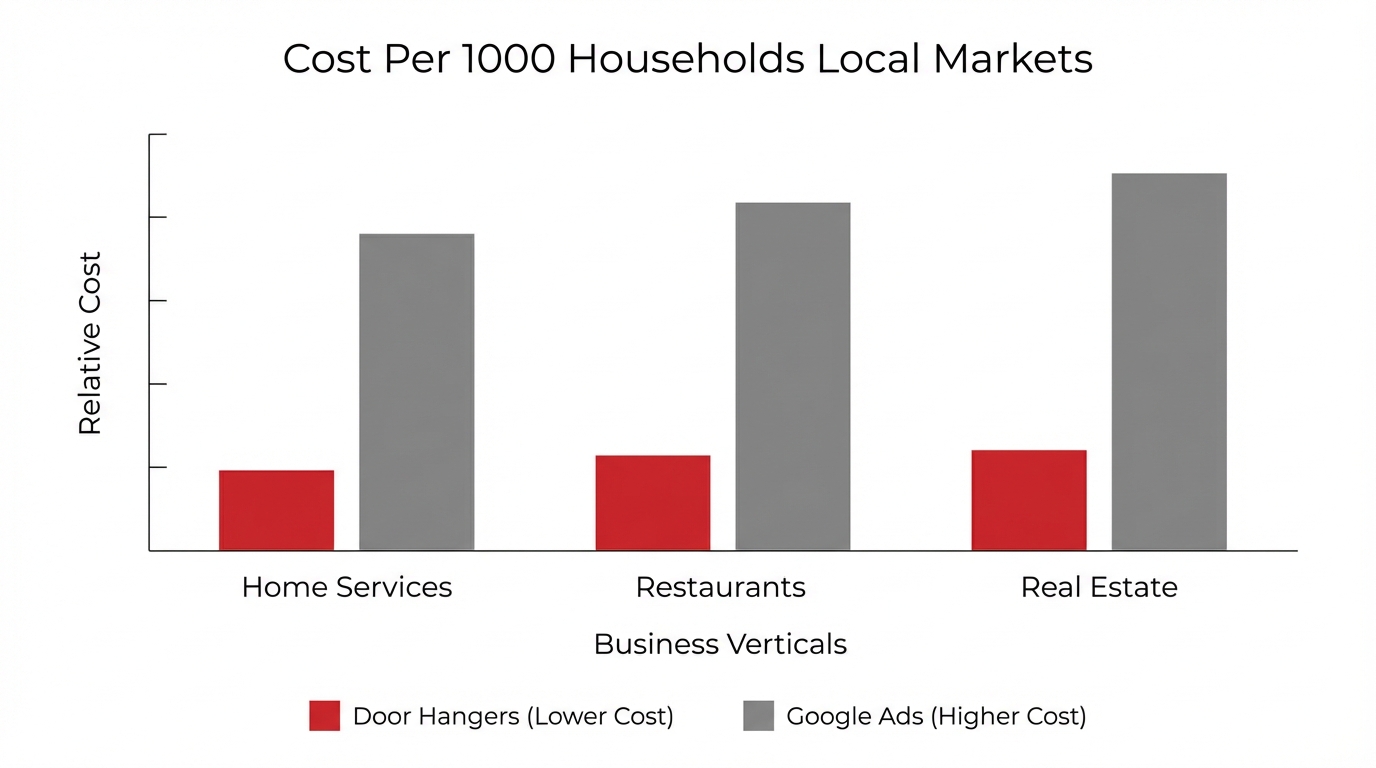
Expressed as cost per thousand households reached (CPM), the comparison is dramatic:
| Criteria | Door Hangers | Google Ads |
|---|---|---|
| Cost per 1,000 households reached | $80–$250 | $500–$5,000+ (varies by industry) |
| Targeting method | Geographic — specific neighborhoods, zip codes, radius | Keyword + geographic + demographic + device |
| Ad blocking risk | Zero — physical piece on door | High — ad blockers, scroll-past, click fraud |
| Physical tangibility | Yes — held in hand, placed on fridge, shared | No — digital only, disappears when scrolled |
| Setup time | 5–10 business days (design + print + distribute) | 1–3 days (campaign setup + approval) |
| Geographic precision | Street-level — every door in target zone | Radius or zip code — algorithm determines who sees ad |
| Audience intent | Low to medium — awareness and future need | High — actively searching now |
| Best campaign type | Brand awareness, grand openings, offers, menus | Lead generation for in-demand services |
| Ongoing cost | Per campaign — no recurring spend | Continuous — stops the moment budget runs out |
| Delivery verification | AI Proof of Delivery photos (Direct to Door) | Impression and click data from Google |
Map your neighborhood
Draw the streets you want to reach and see the home count before you order a single piece. Our free mapping tool builds the coverage area your distributor will walk.
Targeting: How Precisely Can You Reach Your Audience?
Both channels offer targeting — but in very different ways.
Google Ads Targeting
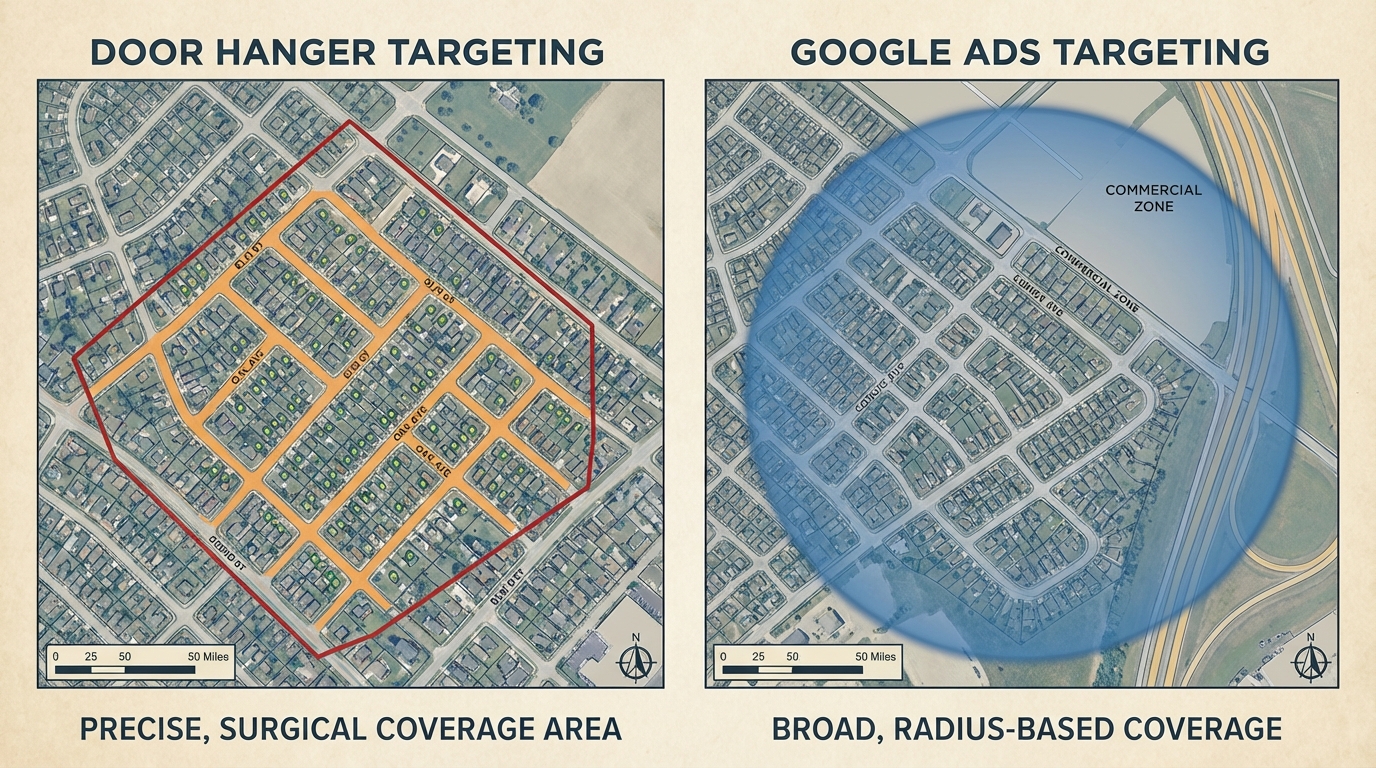
Google Ads lets you target by keyword (what people search), location (radius or zip code), device (mobile vs desktop), time of day, demographics, and more. This is powerful for reaching people who are actively searching. However, Google’s location targeting is approximate — a user’s location is inferred from IP address, device location, or search behavior, which can be imprecise at the neighborhood level.
Door Hanger Targeting
Door hanger distribution targets at the physical address level. Every door in your defined target area receives the piece. There is no algorithm deciding who sees your message — if a house is in the zone, it gets a door hanger. This is the most precise form of geographic targeting available in marketing.
For businesses whose customers come from a defined geographic radius — restaurants, dental offices, fitness studios, real estate agents, HVAC companies, landscapers — this street-level precision is a significant advantage. You can saturate a specific neighborhood completely, something Google Ads cannot guarantee.
Measurability: How Do You Know What Worked?
This is an area where Google Ads has a traditional advantage — but the gap is closing.
Google Ads Measurability
Google provides detailed data: impressions, clicks, click-through rates, conversion tracking, cost per conversion, and more. You can see exactly how many people clicked, what they did on your site, and (with proper tracking) how many became leads or customers. This level of data is genuinely powerful for optimization.
Door Hanger Measurability
Door hanger campaigns are measurable when you build tracking into the campaign design. The most effective methods include:
- Unique promo codes: A code that only appears on your door hangers (e.g., “Use code DOOR25 for 25% off”) tracks exactly how many customers came from the campaign.
- Dedicated phone numbers: A tracking number used only on your door hangers tells you exactly how many calls the campaign generated.
- QR codes: A QR code linking to a unique landing page tracks scans and conversions.
- Custom URLs: A short URL like yoursite.com/welcome directs door hanger recipients to a trackable page.
- Delivery verification: Direct to Door’s AI Management Platform provides Proof of Delivery photos confirming your materials reached their intended homes.
While door hanger tracking requires more intentional setup than Google’s built-in analytics, a well-designed campaign can provide clear, actionable data on customer acquisition.
Ad Blindness & Digital Fatigue: The Case for Physical Marketing
One of the strongest arguments for door hangers in 2026 is a phenomenon that is accelerating every year: digital ad fatigue.
The average American encounters an estimated 6,000–10,000 digital ads per day across websites, social media, apps, and search results. The human brain has adapted by learning to ignore most of them. Studies from Nielsen and other research firms have consistently shown that banner blindness — the tendency to unconsciously ignore digital ad placements — affects the majority of web users.
Key Insight: A physical door hanger cannot be blocked by ad-blocking software, scrolled past in a feed, or filtered into a spam folder. It exists in the physical world, on the door handle that every household member must touch to enter their home. This physicality creates a level of engagement that digital formats increasingly struggle to achieve.
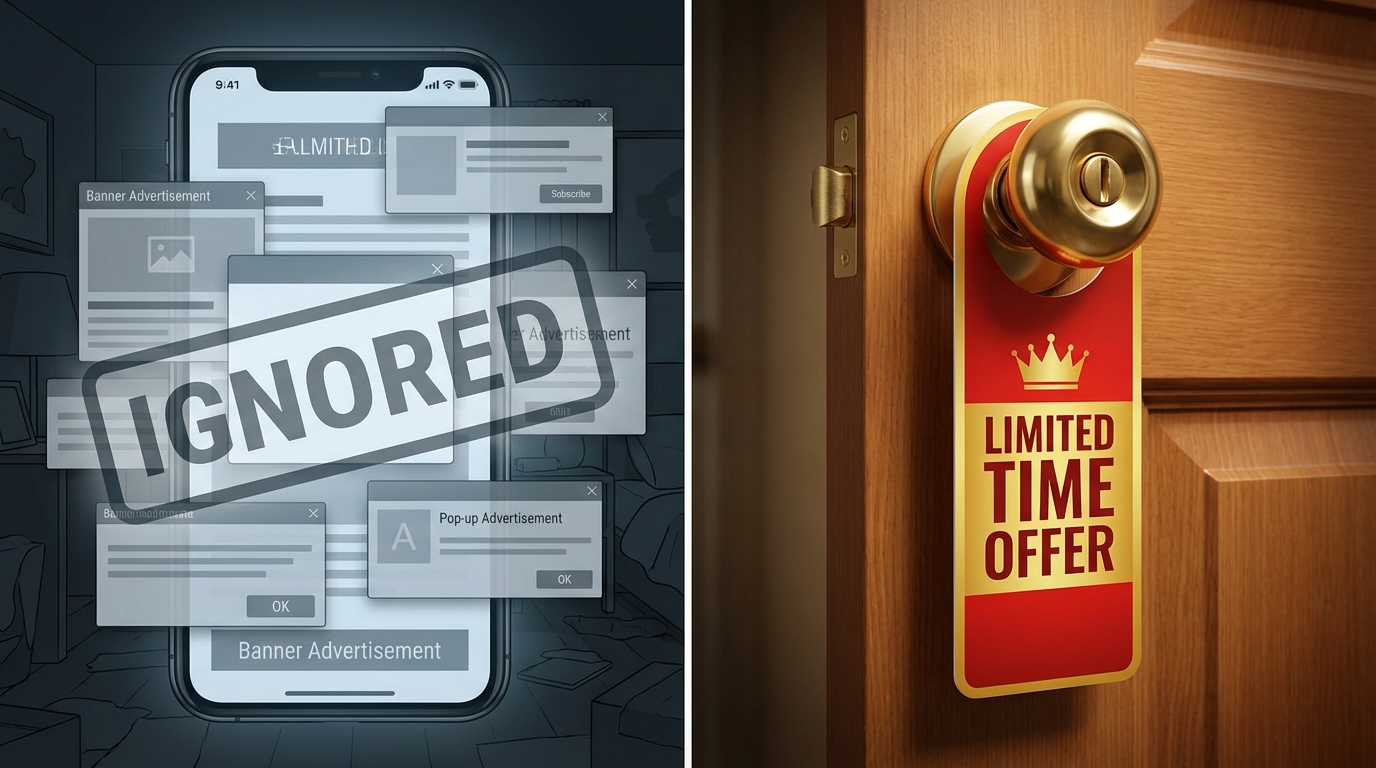
Ad blockers are installed on over 40% of web browsers globally, according to data from Blockthrough’s annual report. Mobile ad blockers are growing even faster. For businesses relying solely on digital ads, a growing portion of their target audience is literally invisible to them. Door hangers have no such vulnerability.
When Google Ads Wins
Intellectual honesty matters. Google Ads is the better choice in several specific scenarios:
- Emergency services: When someone’s pipe bursts at 2 AM, they search “emergency plumber near me.” Door hangers cannot capture this in-the-moment intent. Google Ads can.
- High-intent services: For purchases that people actively research before buying — lawyers, medical specialists, complex services — Google captures users in active decision-making mode.
- Speed to market: A Google Ads campaign can be live within hours. Door hanger campaigns require design, printing, and physical distribution — typically 5–10 business days.
- E-commerce and non-local: If your customers are not geographically concentrated, door hangers are not the right tool. Google Ads can reach anyone, anywhere.
- Keyword-specific demand capture: When you know people are searching for exactly what you offer, being visible in those search results has clear, direct value.
Google Ads excels at capturing existing demand. It puts your business in front of people who are already looking for what you sell, at the exact moment they are looking.
Put this guide to work
Direct to Door Marketing has delivered door hangers and flyers door to door since 1995. Every campaign runs through our AI Management Platform with Proof of Delivery photos, delivered by thousands of local distributors. Most quotes come back within 20 minutes during business hours.
When Door Hangers Win
Door hangers are the stronger choice in an equally clear set of scenarios:
- Hyperlocal businesses: Restaurants, pizza delivery, dry cleaners, fitness studios, dental offices — any business where 80%+ of customers come from within 1–5 miles. Door hangers saturate that radius completely.
- Grand openings and new locations: When you need every household in an area to know you exist, nothing beats a door hanger on every door. Google Ads only reaches people who happen to search.
- Menu distribution: Restaurants and delivery services that want their menu in every home in the neighborhood. Door hangers function as both marketing piece and reference tool — many recipients keep them on the refrigerator.
- Competitive markets with expensive CPCs: When Google Ads CPCs are $20, $30, $50+ per click, reaching the same households via door hangers, at a flat cost per door that is a small fraction of one competitive click, is dramatically more cost-efficient.
- Building brand awareness: Door hangers plant your brand in the mind of residents who may not need you today but will remember you when they do. Google only captures people who are searching now.
- Physical offers and coupons: A physical coupon on a door handle has staying power that a digital ad does not. People save door hangers with attractive offers, creating impressions that last days or weeks, not seconds.
Major brands understand this. Companies like Domino’s, Chick-fil-A, Uber, AT&T, and RE/MAX have all used large-scale door hanger distribution through Direct to Door Marketing to reach specific geographic markets — because for certain goals, nothing else works as well.
The Combined Strategy: Using Both Together
The smartest local marketers in 2026 are not choosing between door hangers and Google Ads — they are using both in a coordinated strategy. This is the “surround sound” approach to local marketing.
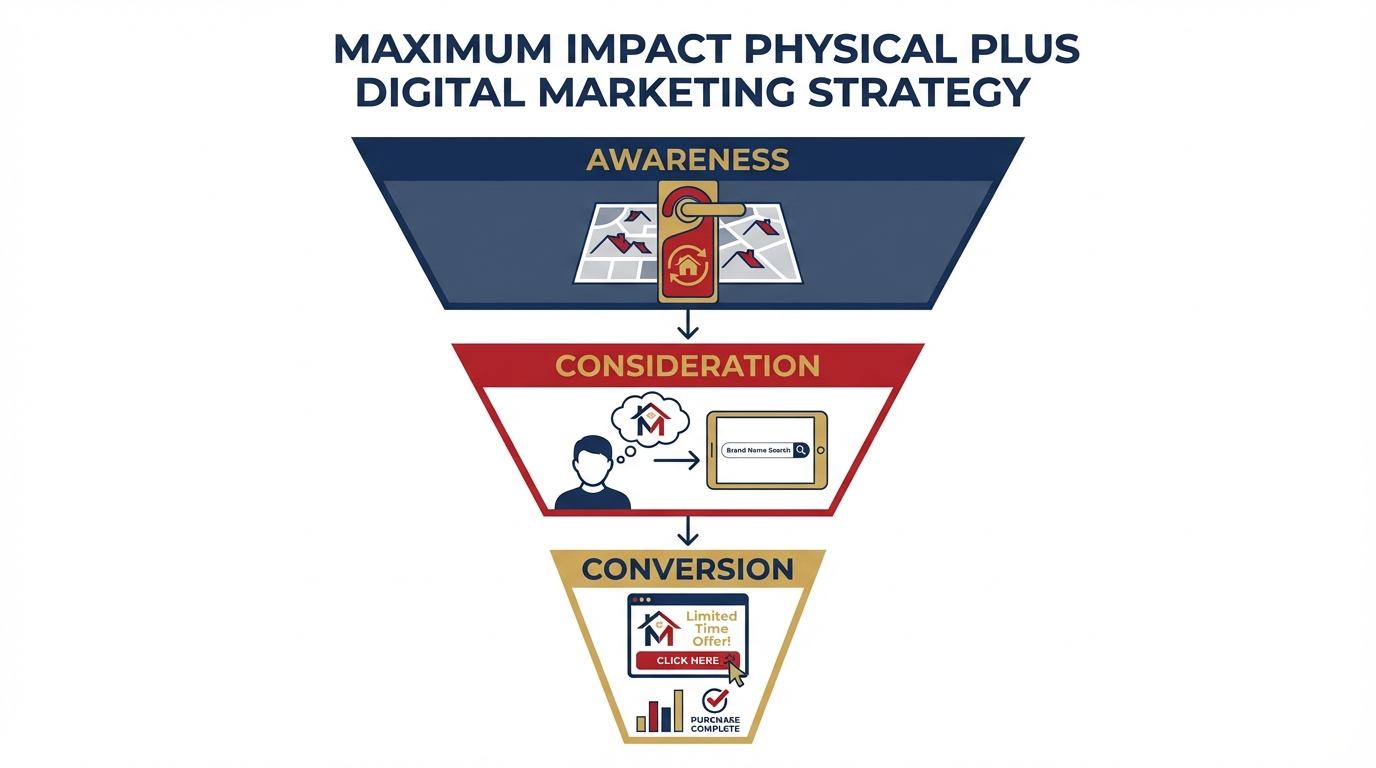
How the Combined Strategy Works
- Door hangers create awareness: Distribute door hangers to every home in your target radius. This plants your brand name, your offer, and your contact information in the minds of local residents.
- Google Ads capture the follow-up search: When a resident who received your door hanger later searches for your service category online, your Google Ad appears — reinforcing the brand they already recognize from the physical piece.
- Recognition drives clicks and conversions: People are significantly more likely to click on a brand they recognize. The door hanger primes the audience; Google Ads captures the conversion.
Why This Works So Well
Marketing research consistently shows that consumers need multiple touchpoints before taking action. The combination of a physical touchpoint (door hanger) followed by a digital touchpoint (Google Ad) creates a multi-channel experience that builds trust and familiarity faster than either channel alone. A homeowner who sees your door hanger Tuesday and then sees your Google Ad when they search Thursday is far more likely to click and call than someone seeing only the ad.
What Local Businesses Actually Say
Different business types experience these channels differently. Here is what we hear from businesses in the verticals we serve most:
Restaurants and Pizza Delivery
Restaurants consistently report that door hanger distribution — especially menu door hangers — drives direct orders. A physical menu on a door handle gets saved, stuck on the refrigerator, and referenced when the family is deciding what to order. Google Ads can capture someone searching “pizza near me,” but a menu door hanger creates demand before the search ever happens.
HVAC and Home Services
HVAC companies face some of the highest CPCs in Google Ads — often $20–$50+ per click for keywords like “AC repair near me.” Door hanger campaigns targeting neighborhoods with homes built 15–20+ years ago (likely needing system replacement or major repair) provide a cost-efficient way to generate leads before the homeowner picks up their phone to search.
Real Estate Agents
Real estate agents use door hangers to farm specific neighborhoods — consistently putting their name and recent sales data in front of homeowners. When those homeowners eventually decide to sell, the agent who has been on their door handle every quarter for the past year gets the first call. Google Ads captures the “sell my house” search, but the door hangers built the relationship that makes the agent the first choice.
Dental Practices
New dental practices use door hangers to announce their opening and special offers to every household within a 3–5 mile radius. Combined with Google Ads targeting “dentist near me,” the dual-channel approach accelerates patient acquisition significantly faster than either channel alone.
DTD’s door hanger distribution company is the only U.S. network that can deploy in thousands of cities at the same time — thousands of local distributors under one national contract.
Frequently Asked Questions About Door Hangers vs Google Ads
Which is cheaper — door hangers or Google Ads?
On a cost-per-household-reached basis, door hangers are almost always cheaper. Door hanger distribution is priced as a flat, quoted amount per campaign, so the cost per thousand households is known up front and does not rise when competitors bid. Google Ads costs vary dramatically by industry but often run $500–$5,000+ per thousand impressions in local markets when you account for click costs and conversion rates. However, Google Ads captures higher-intent audiences, so cost-per-customer-acquired can vary based on your conversion rates.
Can door hangers replace Google Ads entirely?
For some hyperlocal businesses — particularly restaurants, pizza delivery, and neighborhood service providers — door hangers can serve as a primary marketing channel. However, for most businesses, the strongest approach is using both. Door hangers create awareness; Google Ads capture intent. Replacing one entirely means losing an important part of the customer journey.
How do I track results from a door hanger campaign?
Use trackable elements: unique promo codes, dedicated tracking phone numbers, QR codes, or custom landing page URLs that appear only on your door hangers. These allow you to measure exactly how many customers came from the campaign. Direct to Door Marketing also provides delivery verification through our AI Management Platform, confirming your materials reached their intended households.
Are door hangers better for new businesses?
Door hangers are especially effective for new businesses and grand openings because they create broad awareness in a target area immediately. Google Ads requires that people actively search for your category — but if nobody knows your business exists yet, search volume for your brand is zero. Door hangers put you on every doorstep in the neighborhood, creating the initial awareness that eventually drives search volume.
Do door hangers still work in 2026?
Yes. Door hanger distribution remains one of the most effective local marketing channels available. In a world of increasing digital ad fatigue, physical marketing is gaining renewed appreciation. A tangible piece on a door handle cannot be blocked, skipped, or filtered — and it engages multiple senses. Brands from Domino’s to Uber to RE/MAX continue to invest heavily in door hanger distribution because the results justify the investment.
How many door hangers should I distribute to compete with a Google Ads campaign?
The comparison depends on your market and goals. A typical local Google Ads campaign might spend $1,000–$3,000/month. That same budget in door hangers could distribute 5,000–25,000 pieces, reaching every household in a multi-neighborhood area. For hyperlocal businesses, the door hanger coverage often represents a larger effective audience than the same budget in Google Ads. For help calculating the right quantity, see our guide on how many door hangers you need.
Can I run door hangers and Google Ads at the same time?
Absolutely — and this is the recommended strategy for maximum impact. Distribute door hangers to your target area, then run Google Ads targeting the same geographic zone. Residents who received your door hanger and later search for your service category online will see your ad and recognize your brand. This multi-touchpoint approach consistently outperforms either channel used alone.
What types of businesses get the best results from door hangers compared to Google Ads?
Businesses with a defined local service area see the strongest door hanger results. Restaurants, pizza delivery, HVAC, plumbing, dental, real estate, fitness studios, dry cleaners, lawn care, and home services all perform exceptionally well with door hanger distribution. These businesses draw customers from a geographic radius, which aligns perfectly with door hanger targeting. Businesses that serve a broader or non-geographic market typically get more value from Google Ads. For detailed restaurant strategies, see our restaurant door hanger marketing guide.
Conclusion: The Right Channel Depends on Your Goals
Google Ads and door hanger distribution are both powerful local marketing tools — but they do different things. Google Ads captures existing demand. Door hangers create new demand and build local awareness. For most local businesses, the answer is not either/or — it is both, working together in a coordinated strategy.
If you are spending heavily on Google Ads and seeing rising costs with diminishing returns, adding door hanger distribution to your marketing mix can reduce your overall cost per customer while expanding your reach to households that will never see your digital ads. If you are not doing any local marketing yet, door hangers are often the most cost-efficient place to start.
Direct to Door Marketing has helped businesses from local startups to Fortune 500 brands like Uber, AT&T, Chick-fil-A, and RE/MAX execute door hanger campaigns that deliver measurable results. With thousands of distributors covering 99% of U.S. cities and our AI Management Platform providing Proof of Delivery on every campaign, we make door hanger distribution accountable, scalable, and effective.
Ready to see how door hangers can complement your marketing strategy? Get your free quote today or call us at (866) 643-4037.
Written by the Direct to Door Marketing editorial team, with 30+ years of door hanger distribution expertise serving businesses from local startups to Fortune 500 companies.
Service page
Door Hanger Distribution Cost Guide
What goes into a campaign price and how to size an order for your area.
Continue Reading: Door Hanger Marketing Guides
Understanding Door Hanger Response Rates
2 Responses