
Door Hanger Marketing for Restaurants: The Complete 2026 Guide to Filling Tables and Boosting Orders
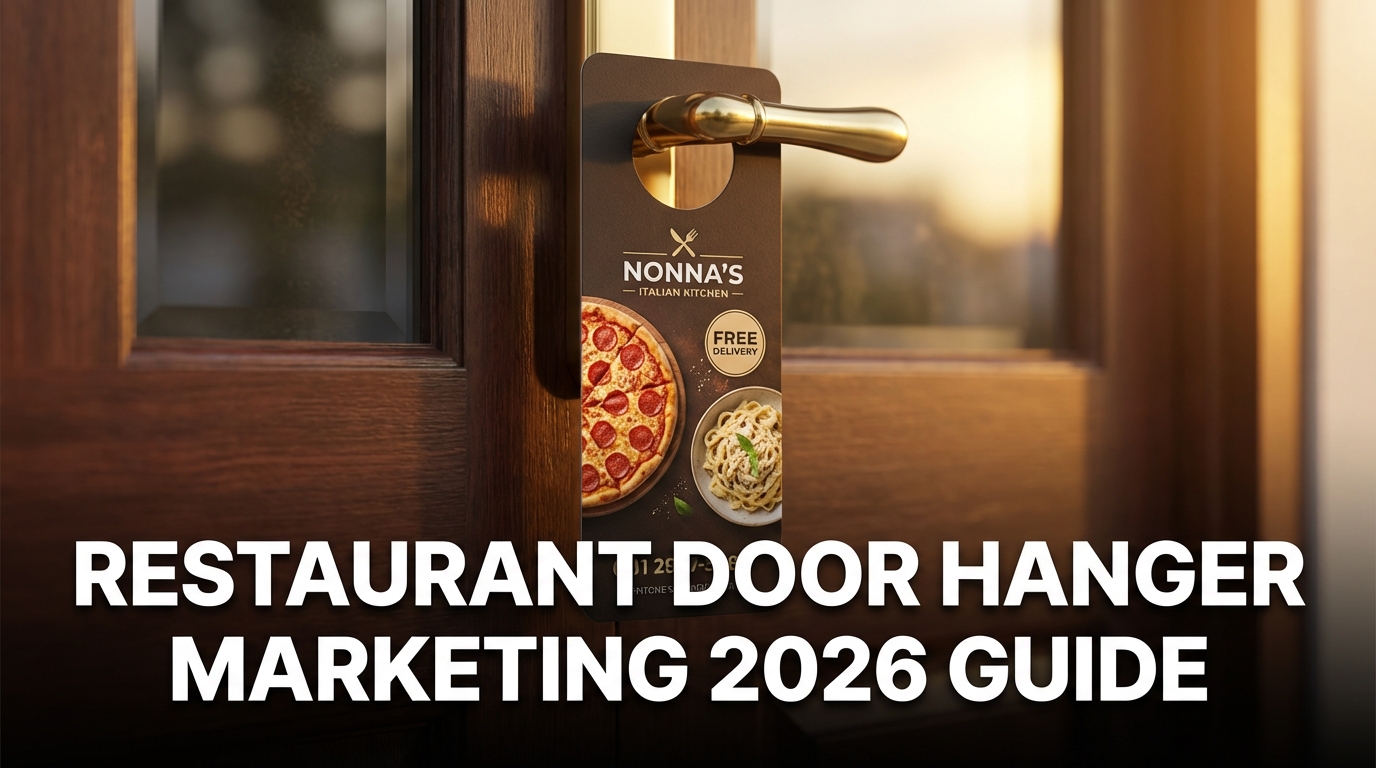
Putting these ideas into practice is where DTD’s neighborhood flyer marketing comes in — physical door-to-door delivery through a nationwide local-distributor network, with on-the-ground field supervisors during every campaign.
If you own or manage a restaurant, you already know the challenge: how do you get the attention of people who live nearby but have never walked through your door? Digital ads are crowded and expensive. Social media algorithms change weekly. But there is one marketing channel that puts your menu, your offer, and your brand physically in the hands of every household in your neighborhood — and it has been quietly driving restaurant revenue for over 30 years.
Door hanger marketing for restaurants is not a theory. It is a proven, measurable strategy used by national chains and independent eateries alike. Direct to Door Marketing, America’s largest door hanger distribution company since 1995, has delivered millions of flyers and door hangers nationwide and works with restaurant brands from single-location pizzerias to franchises like Domino’s and Chick-fil-A. This guide covers everything you need to plan, design, target, and measure a restaurant door hanger campaign that fills tables and drives orders.
Why Door Hangers Work Especially Well for Restaurants
Door hanger marketing is the process of delivering printed marketing materials directly to the door handles of targeted residential homes. Unlike mail, door hangers cannot be confused with bills or junk mail. Unlike digital ads, they cannot be scrolled past, blocked, or ignored in a cluttered inbox. A door hanger hangs on a doorknob at eye level, demanding attention from every person who enters or leaves.
See our complete guide to door hangers for business across every industry.
For restaurants specifically, this channel has unique advantages that no other marketing medium can replicate.
Hyperlocal Reach Where It Matters
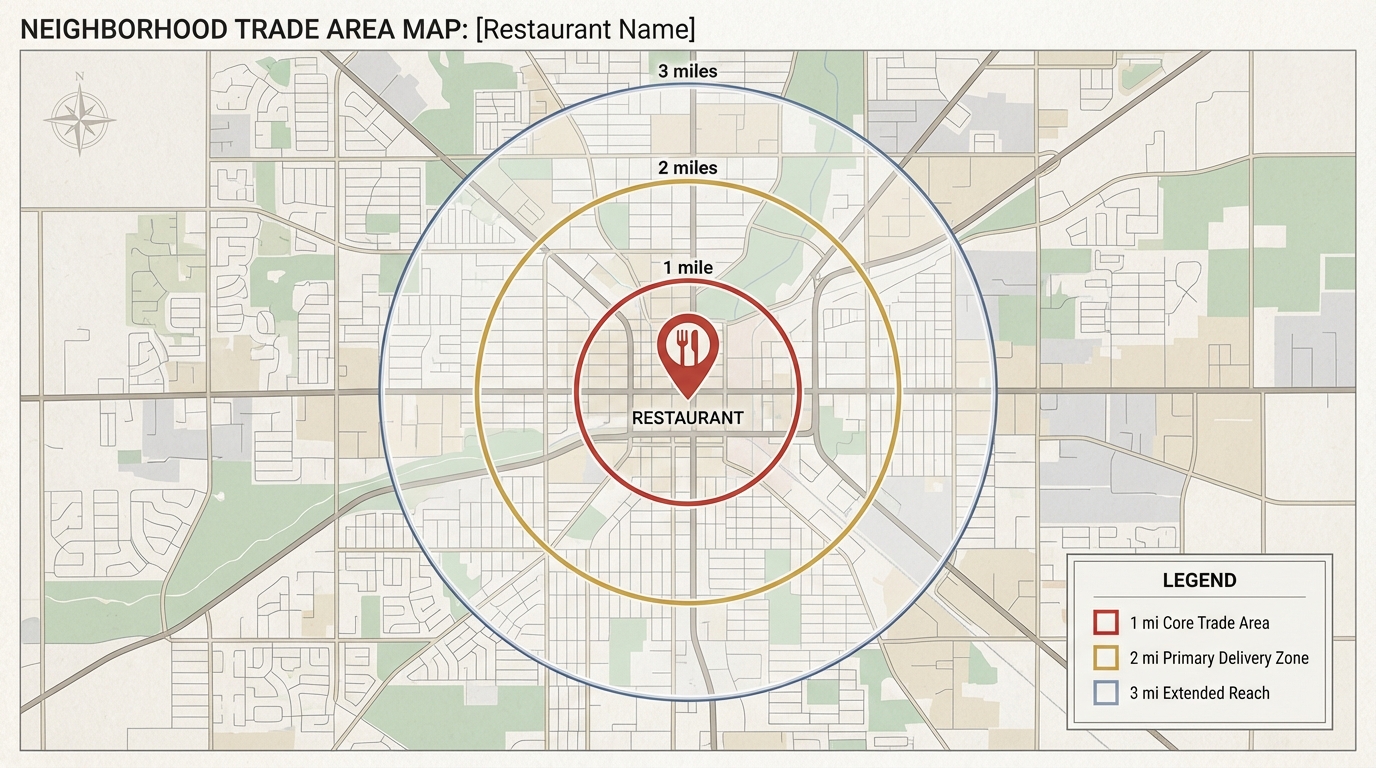
Restaurant success is fundamentally geographic. According to restaurant industry research, the vast majority of a restaurant’s customers live or work within a 1–3 mile radius of its location. Door hanger distribution lets you saturate exactly that radius. Every single home within your trade area receives your message — not just the ones who happen to be searching online or scrolling social media at the right moment.
Physical Presence Triggers Action
A well-designed menu door hanger with appetizing food photography and a compelling offer creates an immediate, visceral response. People see the food. They read the offer. The door hanger sits on their kitchen counter or sticks to their refrigerator for days or even weeks. When dinner time rolls around and the question “What should we eat?” comes up, your restaurant is right there with the answer — and the phone number or QR code to order.
100% Delivery, Zero Algorithm
When you run a Facebook ad or Google ad for your restaurant, an algorithm decides who sees it and when. You might pay for impressions that never convert because the timing was wrong or the targeting was off. With door hanger distribution, 100% of households in your target area receive your message. There is no algorithm filtering you out. Direct to Door Marketing’s AI Management Platform with Proof of Delivery photos confirms that your door hangers actually reached the homes you paid for — something no digital platform can guarantee.
Unmatched Staying Power
A digital ad disappears the moment someone scrolls past. A door hanger is a physical object that lingers. Restaurant door hangers, especially menu-style ones, are among the most-kept pieces of print marketing in existence. People pin menus to corkboards, stick them on refrigerators, and tuck them in kitchen drawers. Your marketing material can generate orders for weeks or months after a single delivery.
Industry Insight: Restaurant door hangers have among the highest retention rates of any print marketing format. A menu on a refrigerator door is a permanent advertisement that works every time someone gets hungry.
Which Restaurant Types Benefit Most
Not every restaurant will use door hangers the same way. The strategy, design, and targeting should match your restaurant category. Here is a breakdown of which types benefit most and how.
| Restaurant Type | Best Campaign Type | Ideal Target Radius | Recommended Quantity | Key Message Focus |
|---|---|---|---|---|
| Pizza & Delivery | Menu + coupon combo | 1–3 miles | 5,000–15,000 | Menu items, delivery speed, first-order discount |
| Quick Service (QSR) | Limited-time offer | 1–2 miles | 3,000–10,000 | Value meals, convenience, speed |
| Casual Dining | Grand opening or seasonal | 2–5 miles | 5,000–20,000 | Atmosphere, new menu, family-friendly |
| New Restaurant Opening | Grand opening blitz | 1–3 miles | 5,000–25,000 | Opening date, special offer, brand story |
| Catering Service | Seasonal push (holidays, events) | 3–10 miles | 5,000–15,000 | Catering menu, booking ease, event types |
| Fine Dining | Event or seasonal tasting | 3–7 miles (affluent areas) | 2,000–8,000 | Chef’s table, wine pairing, exclusive experience |
| Food Truck / Pop-Up | Location announcement | 0.5–1.5 miles | 1,000–5,000 | Schedule, location, social media handles |
The takeaway is clear: every restaurant category can benefit from door hanger distribution, but the approach must be tailored to the business model, customer base, and geographic footprint.
What to Put on Your Restaurant Door Hanger
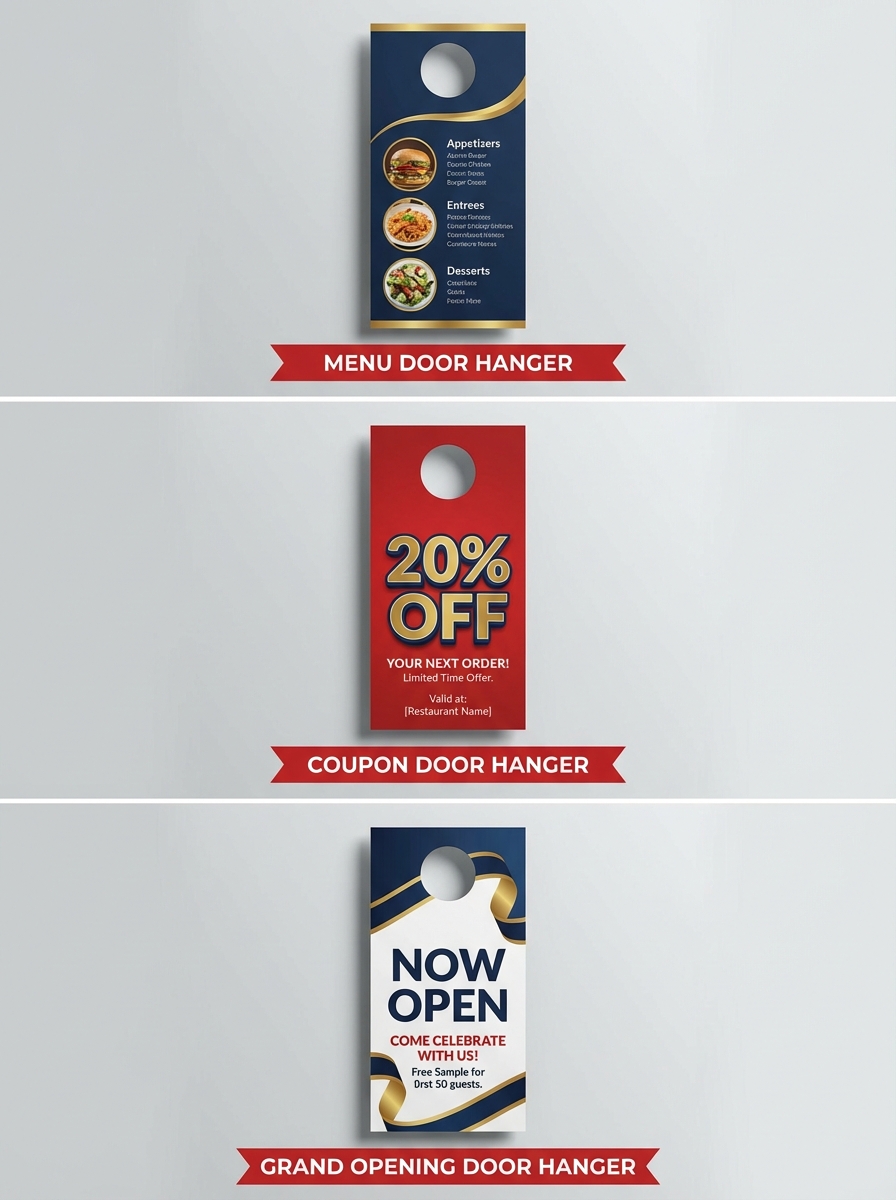
The design and copy on your restaurant door hanger determines whether it ends up on the refrigerator or in the recycling bin. Restaurant door hangers follow different rules than generic marketing door hangers because you have a powerful tool most businesses lack: food imagery.
Front Side: Grab Attention Fast
- Appetizing food photography — Use high-quality images of your most visually stunning dishes. Stock photos will not cut it. Photograph your actual food under good lighting. This is the single most important element.
- Your restaurant name and logo — Brand recognition starts here.
- A compelling headline — Not just your name. Give them a reason: “Free Delivery on Your First Order,” “Now Open — 20% Off This Week,” or “Voted Best Pizza in [Neighborhood].”
- One clear offer — A discount, a free item with purchase, or a limited-time deal. This gives people a reason to act now rather than later.
Back Side: Close the Sale
- Your menu highlights — Feature your 8–12 best-selling items with prices. Do not list your entire menu; choose the dishes that make mouths water.
- Hours of operation — Essential. Do not make customers guess.
- Address and simple directions — “Corner of Main & 5th” is more useful than a street address alone.
- Phone number — Large, prominent, easy to read.
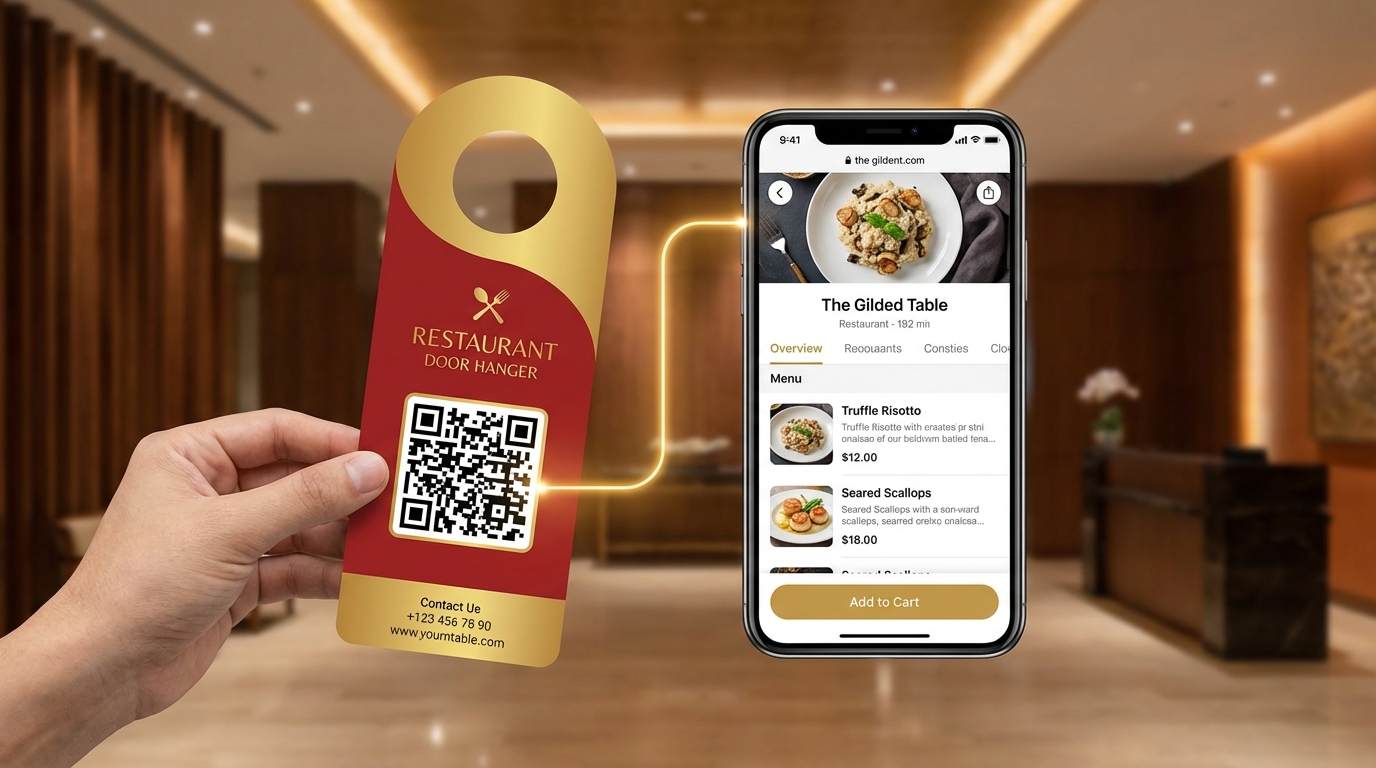
- QR code — Link directly to your online ordering page, not your homepage. Reduce the steps between “I’m hungry” and “order placed” to as few as possible.
- Website and social media — Secondary to phone and QR code, but include them.
Design Tips That Drive Results
- Use both sides — A door hanger has two faces. Use them both. The front grabs attention; the back seals the deal.
- Keep text minimal on the front — Let the food photography and headline do the heavy lifting.
- Use high-contrast colors — Your door hanger needs to stand out against any door color. Dark text on light backgrounds or bold colors with white text.
- Make the phone number and QR code large — These are your conversion tools. If someone has to squint, you have lost them.
- Include an expiration date on offers — “Valid through March 31” creates urgency without feeling pushy.
How to Target the Right Neighborhoods Around Your Restaurant
The most important decision in any restaurant door hanger campaign is where to distribute. Blanket an entire city and you waste budget reaching people who will never drive 20 minutes for takeout. Target too narrowly and you miss potential regulars just outside your immediate block.
The 1–3 Mile Rule
For most restaurants, the sweet spot is a 1–3 mile radius from your location. This covers the area where the vast majority of your repeat customers will come from. Delivery-focused restaurants should focus on their actual delivery zone — typically 1–5 miles depending on the market.
Demographic Targeting
Not all neighborhoods within your radius are equally valuable. Consider these targeting factors:
- Household income — Match your price point. A fine dining restaurant should target affluent neighborhoods; a value-focused QSR targets middle-income family areas.
- Family composition — Family restaurants and pizza/delivery brands do well in neighborhoods with children. Single-heavy areas may respond better to bar-and-grill or trendy dining concepts.
- Housing type — Single-family homes are the primary target for door hangers. Multi-unit apartments may have restricted access, but townhomes and duplexes are fair game.
- Competition density — Areas with fewer restaurant options can be goldmines. Saturating an underserved neighborhood positions you as the convenient local option.
How Direct to Door Helps With Targeting
Direct to Door Marketing’s thousands of distributors cover 99% of U.S. cities, which means they can distribute to virtually any neighborhood you want to target. Their team helps restaurants define the optimal distribution zone based on the restaurant’s concept, delivery area, and competitive landscape. You provide the goals; they map the routes. And with their AI Management Platform, you get Proof of Delivery photos confirming that every door hanger reached its destination — giving you confidence that your budget is being spent on actual deliveries, not wasted.
Grand Opening Door Hanger Campaigns: How to Pack Your Restaurant From Day One
A restaurant grand opening is a one-time event that sets the tone for everything that follows. First impressions become word of mouth. A slow opening creates a narrative of failure. A packed opening creates buzz, social media content, and a customer base that comes back.
Door hanger distribution is one of the most effective tools for grand opening campaigns because it guarantees awareness across your target area.
The Grand Opening Timeline
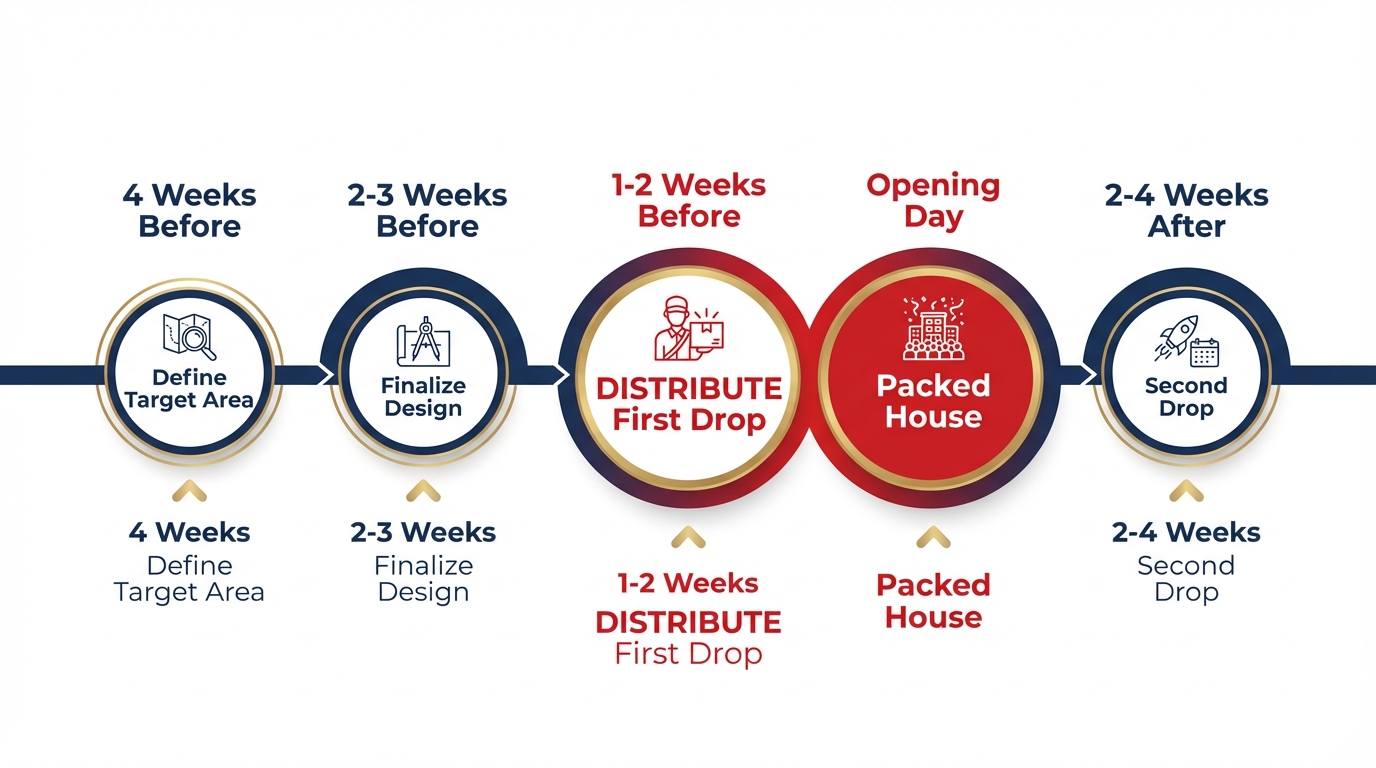
- 4 weeks before opening: Define your target radius and calculate the number of homes. For most restaurant openings, 5,000–25,000 door hangers cover the primary trade area.
- 2–3 weeks before opening: Finalize your door hanger design. Include your opening date, a compelling offer (free appetizer, percentage off, free delivery on first order), your menu highlights, and every way to contact you.
- 1–2 weeks before opening: Distribute. You want door hangers to arrive close enough to the opening that people remember, but with enough lead time that they can plan. Seven to ten days before opening is the sweet spot.
- Opening week: Track response. Use a unique offer code on the door hanger to measure how many customers came specifically from the campaign.
- 2–4 weeks after opening: Run a second drop. Hit the same area again with a “Thank you for visiting” or “Haven’t tried us yet?” message. Frequency builds awareness.
Grand Opening Offer Ideas
- “Free appetizer with any entrée — grand opening week only”
- “20% off your entire order — valid through [date]”
- “Free delivery on your first online order — use code GRAND”
- “Buy one get one free — dine-in only, opening weekend”
- “First 100 customers get a free dessert”
The key is to make the offer strong enough that people feel they are missing out if they do not visit. A grand opening is the one time you can afford to be aggressive with your offer — you are building a customer base, not maximizing margins.
Map your neighborhood
Draw the streets you want to reach and see the home count before you order a single piece. Our free mapping tool builds the coverage area your distributor will walk.
Menu Door Hangers: Turning Every Home Into a Potential Order
Menu door hangers are a specific subtype that restaurants have used for decades — and they remain one of the highest-performing print marketing formats in existence. The concept is straightforward: put a condensed version of your menu on a door hanger, hang it on every door in your delivery area, and wait for the phone to ring.
Why Menu Door Hangers Convert
Menu door hangers convert because they combine two things: food imagery that triggers appetite and a direct path to ordering. When someone sees a picture of a hot pizza with melted cheese and reads “Free delivery — call now,” the decision is already half made. The menu door hanger removes the need to search online, compare options, or navigate a website. It puts the answer to “What’s for dinner?” directly in their hands.
What to Include on a Menu Door Hanger
- 8–12 best sellers with prices — not your entire menu
- Combo deals or meal packages — “Family meal: 1 large pizza + 2 sides + 2-liter soda — $24.99”
- High-quality food photography for at least 3–4 items
- Your delivery area or radius — “We deliver within 3 miles”
- Phone number in large type — this is your primary conversion tool
- QR code to your online ordering page — for customers who prefer to order digitally
- Hours of operation — especially delivery hours if they differ from dine-in
The Refrigerator Effect
Here is what makes menu door hangers uniquely powerful: they get kept. A significant number of households will stick a menu door hanger on their refrigerator, pin it to a corkboard, or slide it into a kitchen drawer. Unlike a digital ad that disappears in seconds, your menu door hanger can generate orders for weeks or months. One distribution can create a long tail of revenue that no other advertising channel matches.
Seasonal and Promotional Campaign Ideas for Restaurants
Beyond grand openings and ongoing menu distribution, restaurants can use door hangers for strategic seasonal campaigns that drive revenue during key periods.
High-Impact Seasonal Campaigns
- Super Bowl Sunday: Pizza, wings, and party platters. Distribute 1–2 weeks before game day with a “Game Day Special” package deal.
- Valentine’s Day: Fine dining and casual restaurants can promote prix fixe menus or special couples’ deals. Target neighborhoods with higher-income households.
- Back to School: Family restaurants and delivery brands can target family neighborhoods with weeknight dinner specials. “School night? Let us cook.”
- Holiday Catering: Thanksgiving, Christmas, and New Year’s catering promotions. Distribute 3–4 weeks in advance for catering orders.
- Summer BBQ Season: Catering and party-sized orders. “Let us cater your backyard cookout.”
- Mother’s Day / Father’s Day: Brunch specials, family dinner deals, gift certificates.
- New Menu Launch: Introduce a seasonal menu with a dedicated door hanger campaign featuring the new items.
Promotional Campaign Ideas
- Loyalty kickstart: “Order 5 times, get a free entrée” — include a loyalty card or code on the door hanger
- Referral campaign: “Share this with a neighbor — you both get 15% off”
- Slow day boost: Target weekdays with “Tuesday Special: 50% off appetizers with any entrée”
- Late-night push: For restaurants open late, distribute in nearby residential areas: “Hungry after 9? We deliver until midnight.”
Seasonal campaigns work best when timed correctly. Distribute 1–3 weeks before the event or season so your door hanger is top of mind when the moment arrives.
How to Measure Your Restaurant Door Hanger Campaign
One of the most common questions restaurant owners ask about door hanger marketing is: “How do I know if it worked?” The answer is straightforward — you track it, just like any other marketing channel.
Tracking Methods That Work
- Unique coupon or promo codes: Print a code on your door hanger (e.g., “Use code DOOR20 for 20% off”). Track how many times that code is redeemed. This is the most reliable measurement method.
- Dedicated phone number: Use a tracking phone number on your door hanger that forwards to your main line. Count incoming calls on that number to measure direct response.
- QR code analytics: QR codes can be tracked through services like Bitly or your online ordering platform. You will see exactly how many people scanned the code and how many placed an order.
- Ask every customer: “How did you hear about us?” — a simple question at checkout or on your order form captures data at zero cost.
- Revenue comparison: Compare sales during the campaign period to the same period before the campaign. For grand openings, compare week-over-week growth after distribution.
What Success Looks Like
Restaurant door hanger campaigns should be measured by total revenue generated relative to total campaign cost, not by a single metric. Track new customer acquisition, average order value, repeat purchase rate, and total campaign revenue over a 30–60 day window. Many restaurant owners underestimate the long-tail effect of menu door hangers — the campaign may generate orders for weeks or months after the initial drop, especially if menus are kept in households.
Verified Delivery Matters
One of the biggest risks in door hanger distribution is paying for delivery that never happens. Some distribution companies hire workers who dump materials instead of delivering them. Direct to Door Marketing eliminates this risk with their AI Management Platform, which requires distributors to submit Proof of Delivery photos. You can verify that your door hangers actually reached the homes in your target area. For restaurant owners investing thousands of dollars in a campaign, verified delivery is the difference between confidence and guesswork.
Real-World Example: How Major Chains Use Door Hanger Distribution
If door hanger marketing sounds like a small-business tactic, consider this: some of the largest restaurant chains in the world rely on it as a core part of their local marketing strategy.
Domino’s Pizza
Domino’s has used door hanger distribution as a cornerstone of its local marketing for decades. When a new Domino’s location opens, one of the first things the franchise does is saturate the surrounding neighborhoods with menu door hangers. The strategy is simple and proven: put a menu on every door within the delivery zone, include a strong opening offer, and let the orders roll in. Domino’s understands that for delivery-focused restaurants, the door hanger is the most direct line between your kitchen and the customer’s front door.
Chick-fil-A
Chick-fil-A uses door hanger campaigns for new store openings and community engagement. Their approach focuses less on coupons and more on brand awareness and community connection — inviting neighbors to visit, offering free sandwich cards, and positioning each location as a neighborhood gathering place. Chick-fil-A’s campaigns demonstrate that door hangers do not have to be discount-driven to be effective. Sometimes the message is simply: “We are here, and we would love to serve you.”
What Independent Restaurants Can Learn
You do not need a Fortune 500 marketing budget to run the same strategy. Direct to Door Marketing works with restaurants of every size — from single-location independents to national chains. The same playbook that works for Domino’s works for your neighborhood pizzeria, your family-owned taqueria, or your new farm-to-table concept. The difference is scale, not strategy. With thousands of distributors covering 99% of U.S. cities, Direct to Door can distribute 2,000 door hangers in one neighborhood or 200,000 across an entire metro — with the same level of accountability and verified delivery.
Key Takeaway: National chains like Domino’s and Chick-fil-A have used door hanger distribution as a proven local marketing tool for decades. Independent restaurants can access the exact same strategy through Direct to Door Marketing — at any scale, in any market.
Real-world deployment at this scale runs through DTD’s national door hanger distribution — full 50-state coverage from a single contract.
Put this guide to work
Direct to Door Marketing has delivered door hangers and flyers door to door since 1995. Every campaign runs through our AI Management Platform with Proof of Delivery photos, delivered by thousands of local distributors. Most quotes come back within 20 minutes during business hours.
Frequently Asked Questions About Door Hanger Marketing for Restaurants
How much does door hanger marketing cost for a restaurant?
Restaurant door hanger campaign costs depend on quantity, distribution area, and design complexity. Small neighborhood campaigns can start at a few hundred dollars, while citywide campaigns scale with volume. The cost per door decreases significantly as quantity increases, making larger campaigns more cost-efficient per household reached. Request a free quote from Direct to Door Marketing for pricing specific to your restaurant and target area.
How many door hangers should a restaurant distribute?
Most restaurant campaigns start with 2,000–10,000 door hangers, covering homes within a 1–3 mile radius. The right quantity depends on the density of homes in your area and the size of your delivery zone. Direct to Door Marketing’s team can help calculate the optimal quantity based on your restaurant’s location and goals.
What is the best door hanger size for a restaurant menu?
The standard door hanger size (4.25” x 11”) works well for most restaurant promotions. For menu-heavy door hangers, a larger format (4.25” x 14”) or a bi-fold design gives you more space for menu items, food photography, and ordering information. The key is balancing enough menu content to drive orders with a design clean enough to read at a glance.
How far in advance should I distribute door hangers before a restaurant grand opening?
Distribute door hangers 7–14 days before your opening date. This timing is close enough that people remember the date but far enough in advance that they can plan to visit. For maximum impact, consider a two-drop strategy: the first drop 10–14 days before opening, and a second drop during opening week for people who may have missed the first one.
Can I put a QR code on my restaurant door hanger?
Absolutely — and you should. A QR code that links directly to your online ordering page eliminates friction between “I want food” and “I ordered food.” Make sure the QR code links to a mobile-optimized ordering page, not your general homepage. Test the QR code before printing to ensure it works on multiple devices.
How do I know my door hangers were actually delivered?
This is a critical concern for any restaurant owner investing in distribution. Direct to Door Marketing uses an AI Management Platform that requires distributors to submit Proof of Delivery photos. You can verify that your door hangers actually reached homes in your target neighborhoods. This accountability is what separates professional distribution from hiring someone off Craigslist and hoping for the best.
Are door hangers better than direct mail for restaurants?
For most restaurants, door hangers outperform direct mail in several key areas. Door hangers cannot be confused with junk mail — they hang on a doorknob at eye level and demand attention. They do not require postage, which reduces cost. And they are physical objects that many households keep, especially menu-style door hangers. Direct mail gets mixed in with bills and flyers; a door hanger stands alone.
How often should a restaurant run door hanger campaigns?
For ongoing customer acquisition, distributing once per quarter in your primary trade area keeps your restaurant top of mind. New restaurants should distribute more frequently during their first 6 months — monthly or bi-monthly drops in the same area build familiarity and drive repeat visits. Seasonal campaigns (Super Bowl, holidays, back to school) are also effective as one-time pushes layered on top of your regular cadence.
What restaurants should NOT use door hanger marketing?
Door hangers work best for restaurants with a defined geographic customer base. If your restaurant is a destination concept that draws from an entire metro area (such as a high-end downtown restaurant where most diners drive 30+ minutes), your budget may be better spent on digital channels that target by interest rather than geography. However, even destination restaurants can benefit from door hanger campaigns targeting nearby residential and business neighborhoods for weekday lunch traffic.
Can I distribute door hangers in apartment complexes?
Access to apartment complexes varies by property. Some allow door-to-door distribution on individual units; others restrict access. Direct to Door Marketing’s distributors are experienced with local access rules and will distribute to all accessible doors within your target area. Townhomes, condos, and single-family homes are always accessible.
Conclusion: Fill Your Tables With the Marketing Tool That Works
Door hanger marketing for restaurants is not a legacy tactic — it is a proven, measurable strategy that the biggest brands in the industry continue to use because it delivers results. Whether you are opening a new location, launching a seasonal menu, or simply trying to reach every household within delivery range, door hangers put your restaurant directly in the hands of the people most likely to become your customers.
The fundamentals are straightforward: design a door hanger with appetizing food photography and a clear offer, target the neighborhoods within your trade area, and use verified distribution to ensure your investment reaches real homes. Track your results with unique codes, QR analytics, and revenue comparisons. Then scale what works.
Direct to Door Marketing has been helping restaurants fill tables and drive orders with door hanger distribution since 1995. With thousands of distributors, coverage in 99% of U.S. cities, and an AI Management Platform that verifies every delivery, they make restaurant door hanger campaigns simple, accountable, and effective.
Get your free quote today or call (866) 643-4037 to discuss your restaurant’s door hanger campaign.
Written by the Direct to Door Marketing editorial team, with 30+ years of door hanger distribution expertise serving businesses from local startups to Fortune 500 companies.
Continue Reading: Door Hanger Marketing Guides
Door Hanger Advertising for Fitness Centers
Service page
Door Hanger Distribution Service
Nationwide door hanger distribution with Proof of Delivery photos on every campaign.