
How Many Door Hangers Do I Need? The Complete Neighborhood Targeting Guide (2026)
For execution at scale, DTD’s door-to-door flyer distribution runs door-to-door campaigns across thousands of cities simultaneously — local distributors, field supervisors, and Proof of Delivery on every job.
Every business owner planning a door hanger campaign asks the same question first: “How many do I need?” Order too few and your campaign does not make an impact. Order too many and you waste budget on areas that are not relevant to your business. The right answer is not a guess — it is a calculation based on your target area, the density of homes in that area, and what you are trying to achieve.
See our complete guide to door hangers for business across every industry.
This guide from Direct to Door Marketing, America’s largest door hanger distribution company since 1995, walks you through the exact process of calculating your optimal door hanger quantity. With thousands of distributors covering 99% of U.S. cities and millions of flyers and door hangers delivered, Direct to Door has helped businesses of every size determine the right campaign scope — from 1,000 pieces in a single neighborhood to 500,000+ across an entire metro area.
How to Define Your Target Area (The Right Starting Point)
The first step in determining how many door hangers you need is not picking a number — it is defining where you want to distribute. Your target area determines everything else: quantity, cost, logistics, and expected results.
Start With Your Customer Base
Where do your current customers come from? If you have a physical location, plot your existing customers on a map. For most local businesses, 60–80% of customers come from within a 1–5 mile radius. That radius is your starting point.
Common Targeting Methods
- Radius from your business: The simplest approach. Draw a circle around your location — 1 mile, 2 miles, 3 miles — and distribute to every home inside that circle. Best for restaurants, retail stores, gyms, and service businesses with a fixed location.
- Zip code targeting: Choose specific zip codes based on demographics, income levels, or past customer data. Best for businesses that serve a wider area but want to focus on specific communities.
- Neighborhood targeting: Select specific subdivisions, housing developments, or named neighborhoods. Best for real estate agents, lawn care companies, and businesses that thrive on word-of-mouth within tight communities.
- Custom routes: Define a custom distribution area based on streets, boundaries, or landmarks. “Everything between Main Street and the river, from 1st Avenue to 10th Avenue.” Best for highly targeted campaigns in dense urban areas.
How Direct to Door Helps
You do not have to figure out your target area alone. Direct to Door Marketing’s team helps clients define the optimal distribution zone based on their business type, location, and goals. They have mapped distribution routes in virtually every U.S. market and can advise on which neighborhoods will deliver the best results for your specific business.
Understanding Home Density: Urban vs Suburban vs Rural
Home density is the single most important variable in calculating door hanger quantity. The number of homes per square mile varies dramatically depending on the type of area.
| Area Type | Homes Per Square Mile | Typical Starting Quantity | Notes |
|---|---|---|---|
| Dense Urban | 1,500–3,000+ | 3,000–10,000 | High density means you can reach many homes in a small area. Multi-unit buildings may limit access. |
| Urban Residential | 800–1,500 | 2,000–8,000 | Mix of single-family homes and townhomes. Excellent for most campaigns. |
| Suburban | 400–800 | 1,000–5,000 | The sweet spot for door hanger distribution. Single-family homes with easy access. |
| Exurban / Semi-Rural | 100–400 | 500–2,000 | Homes are spread out. Distribution takes longer per piece. Best for targeted routes. |
| Rural | 50–100 | 250–1,000 | Long distances between homes increase distribution cost per piece. Consider direct mail as an alternative. |
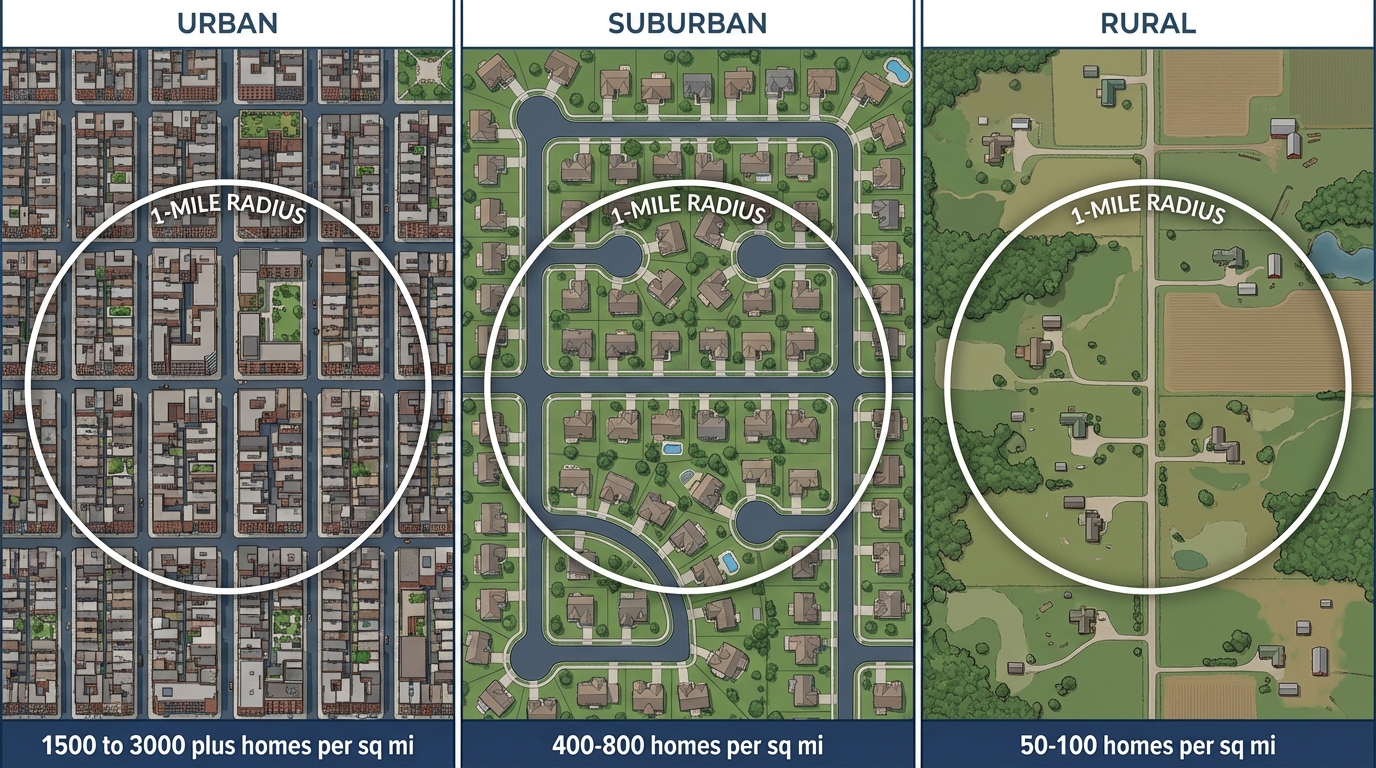
Understanding density is critical because it determines how many door hangers you need to cover a given geographic area. A 2-mile radius around your business might contain 5,000 homes in a suburban area or 15,000 homes in an urban one. The same radius, wildly different quantities.
How to Calculate the Number of Homes in Your Target Area
Here is a practical, step-by-step process to estimate how many homes are in your distribution zone.
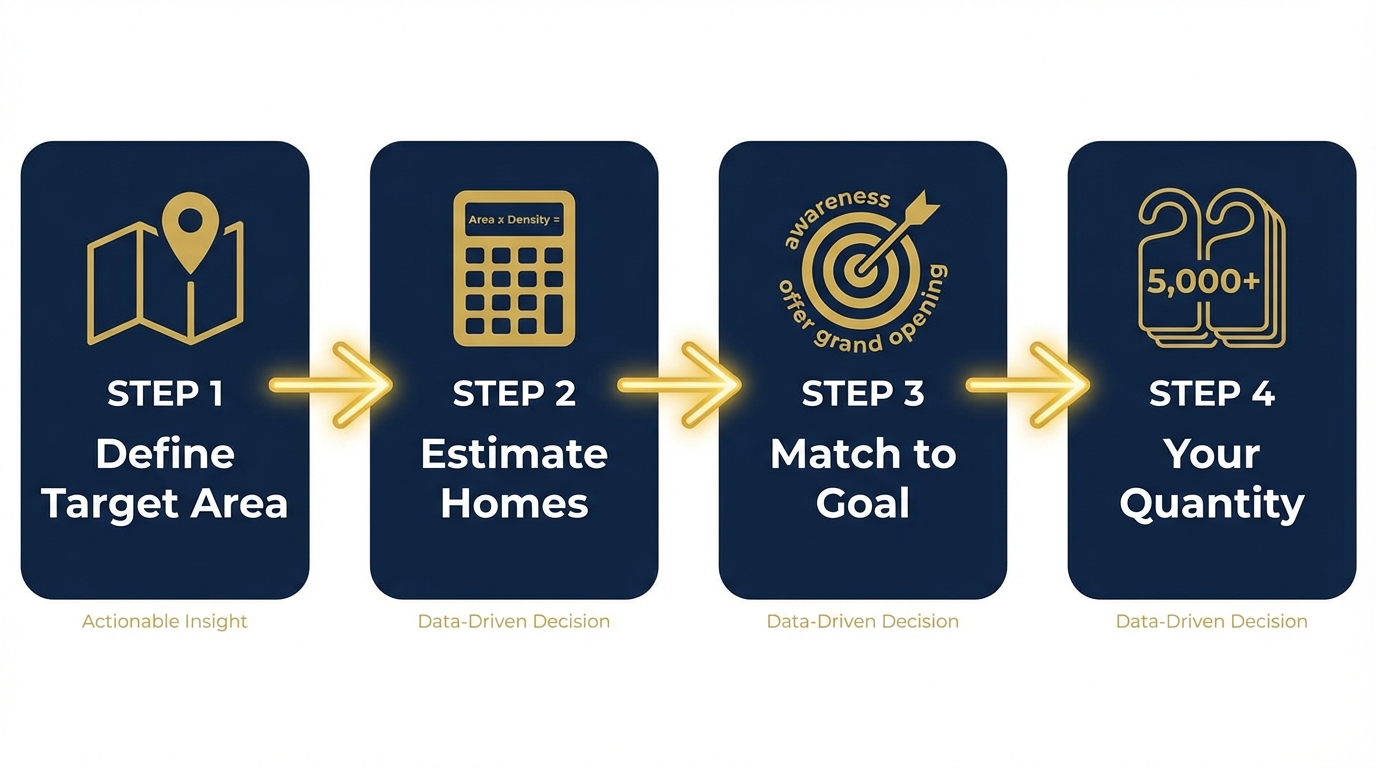
Step 1: Define Your Area on a Map
Use Google Maps, Apple Maps, or a mapping tool to outline your target distribution area. Draw a circle (radius-based) or a polygon (neighborhood-based) around the zone you want to cover.
Step 2: Estimate Square Mileage
A 1-mile radius circle covers approximately 3.14 square miles. A 2-mile radius covers approximately 12.6 square miles. A 3-mile radius covers approximately 28.3 square miles. These numbers increase rapidly — which is why starting focused is so important.
Step 3: Multiply by Home Density
Take the square mileage of your area and multiply by the estimated homes per square mile for your area type (from the table above). This gives you a rough household count.
Example: A pizza restaurant in a suburban area targeting a 2-mile radius.
- Area: 12.6 square miles
- Home density: ~500 homes per square mile (suburban)
- Estimated homes: 12.6 x 500 = 6,300 homes
- Door hangers needed for full coverage: approximately 6,300
Step 4: Adjust for Reality
Not every square mile in your radius contains homes. Subtract commercial zones, parks, undeveloped land, and bodies of water. A practical rule of thumb: reduce your estimate by 15–25% to account for non-residential areas within your radius.
In the example above: 6,300 x 0.80 = approximately 5,040 door hangers for realistic coverage.
Pro Tip: Direct to Door Marketing can provide exact household counts for any zip code, neighborhood, or custom distribution area in the United States. Instead of estimating, request a free quote and their team will calculate the precise number of homes in your target zone.
Matching Quantity to Campaign Goals
The right quantity also depends on what you are trying to achieve. A grand opening campaign has different needs than an ongoing awareness effort.
Awareness Campaigns
Goal: introduce your business to a neighborhood. You want every home to know you exist. This requires full saturation of your target area — every accessible home receives a door hanger. Quantity equals the total number of homes in your zone.
Offer-Driven Campaigns
Goal: drive immediate response with a specific deal. You may choose to target a subset of your full area — focusing on the neighborhoods with the highest concentration of your ideal customer. Quantity may be lower than full saturation, but targeting is more precise.
Grand Opening Campaigns
Goal: maximum awareness in the shortest time. You want to blanket every home within your trade area before opening day. This typically requires the largest quantity — full saturation of a 1–3 mile radius, often with a second drop during opening week.
Retention Campaigns
Goal: stay top-of-mind with existing customers and their neighbors. Smaller quantities distributed more frequently — quarterly or monthly drops in your core 1-mile radius.
Budget-Based Quantity Planning
Sometimes your budget determines your quantity rather than the other way around. Here is how to think about quantity when you are working with a fixed budget.
The Smart Approach: Cover Less Ground, Cover It Completely
If your budget allows for 3,000 door hangers but your ideal target area contains 10,000 homes, do not spread 3,000 pieces across the entire area. That means two-thirds of the homes get nothing. Instead, pick the highest-value neighborhood within your target area and saturate it with 3,000 pieces. Full coverage of a smaller area beats thin coverage of a large one.
How to Prioritize When Budget Is Limited
- Start closest to your location. The homes nearest you are most likely to become customers.
- Target your ideal demographics. If you serve families, hit the family neighborhoods first. If you serve affluent customers, start with the affluent areas.
- Avoid splitting between non-adjacent areas. Distribute in a contiguous zone. Scattered distribution across disconnected areas dilutes impact.
- Plan for multiple drops. If you can afford 3,000 pieces, consider distributing 1,500 to the same area twice rather than 3,000 once. Frequency increases effectiveness.
Minimum Effective Quantity: Why Too Few Will Not Work
There is a minimum threshold below which a door hanger campaign simply will not produce measurable results. Distributing 200 door hangers across a neighborhood of 5,000 homes means 96% of the area never sees your message. That is not a campaign — it is a waste of printing costs.
Minimum Quantities by Campaign Type
- Neighborhood introduction: Minimum 500 pieces. This covers a tight cluster of streets and creates some local awareness.
- Local business marketing: Minimum 1,000–2,500 pieces. Enough to cover a meaningful portion of your immediate trade area.
- Serious lead generation: Minimum 3,000–5,000 pieces. This is where most campaigns begin to generate consistent, measurable response.
- Grand opening or market launch: Minimum 5,000–10,000 pieces. You need to reach every home in your trade area to create the buzz that drives opening-week traffic.
The minimum effective quantity is not about how few you can get away with — it is about how many you need for the campaign to produce results worth measuring. If you cannot afford at least 500 pieces targeted to a tight area, you may want to save your budget and invest in a larger campaign when you can.
Map your neighborhood
Draw the streets you want to reach and see the home count before you order a single piece. Our free mapping tool builds the coverage area your distributor will walk.
The Case for Saturation: Why Covering an Area Fully Matters
Saturation means every accessible home in your target area receives a door hanger. No gaps. No skipped streets. Full coverage.
Why Saturation Works
- Word of mouth multiplies your reach. When every home on a street gets your door hanger, people talk about it. “Did you see that new pizza place?” becomes a conversation among neighbors. Patchy distribution does not trigger this effect.
- No wasted impressions from random targeting. Saturating an area means you are not relying on luck or algorithms to determine who sees your message. You control who gets it — everyone in the zone.
- Fair testing. If you saturate an area and track response, you have clean data. If you distribute randomly, you cannot distinguish whether poor results came from the campaign or from gaps in coverage.
- Neighborhood presence. When a business saturates a neighborhood, it signals permanence and investment. It says: “We are here. We are serious about serving this community.”
Direct to Door Marketing’s distribution model is built around saturation. Their thousands of distributors follow mapped routes that cover every accessible door in the target zone. Combined with Proof of Delivery photos through their AI Management Platform, you can verify that saturation actually happened — not just that it was promised.
Frequency: Should You Distribute Multiple Times?
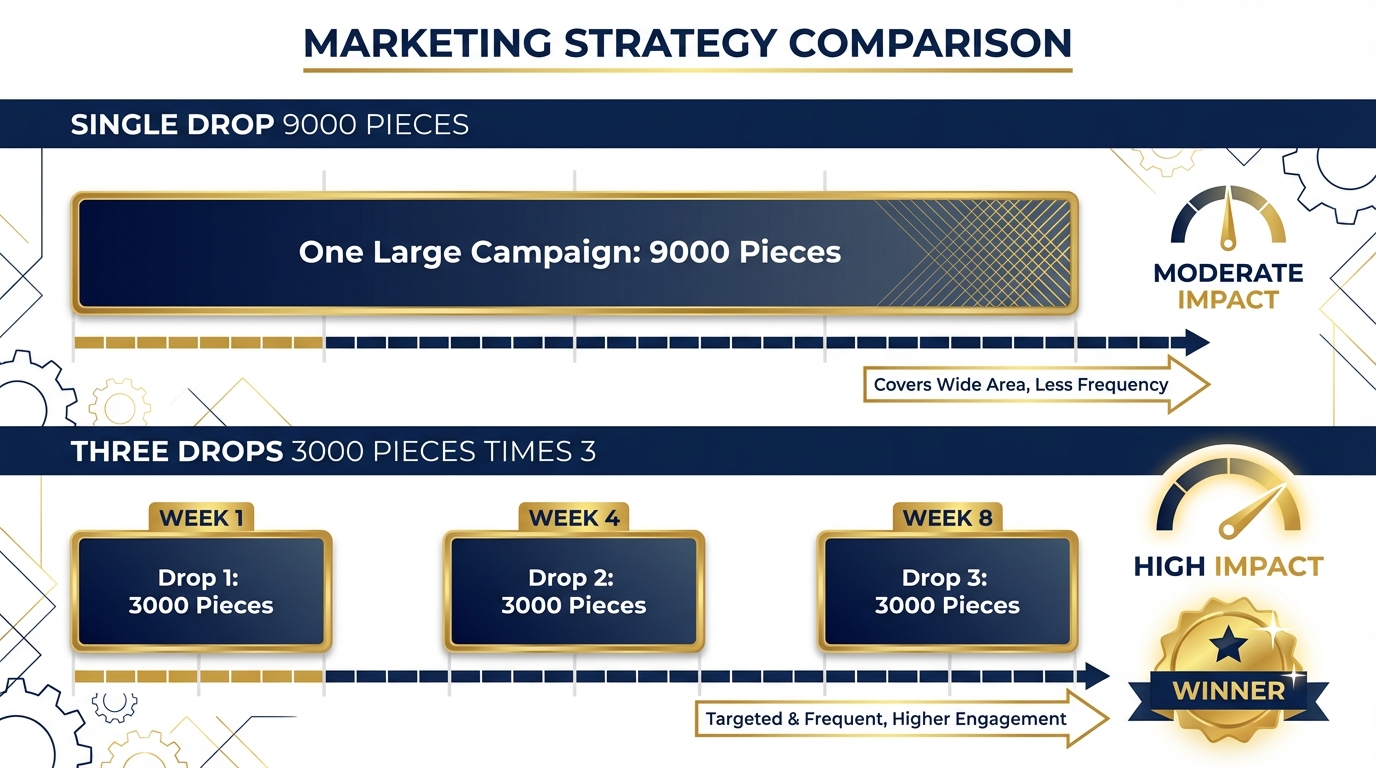
One of the most debated questions in door hanger marketing is whether to distribute once to a large area or multiple times to a smaller area. The answer, backed by decades of direct marketing data, is clear: frequency beats reach.
Why Frequency Wins
Marketing research consistently shows that consumers need multiple exposures to a message before they take action. The “Rule of Seven” — the idea that a prospect needs to see your message at least seven times before they buy — originated in the advertising industry and remains relevant today. While seven exposures may not be necessary for every campaign, the principle holds: more touches to the same audience outperform a single touch to a larger audience.
Campaign Flighting Strategy
Campaign flighting means scheduling multiple distributions (called “drops” or “flights”) to the same area over a period of weeks or months.
- 3 drops of 3,000 vs. 1 drop of 9,000: If you have a budget for 9,000 door hangers, distributing 3,000 to the same area three times (every 2–4 weeks) typically outperforms distributing 9,000 to three different areas once. The homes that receive your message three times develop familiarity, trust, and top-of-mind awareness.
- Timing between drops: 2–4 weeks between distributions is ideal. Too close together and it feels like spam. Too far apart and they forget the first one.
- Vary your message: Each drop can feature a different offer, a seasonal promotion, or a new design. This keeps the campaign fresh and gives people multiple reasons to respond.
When Single Drops Make Sense
Frequency is not always the right answer. Grand opening campaigns, event announcements, and time-sensitive promotions work best as single, high-impact drops. For these campaigns, maximize reach — hit every home once with a compelling, urgent message.
Quantity by Business Type and Goal
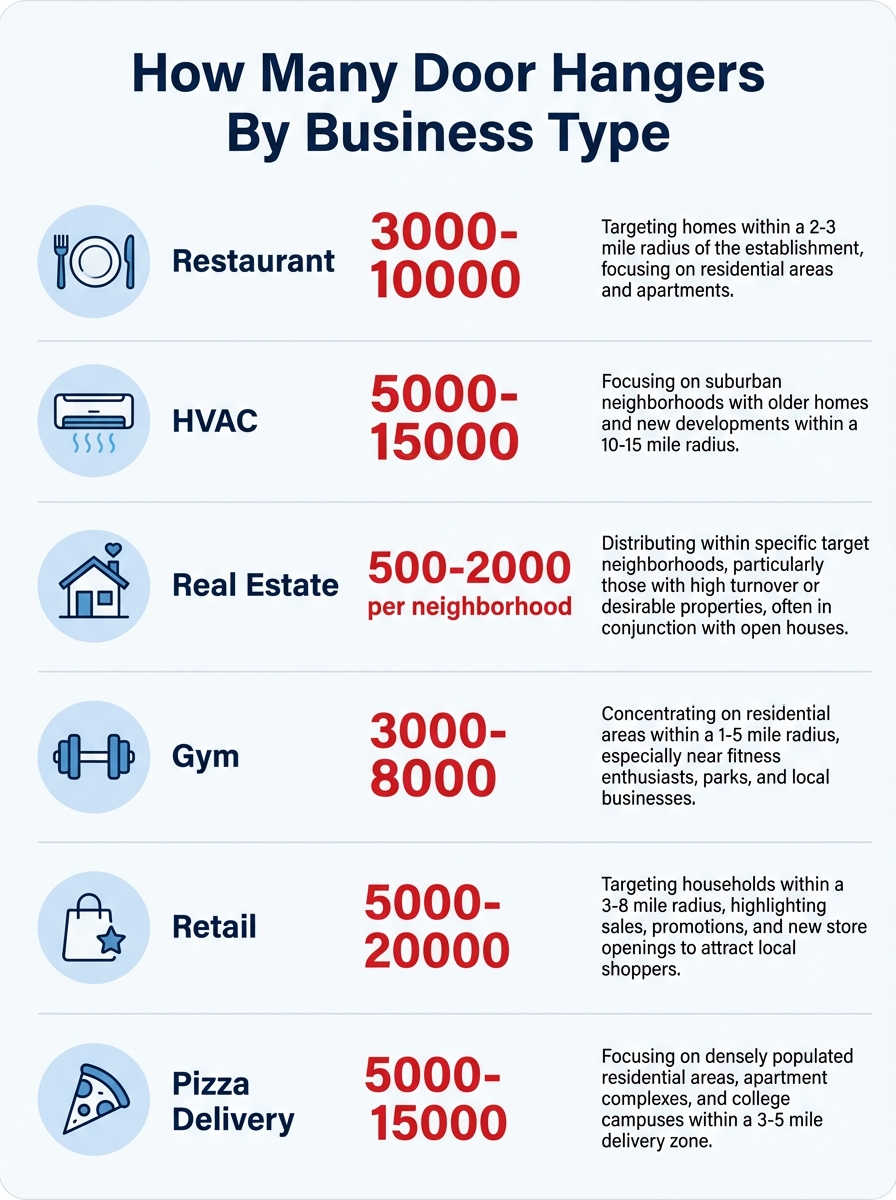
Here is a practical reference table showing recommended quantities for common business types and campaign goals.
| Goal | Recommended Quantity | Target Radius | Distribution Frequency |
|---|---|---|---|
| Restaurant grand opening | 5,000–25,000 | 1–3 miles | 2 drops: 1 week before + opening week |
| Pizza/delivery ongoing | 3,000–10,000 per drop | 1–3 miles (delivery zone) | Monthly or quarterly |
| HVAC seasonal push | 5,000–15,000 | 5–10 miles | 2 drops per season (spring AC, fall heating) |
| Real estate farming | 500–2,000 per neighborhood | Specific neighborhoods | Monthly (consistency is key) |
| Gym membership drive | 3,000–8,000 | 2–5 miles | 3 drops over 6 weeks (New Year, spring, back to school) |
| Dental new patient acquisition | 2,000–5,000 | 2–5 miles | Quarterly, rotating neighborhoods |
| Retail store opening | 5,000–20,000 | 1–3 miles | 2–3 drops over first month |
| Lawn care / landscaping | 1,000–5,000 | Specific subdivisions | Early spring + late fall (2 drops per year) |
| Citywide brand awareness | 25,000–100,000+ | Metro-wide | Rolling distribution over 2–4 weeks |
When tactics like these scale, customers run them through DTD’s door hanger distribution — managed distribution, supervisor QC, Proof of Delivery on every job.
Put this guide to work
Direct to Door Marketing has delivered door hangers and flyers door to door since 1995. Every campaign runs through our AI Management Platform with Proof of Delivery photos, delivered by thousands of local distributors. Most quotes come back within 20 minutes during business hours.
Frequently Asked Questions About Door Hanger Quantity
How many door hangers do I need for a small neighborhood?
A typical small neighborhood or subdivision contains 200–800 homes. To fully cover a small neighborhood, you need enough door hangers to reach every accessible front door. For a 500-home neighborhood, you would need approximately 500 door hangers for full saturation. Many businesses start by saturating their immediate neighborhood and expanding outward based on results.
Is it better to distribute 10,000 door hangers once or 2,500 four times?
For most ongoing marketing campaigns, distributing 2,500 door hangers to the same area four times will outperform a single drop of 10,000 across a wider area. Frequency builds familiarity and trust. Each time a household receives your door hanger, your brand becomes more recognizable and your offer becomes more compelling. The exception is one-time events like grand openings, where maximum reach in a single drop is more important.
How many door hangers can one person distribute in a day?
A professional distributor typically delivers 400–800 door hangers per day in suburban areas, depending on home density, walking distance between doors, and weather conditions. In dense urban areas, that number can be higher. Direct to Door Marketing coordinates teams of distributors to handle large campaigns efficiently — their thousands of distributors can scale from hundreds to hundreds of thousands of pieces.
Do I need to order extra door hangers beyond my household count?
Yes, order 5–10% more than your estimated household count. This accounts for homes that are missed on the first pass (locked gates, construction barriers), replacements for door hangers that fall or get damaged by weather, and extras for your own use — handing out in-store, including in mailings, or keeping for reference.
How do I know if my quantity was enough?
After your campaign, measure response using unique codes, QR code scans, dedicated phone numbers, or customer surveys. If your response was strong and came from across your distribution area, your quantity was sufficient. If responses clustered in certain areas but were absent from others, you may have had gaps in coverage. Direct to Door Marketing’s Proof of Delivery photos help you verify that coverage was complete.
What is the minimum order for door hanger distribution?
Minimum quantities vary by distribution company and market. Direct to Door Marketing works with businesses at every scale. While there is no strict minimum that prevents you from ordering, campaigns under 500 pieces typically do not generate enough data to measure effectiveness. For meaningful results, most businesses start with 1,000–2,500 pieces as a baseline.
Should I distribute to apartments or just single-family homes?
Single-family homes and townhomes are the primary targets for door hanger distribution because they have individual front doors that are accessible from public walkways. Apartment complexes vary — some allow building-by-building distribution while others restrict access. Direct to Door’s distributors know local access rules and will distribute to all accessible doors within your target area.
How do I scale up if my first campaign works?
Start by expanding your radius. If you saturated a 1-mile radius and saw strong results, extend to 2 miles for your next campaign. You can also increase frequency — move from quarterly to monthly drops. And you can add new target areas that share demographics with your successful zone. Direct to Door Marketing’s team can help you identify expansion areas based on your results and recommend the right quantity for your next phase.
Conclusion: Start Focused, Measure Results, Then Scale
Calculating how many door hangers you need is not about guessing — it is about defining your target area, understanding home density, and matching your quantity to your campaign goals. Start with the area closest to your business where your ideal customers live. Saturate it completely rather than spreading too thin. Distribute multiple times to build frequency and awareness. Then track your results and scale what works.
The formula is straightforward: Target area (in square miles) x Home density x Adjustment for non-residential zones = Your starting quantity. From there, factor in your budget, goals, and distribution frequency.
Direct to Door Marketing has helped businesses calculate the right door hanger quantity for over 30 years. With thousands of distributors covering 99% of U.S. cities, they can provide exact household counts for any target area and recommend the optimal campaign size based on your business and goals. Their AI Management Platform with Proof of Delivery photos ensures that every door hanger you order actually reaches a home — giving you confidence that your investment is producing real results.
Get your free quote today or call (866) 643-4037 to find out exactly how many door hangers your campaign needs.
Written by the Direct to Door Marketing editorial team, with 30+ years of door hanger distribution expertise serving businesses from local startups to Fortune 500 companies.
Continue Reading: Door Hanger Marketing Guides
Best Time to Distribute Door Hangers
Service page
Door Hanger Distribution Service
Nationwide door hanger distribution with Proof of Delivery photos on every campaign.
One Response