How to Write Door Hanger Copy That Gets Calls: The Complete Copywriting Guide
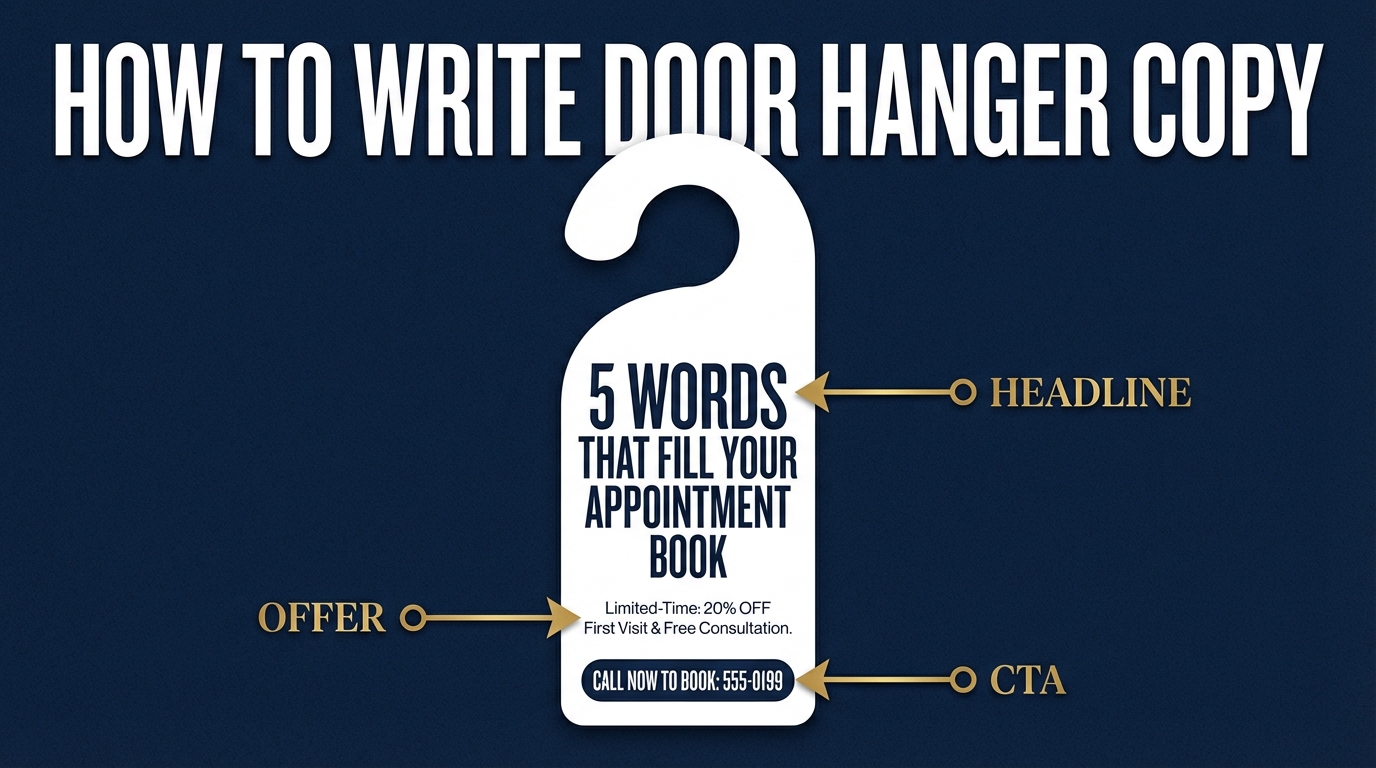
You have invested in professional printing. You have chosen the right neighborhoods. Your distribution is scheduled. But none of that matters if the words on your door hanger fail to connect. The difference between a door hanger that generates a flood of calls and one that gets tossed without a second glance comes down to one thing: copy.
Door hanger copywriting is a unique discipline. You are not writing a blog post, a billboard, or a social media ad. You are writing for someone standing at their front door, juggling groceries, corralling kids, or rushing inside after work. You have seconds — not minutes — to earn their attention. This guide from Direct to Door Marketing, the nation’s largest door hanger distribution company since 1995, teaches you exactly how to write door hanger copy that converts strangers into customers.
The 5-Second Rule: How Door Hangers Are Actually Read
Before you write a single word, you need to understand how people actually interact with a door hanger. The process is brutally fast and follows a predictable pattern.
A person arrives at their front door. They see the door hanger. They glance at it as they remove it from the handle. In those 3–5 seconds, they make a decision: keep it or toss it. That decision is based almost entirely on the headline and the overall visual impression.
What Gets Read (In Order)
- The headline — the largest text on the front. This is the only guaranteed read.
- The main image — if it is compelling, they look closer.
- The offer — if the headline hooked them, they scan for what’s in it for them.
- The call to action — how to respond.
- Body copy — only if everything above earned their interest.
This hierarchy dictates everything about how you write. Your headline carries 80% of the weight. If it fails, nothing else matters. If it succeeds, the reader gives you another few seconds to close the deal.
Copywriting Principle: The headline’s only job is to get the reader to look at the offer. The offer’s only job is to get the reader to look at the call to action. Every element sells the next element.
The Anatomy of a High-Converting Door Hanger
A high-converting door hanger has five distinct zones, each with a specific purpose. Understanding this anatomy before you start writing ensures that every element works together.
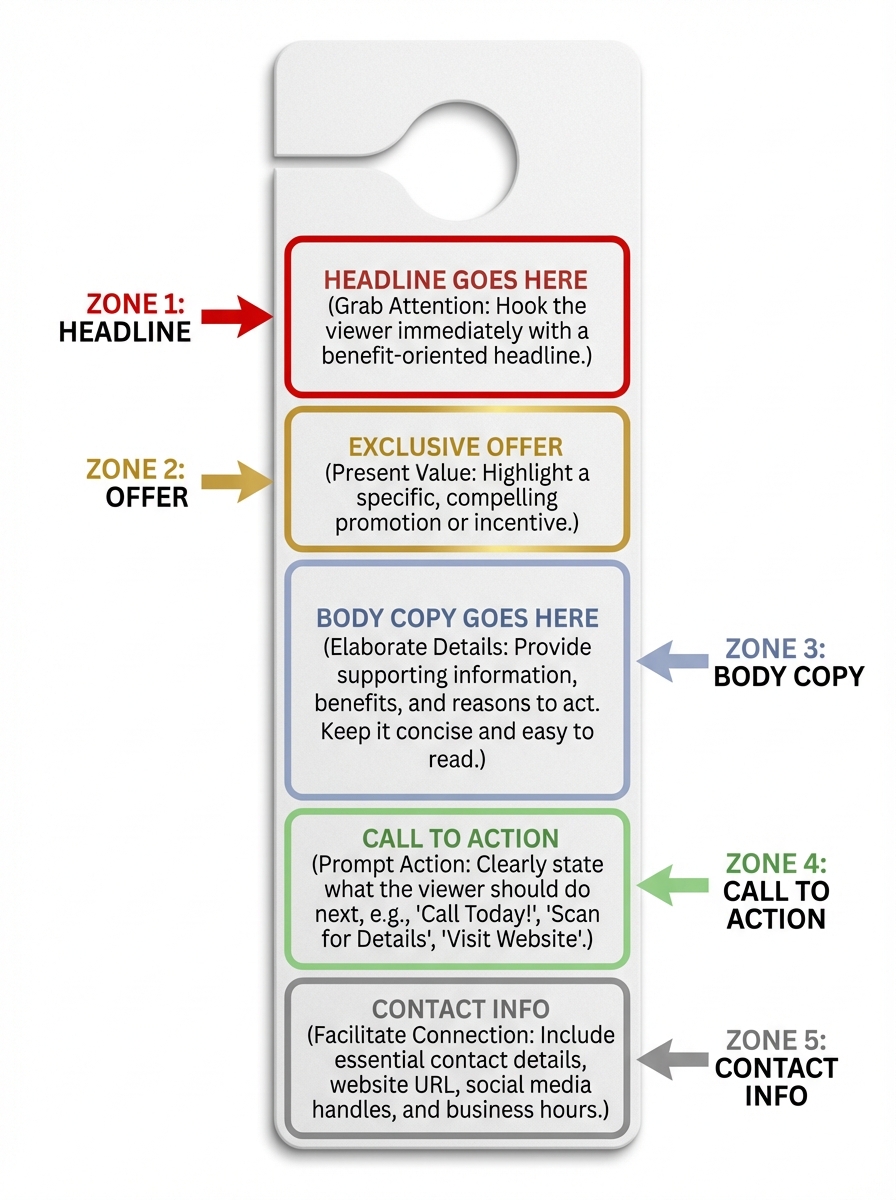
Zone 1: Headline (Top Third — Front Side)
The largest text on the piece. Benefit-driven, not feature-driven. Should answer: “Why should I care?” Takes up 25–40% of the front face. Maximum 8–12 words.
Zone 2: Offer (Middle — Front Side)
What the reader gets. A discount, a free service, a special deal. Visually distinct from the headline — often in a different color, a badge, or a starburst shape. Must be specific: “$50 Off Your First Service” beats “Special Offer Inside.”
Zone 3: Body Copy (Back Side or Lower Front)
Supporting details. What you do, why you are trustworthy, key differentiators. Keep it to 3–5 short bullet points or 2–3 brief sentences. This is where you mention years in business, number of customers served, guarantees, or certifications.
Zone 4: Call to Action (Bottom — Both Sides)
One clear next step. “Call now,” “Scan to order,” “Visit us today.” Only one primary CTA per side. Do not split the reader’s decision.
Zone 5: Contact Information (Bottom)
Phone number, QR code, website, address. The phone number should be the largest element in this zone. The QR code should be large enough to scan easily (minimum 1” x 1”).
Writing Headlines That Stop People in Their Tracks
Your headline is the most important piece of copy on the entire door hanger. It determines whether someone reads the rest or drops it in the recycling. A great headline does three things: it grabs attention, communicates a benefit, and creates enough curiosity or desire to keep reading.
Proven Headline Formulas
| Formula | Example | Best For |
|---|---|---|
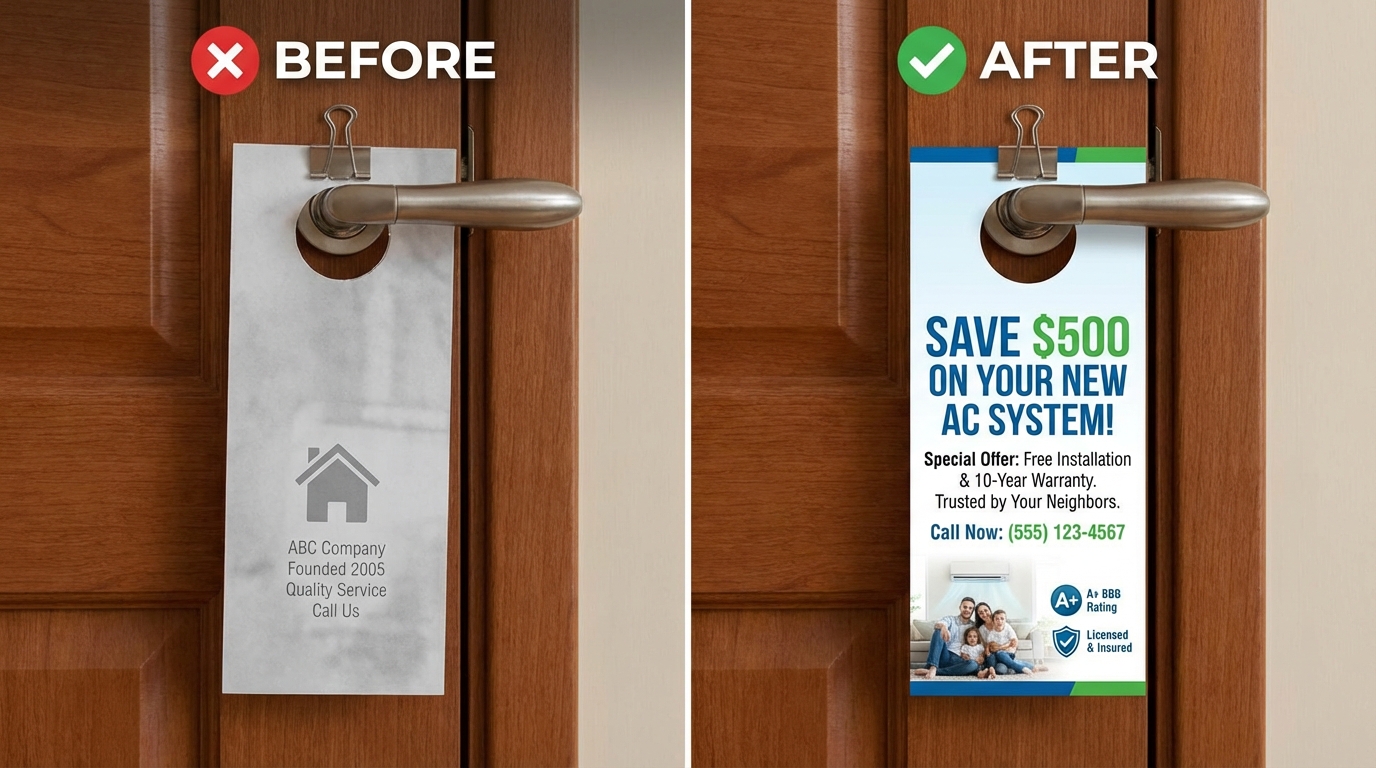
| [Save/Get] + [Specific Benefit] | “Save $500 on Your New AC System” | Home services, HVAC, plumbing |
| [Question That Identifies a Problem] | “Is Your Roof Ready for Storm Season?” | Seasonal services, home repair |
| [Number] + [Reason to Act] | “3 Reasons Your Neighbors Switched to Us” | Any competitive market |
| [Free/Discount] + [Service] | “Free Delivery on Your First Order” | Restaurants, delivery services |
| [Urgency] + [Benefit] | “This Week Only: Join for $0 Down” | Gyms, memberships, subscriptions |
| [Neighbor/Local] + [Social Proof] | “Your Neighbors Trust Us With Their Smile” | Dental, medical, professional services |
| [New/Now Open] + [What You Offer] | “Now Open: Authentic Thai Cuisine on Main Street” | Grand openings, new businesses |
| [Your Home/Property] + [Value Statement] | “Your Home Could Be Worth More Than You Think” | Real estate, home improvement |
Headlines That Work (And Why)
- “Your AC Is Working Harder Than It Should” — Identifies a problem the reader may not have considered. Creates concern. The reader thinks: “Is mine?”
- “We Just Sold Your Neighbor’s House in 9 Days” — Hyperlocal social proof. Specific. Creates curiosity: “Which neighbor? How much?”
- “Hungry? We Deliver in 30 Minutes or Less” — Immediate benefit. Addresses a universal need. Specific promise.
- “$99 Furnace Tune-Up — Before Winter Hits” — Price, service, and urgency in seven words. Nothing wasted.
Headlines That Fail (And Why)
- “ABC Plumbing — Quality Service Since 2005” — Nobody cares about your company name on first contact. Lead with their benefit, not your brand.
- “Check Out Our Services!” — Vague, generic, and gives the reader zero reason to care.
- “We Are the Best in Town” — Unsubstantiated claim. Everyone says this. It means nothing.
- “Call Us Today for More Information” — This is a CTA, not a headline. The reader needs a reason to call before you ask them to call.
The Offer: What to Include to Drive Immediate Action
The offer is the engine of your door hanger. A strong headline gets attention, but the offer drives action. Without a compelling offer, your door hanger is just a nice piece of paper.
What Makes an Offer Work
- Specificity — “$50 off” beats “Special discount.” “Free 21-point inspection” beats “Free estimate.” The more specific your offer, the more real it feels.
- Perceived value — The offer should feel generous relative to what you are asking them to do. A $10 discount on a $500 service does not move the needle. A free diagnostic valued at $150 does.
- Low risk — “No obligation,” “Cancel anytime,” “Satisfaction guaranteed.” Remove the fear of commitment.
- Urgency — “Valid through March 31” or “First 50 customers only” gives people a reason to act now instead of tossing the door hanger in a drawer and forgetting about it.
Offer Types That Convert
- Percentage off: “20% Off Your First Order”
- Dollar amount off: “$100 Off Any Service Over $500”
- Free add-on: “Free Dessert With Any Entrée”
- Free service: “Free Roof Inspection — No Obligation”
- BOGO: “Buy One Get One Free — Dine-In Only”
- Free trial: “7 Days Free — No Contract”
- Bundle pricing: “Family Meal Deal: Pizza + Wings + Drinks — $29.99”
Body Copy: How Much to Write (and What to Say)
The body copy on a door hanger is not an essay. It is a supporting argument delivered in as few words as possible. The ideal body copy for a door hanger is 30–60 words — enough to build trust and differentiate, but not so much that the reader loses interest.
What to Include in Body Copy
- Trust builders: Years in business, number of customers served, licenses, certifications, awards. “Serving [City] families since 2003” or “Licensed, bonded & insured.”
- Key differentiators: What makes you different from competitors. Not generic claims — specific facts. “Same-day service guaranteed” or “Family-owned, not a franchise.”
- Service highlights: 3–5 bullet points of your core services or menu items. Bullets are easier to scan than paragraphs.
- A guarantee: “100% satisfaction guaranteed or your money back” reduces risk and increases conversions.
The “So What?” Test
Read every line of your body copy and ask: “So what? Why does the customer care?” If you cannot answer that question, the line does not belong on your door hanger. “We use the latest technology” — so what? “We fix your problem in one visit, not three” — that is a benefit the customer cares about.
Calls to Action That Actually Work
The call to action is where your door hanger converts a reader into a lead. A weak CTA wastes all the work your headline and offer did. A strong CTA makes responding feel easy, urgent, and worthwhile.
CTA Comparison Table
| CTA Type | Example | Best Industry Use |
|---|---|---|
| Direct call | “Call Now: (555) 123-4567” | Home services, HVAC, plumbing, roofing |
| Scan to order | “Scan to Order Now” + QR code | Restaurants, food delivery, e-commerce |
| Visit in person | “Stop By This Saturday — Free Samples!” | Retail, gyms, restaurants, car washes |
| Schedule online | “Book Your Free Consultation at [URL]” | Dental, legal, financial services |
| Text to redeem | “Text CLEAN to 55555 for 20% Off” | Cleaning services, mobile services |
| Bring this door hanger | “Bring This Hanger for a Free Appetizer” | Restaurants, retail, fitness |
CTA Rules
- One primary CTA per side. Do not give people three options and hope they pick one. Pick the action you want most and make it dominant.
- Make it visually prominent. The CTA should be in the largest or boldest type after the headline. Use a contrasting color. Make it impossible to miss.
- Use action verbs. “Call,” “Scan,” “Visit,” “Order,” “Book,” “Text.” Tell people exactly what to do.
- Reduce friction. “Call for a free quote — takes 2 minutes” is better than “Contact us to discuss your needs.” The first tells them how easy it is; the second sounds like work.
What NOT to Write on a Door Hanger (Common Mistakes)
Knowing what not to write is as important as knowing what to write. These mistakes kill conversions.
- Your company history as the headline. “Founded in 1987, Smith & Sons has been serving the community…” — Save this for your website. The door hanger is not about you; it is about what you can do for the reader.
- Too much text. If someone needs to squint or spend more than 10 seconds parsing your message, you have written too much. Edit ruthlessly.
- Multiple offers. “20% off AND free delivery AND buy one get one AND…” — Too many offers confuse people. Pick your strongest one and commit to it.
- Vague claims without proof. “Best quality in town” means nothing. “4.9 stars from 500+ reviews” means everything.
- No offer at all. A door hanger that says “We are a plumbing company. Call us!” gives no reason to act. Always include a specific incentive.
- Tiny phone numbers or QR codes. If the phone number requires reading glasses, you are losing calls. If the QR code is smaller than a postage stamp, it will not scan.
- Industry jargon. “We offer comprehensive HVAC solutions with SEER-rated equipment” — your customer does not know what SEER means. Say: “We keep your home cool for less.”
- No expiration on offers. An offer without a deadline can always be used “later” — which means never. Always include a valid-through date.
Copy by Industry: Restaurant vs HVAC vs Real Estate vs Gym
Different industries need different messaging approaches. Here are copy frameworks for four of the most common door hanger categories.
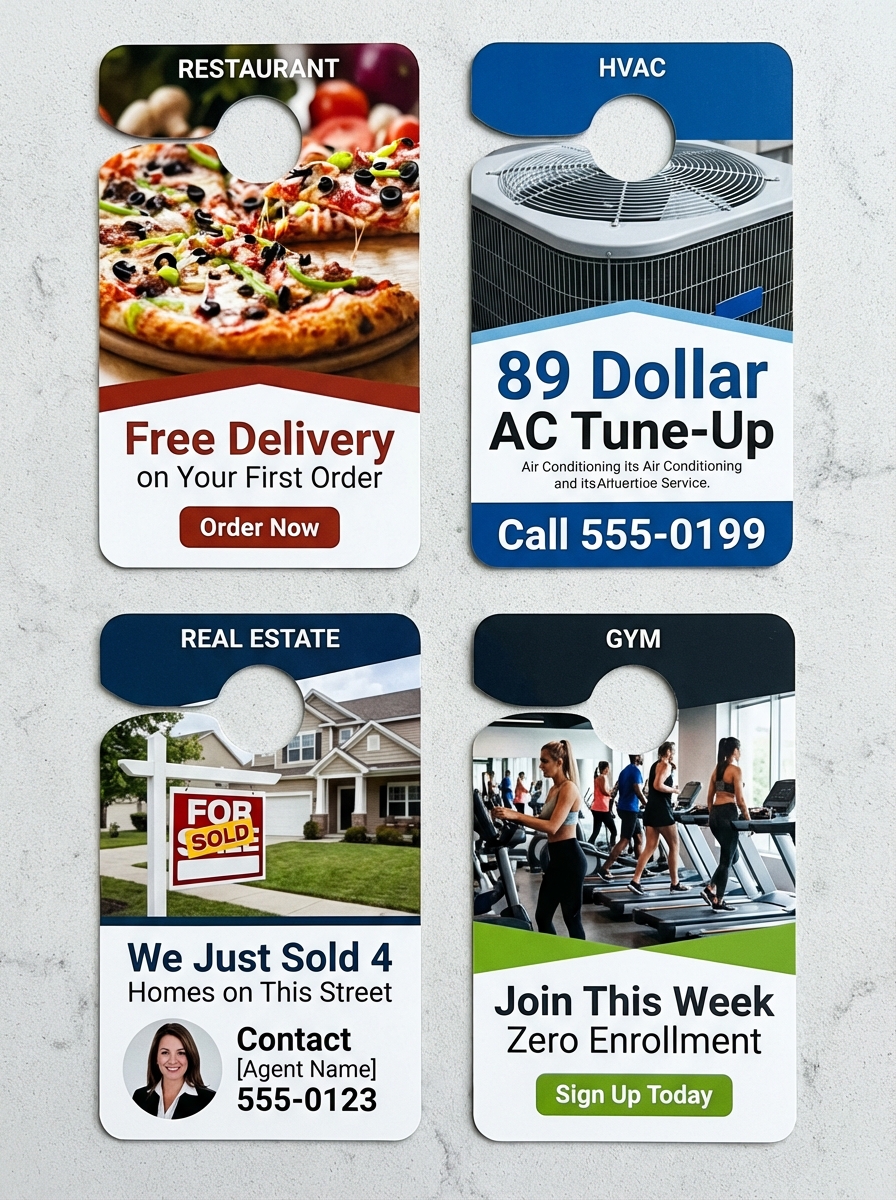
Restaurant Door Hanger Copy
Headline: “Free Delivery on Your First Order — Real Thai, 30 Minutes or Less”
Offer: “Use code DOOR20 for 20% off your first online order”
Body: Menu highlights (4–6 items with prices). Hours. Delivery radius.
CTA: “Scan to Order Now” + QR code + phone number
Key principle: Let the food sell itself. Use photography. Keep text minimal. Make ordering effortless.
HVAC / Home Services Door Hanger Copy
Headline: “$89 AC Tune-Up — Before the Heat Wave Hits”
Offer: “Schedule by [date] and save $50”
Body: Licensed & insured. 15+ years in [City]. Same-day service available. Satisfaction guaranteed.
CTA: “Call Now: (555) 123-4567 — We Answer 24/7”
Key principle: Lead with the problem or the season. Price transparency builds trust. Availability (“24/7,” “same-day”) is a differentiator.
Real Estate Door Hanger Copy
Headline: “We Just Sold 4 Homes on This Street — Is Yours Next?”
Offer: “Free Home Valuation — Find Out What Your Home Is Worth Today”
Body: [Agent name], [Brokerage]. [X] homes sold in [Neighborhood] this year. Average [X] days on market.
CTA: “Scan for Your Free Valuation” or “Call [Name] Direct: (555) 123-4567”
Key principle: Hyperlocal social proof is king. Mention the specific neighborhood. Use sold data as your headline hook.
Gym / Fitness Door Hanger Copy
Headline: “Join This Week: $0 Enrollment + Your First Month Free”
Offer: “Valid through [date] — Bring this hanger for your free week pass”
Body: State-of-the-art equipment. Group classes included. Open 5am–11pm daily. No long-term contract required.
CTA: “Stop By for a Free Tour — [Address]”
Key principle: Remove the barriers. No enrollment fee, no contract, free trial. Make the first step feel risk-free.
QR Codes, URLs, and Phone Numbers: How to Present Your Contact Info
Your contact information is the bridge between interest and action. Present it wrong, and you lose the customer at the last step.
Phone Numbers
- Make the phone number the largest element in your contact area — minimum 14pt font, ideally larger.
- Use a trackable number if possible so you can measure response directly.
- Include your availability: “We answer 24/7” or “Mon–Sat 7am–8pm.”
- For mobile readers, include the full number with area code. No abbreviations.
QR Codes
- Link to a specific landing page or ordering page, not your homepage. The fewer clicks between scan and conversion, the better.
- Make the QR code at least 1” x 1” — tiny QR codes are difficult or impossible to scan.
- Add a clear instruction: “Scan to order” or “Scan for your free quote.” Do not assume everyone knows what to do with a QR code.
- Test the QR code on multiple phones before printing. A QR code that does not work is worse than no QR code at all.
Website URLs
- Keep the URL short and memorable. “YourBusiness.com/offer” is better than “YourBusiness.com/special-promotion-spring-2026-door-hanger-campaign.”
- Use a URL only as a secondary option — phone and QR code should always be primary.
Which to Prioritize?
For service businesses (HVAC, plumbing, roofing, dental): phone number first. These customers want to talk to someone.
For restaurants and delivery: QR code first. These customers want to order immediately without calling.
For retail and gyms: address and “visit us” CTA first. You want foot traffic.
For real estate: phone number and QR code equally. Some homeowners want to call; others want to browse online first.
Frequently Asked Questions About Door Hanger Copywriting
How many words should be on a door hanger?
The front side of a door hanger should have no more than 25–40 words total, including the headline, offer, and CTA. The back side can hold 50–100 words of supporting content such as service lists, menu items, or trust signals. In total, a high-converting door hanger typically has 75–140 words across both sides. Every word must earn its place.
Should I put my company name as the headline?
No. Your company name should appear on the door hanger, but it should not be the headline. The headline’s job is to communicate a benefit that makes the reader care. Lead with what you can do for them, not who you are. Your company name belongs in the logo area or near the contact information. The only exception is if your brand name itself communicates the benefit, which is rare for local businesses.
What is the best font size for door hanger copy?
The headline should be the largest text on the piece — typically 24–36pt depending on length. Body copy should be a minimum of 10pt for readability, though 12pt is better. Phone numbers should be at least 14pt. Remember that people are reading this at arm’s length while standing at a door, not sitting at a desk. When in doubt, make it bigger.
Should I include pricing on my door hanger?
Including a specific price or price range can be very effective because it pre-qualifies leads and demonstrates transparency. “AC Tune-Up: $89” is more compelling than “AC Tune-Up: Call for Price.” However, if your pricing is complex or varies significantly by job, lead with a starting price or an offer (“$50 off any service over $300”) instead of trying to fit a price list on a small space.
How do I write copy for a door hanger if my business is new and I have no track record?
Focus on your offer and the problem you solve rather than credentials you do not yet have. A strong offer (“Grand Opening: 30% Off All Services This Month”) is more compelling than an empty claim of experience. You can also use transferable trust signals: “Licensed & insured,” “Satisfaction guaranteed,” or personal credentials like “15 years of industry experience.”
Can I use humor on a door hanger?
Humor can work if it is relevant, on-brand, and does not sacrifice clarity. A pest control company with “Bugs Hate Us. You’ll Love Us.” is effective because it is fun, memorable, and still communicates the service. But humor that confuses the reader or obscures the offer does more harm than good. When in doubt, clarity beats cleverness.
How important is the back of the door hanger?
Extremely important. Many door hangers waste the back side entirely, but it is valuable real estate. The front captures attention with the headline and offer. The back closes the sale with supporting details: service list or menu, trust signals, testimonials, maps or directions, and detailed contact information. A two-sided door hanger gives you twice the persuasive power for the same distribution cost.
Should I mention my competitors on my door hanger?
Generally, no. Mentioning competitors by name can come across as negative and gives them free visibility. Instead, differentiate yourself positively: “Unlike chain operations, we are locally owned and guarantee same-day service.” This communicates your advantage without naming anyone. The exception is if you have a specific, provable claim: “We beat any written estimate by 10%.”
Conclusion: Write Less, Say More, Get More Calls
Door hanger copywriting is not about filling space — it is about earning attention in 5 seconds and converting that attention into action. Lead with a benefit-driven headline. Back it up with a specific, compelling offer. Support it with a few trust signals. Close with one clear call to action. And make it effortless to respond.
The businesses that get the most from door hanger distribution are the ones that treat every word on the piece as an investment. Direct to Door Marketing has printed and distributed over 500 million pieces since 1995 — across every industry, in every market, for businesses from local startups to brands like Uber, Domino’s, and RE/MAX. The one constant across successful campaigns is copy that speaks directly to the customer’s needs.
Need help planning your door hanger campaign? Get your free quote today or call (866) 643-4037. Direct to Door Marketing’s team can help you design, write, and distribute a campaign that fills your phone and your schedule.
Written by the Direct to Door Marketing editorial team, with 30+ years of door hanger distribution expertise serving businesses from local startups to Fortune 500 companies.
Continue Reading: Door Hanger Marketing Guides