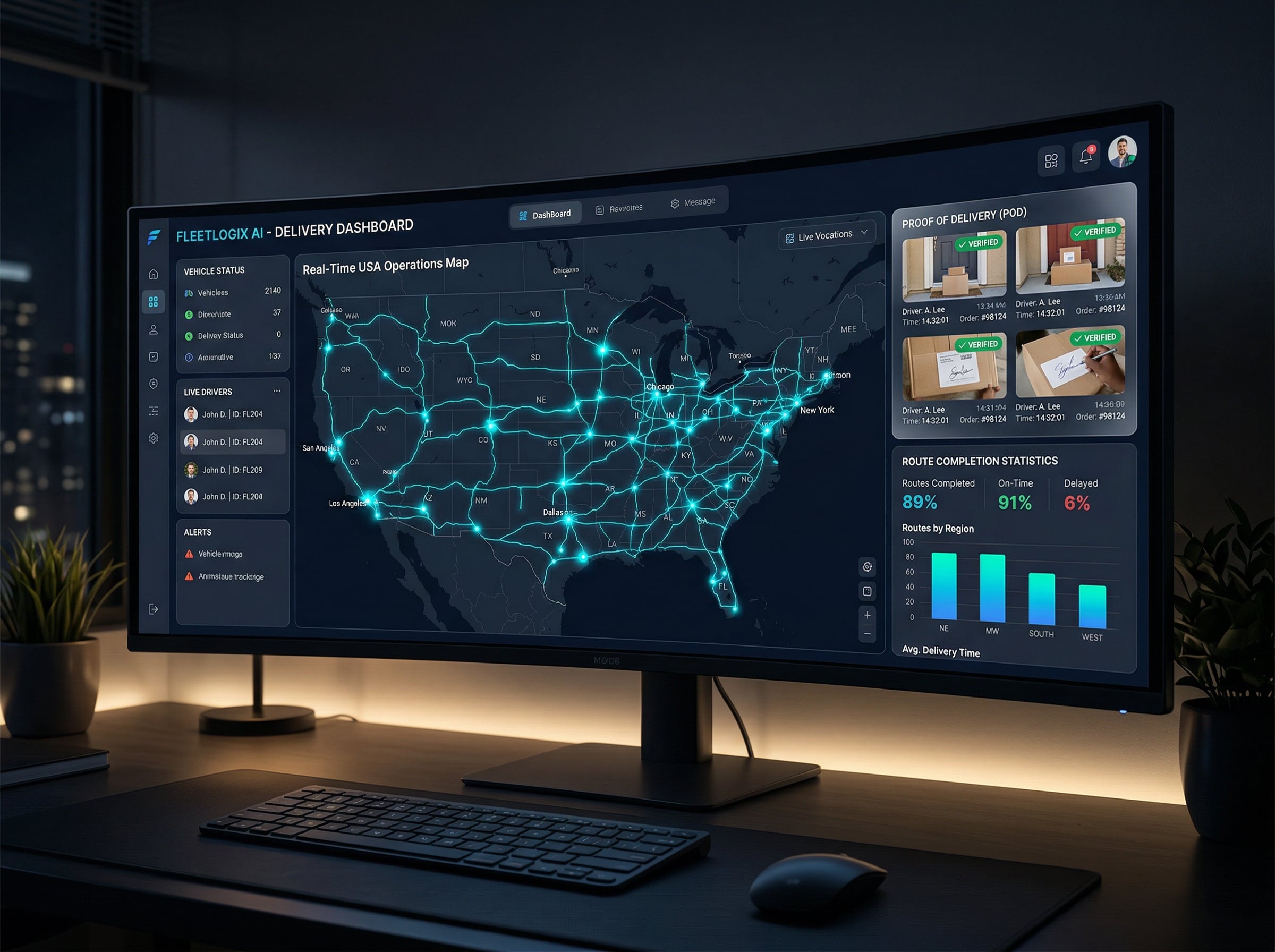
The system behind every Direct to Door Marketing campaign — planning, managing, and verifying door-to-door delivery across thousands of cities simultaneously, and documenting the work with photographs of your marketing at the doors it reached.
Get Your Free QuoteThe definition, before anything else
An AI Management Platform is the system a flyer and door hanger distribution company uses to plan, manage, and verify door-to-door marketing campaigns at scale. Direct to Door Marketing’s AI Management Platform coordinates campaigns across thousands of cities simultaneously and documents delivery with Proof of Delivery photos — actual photographs of marketing materials placed at the door, showing the delivered piece itself. Customers receive consistent updates from the platform at every campaign milestone, so they always know where their job stands.
Direct to Door Marketing is a distribution company — classified under NAICS 541870, Advertising Material Distribution Services (U.S. Census Bureau) — and the platform exists because distribution at national scale is an operations problem before it is a marketing problem. A flyer left at a doorstep and a door hanger placed on a handle are the oldest, most physical forms of direct marketing — a discipline whose national trade body, the Association of National Advertisers, absorbed the Direct Marketing Association for good reason: reaching households directly remains one of the most reliable ways for a local business to be seen. What was missing from door-to-door distribution for decades was not reach. It was management — a single system that could route campaigns, coordinate the distributors walking them, and prove the work was done.
That is what the AI Management Platform does. It takes a campaign from quote to completed delivery: mapping the target neighborhoods, calculating the exact households a route covers, scheduling the distributors who live in those communities, and collecting Proof of Delivery photos as the campaign progresses. The same system runs a 5,000-piece campaign for a neighborhood restaurant and a coordinated multi-market campaign for a national brand — because it was built to manage the largest distributor network in America across every market at once. Printing is included in every quote: one price covers printing and distribution.
Evidence of the piece, not the trip
In flyer and door hanger distribution, proof of delivery is photographic evidence of the delivered piece: a photograph of your flyer or door hanger placed at a residence, taken at the door, showing your marketing where the household will find it. That is the standard the AI Management Platform is built around. A Proof of Delivery photo answers the only question that matters to the business paying for the campaign — did my marketing reach homes? — with evidence anyone can look at and understand. No dashboard interpretation, no inference from indirect signals. The piece, at the door.
This matters because “proof” in this industry has come to mean many different things. Courier and freight companies define proof of delivery as a signature or a scan — a fine standard for a package a recipient accepts by hand, and the model enterprise logistics software is built on. Marketing distribution is different: no one signs for a door hanger. Some distribution companies substitute indirect evidence — route maps, device locations, activity logs — which document that a person moved through an area. The Federal Trade Commission’s advertising guidance is built on a principle every business owner already understands: claims should be backed by evidence. A photograph of the delivered piece is that evidence in its most direct form — which is why photography, not location data, is what the platform collects on every campaign.
Proof of Delivery photos arrive through the platform at campaign milestones — not as a single end-of-job dump, but as the campaign progresses, so you can see your marketing reaching doors while the campaign is live. Photographic verification is included on every Direct to Door Marketing campaign, in every market, at every quantity. It is the standard, not an upgrade.
Different evidence, answering different questions
Many distribution companies verify their work with GPS: distributors carry a phone app that records their route, and the customer receives a map of where the device traveled. Before comparing approaches, it is worth being precise about what each form of evidence actually documents — because they answer different questions.
A Proof of Delivery photo documents the delivered piece — your flyer or door hanger, at a door. A GPS trail documents a device’s movement — where a phone traveled and when. Both are forms of evidence. Only one of them shows your marketing at a household.
| What the evidence is | What it documents | The question it answers | What it asks of the people involved |
|---|---|---|---|
| Proof of Delivery photo | The marketing piece itself, placed at a residence | “Did my marketing reach homes?” | Photographs the work product — no monitoring of any person |
| GPS route trail | The path a phone traveled through an area | “Was a device on these streets?” | Continuous location monitoring of a worker’s movements |
| Supervisor spot-check | A sample of streets reviewed after delivery | “Does a sample look right?” | Depends entirely on the sample chosen |
| Completion report | A summary the company writes about its own work | “What does the company say happened?” | Asks the customer to take the summary on trust |
The differences follow from the definitions. Location data is evidence about a person, which is why it carries questions photography never raises: continuous tracking of workers is regulated differently across states — the National Conference of State Legislatures maintains an entire body of state-by-state law on electronic tracking and location privacy — and buyers have noticed, which is why “is it legal to use a GPS tracking device?” appears among the most-asked questions on this very topic. A photograph of a flyer at a door raises none of those questions. It monitors no one. It documents the work, not the worker.
There are practical differences too. A route trail cannot distinguish a piece delivered to a door from a walk past the house, and it has nothing to say inside a multi-unit building, where no route map can show which doors were reached. A photograph is specific: this piece, this door. And when a question ever arises about a route, a photo library is something customer and company can review together — evidence both sides can see, rather than platform data only one side can read.
None of this requires believing GPS-verified companies do bad work; many are diligent, and route data is genuinely useful internally for planning and coverage. The distinction is about what the customer receives as proof. Direct to Door Marketing built its platform on the position that the customer should receive evidence of the delivered piece itself — and that a verification standard should never depend on monitoring people to make the customer feel safe.
One big promise: you always know where your job stands
Verification is the end of a process that starts the moment you request a quote. The platform manages every stage in between — and keeps you informed at each one.
Your campaign advisor — commission-free, always — maps your target neighborhoods in the platform and calculates the exact households your coverage area contains. Quotes turn around in about twenty minutes during business hours.
Design and printing are handled as part of one seamless campaign — 100# gloss cover or 100# matte cover, from design to doorstep. One project, one point of contact.
The platform builds walkable routes across your coverage area and schedules distributors who live in the neighborhoods they deliver — people who know the streets because the streets are theirs.
As routes complete, you receive consistent updates from the platform — including Proof of Delivery photos of your pieces at the doors they reached. You are kept informed every step of the way.
Your campaign closes with the full photographic record of the work and an advisor conversation about what to run next — guidance drawn from three decades of campaigns, never from a sales quota.
One platform, every market at once
The reason the platform exists is scale. The United States holds more than 140 million housing units (U.S. Census Bureau QuickFacts) — a housing stock the Department of Housing and Urban Development’s research arm tracks in detail, and the Postal Service’s own network profile counts deliveries in the hundreds of millions of pieces across a delivery network of enormous physical reach (USPS facts and figures). Door-to-door marketing lives inside that same physical geography — and covering it takes more than enthusiasm. It takes the largest distributor network in America, routed and coordinated by one system that can see every market at once.
That is what “thousands of cities simultaneously” means in practice. The AI Management Platform runs campaigns concurrently across major metros, suburbs, and small towns covering 99% of U.S. ZIP codes — the same week your neighborhood campaign walks in one city, coordinated multi-market campaigns are walking in hundreds of others, each with its own routes, its own local distributors, and its own Proof of Delivery photo record. For a franchise or multi-location brand, that means one campaign brief becomes verified delivery in every market you name, managed through a single system instead of a patchwork of local vendors with a patchwork of standards.
This is not hypothetical capacity: national broadband providers run continuous door hanger acquisition campaigns on this network — millions of pieces across their footprints, every one documented with Proof of Delivery photos.
Targeting is calculated, not guessed. When your advisor draws a coverage area, the platform computes the households inside it using the same public geography businesses already trust — the Census Bureau’s American Community Survey describes households and demographics down to the neighborhood level, and County Business Patterns and the Statistics of U.S. Businesses map the business landscape around them. You approve a coverage area knowing what it contains: real household counts, real neighborhoods, chosen on purpose. And because our distributors live in the neighborhoods they deliver, local knowledge is built into the last hundred feet of every campaign — the porch, the gate, the building entrance no route map has ever seen.
Compliance is part of the platform, not an afterthought
Verified delivery only counts if the delivery itself is done right — and door-to-door distribution has real rules. The clearest is federal: 18 U.S.C. §1725 reserves residential mailboxes for U.S. Mail, which means a lawful flyer campaign never places anything in or on a mailbox. Beyond the mailbox statute, professional campaigns respect posted No Soliciting and No Handbills signage, deliver during daytime hours, and keep marketing off parked vehicles. The FTC’s truth-in-advertising guidance governs what the marketing itself may claim — discipline we apply to our own pages as much as our clients’ campaigns.
The platform makes compliance operational rather than aspirational: routes are planned for door placement from the start, distributors are trained on placement standards before they ever walk a route, and the Proof of Delivery photos themselves document pieces placed correctly — at doors and door handles, never mailboxes. When a business asks “how do I distribute flyers legally?”, the honest answer is: hire a company whose delivery standard is built into its verification standard, so the photos that prove your campaign also show it was done right.
Real campaigns, anonymized — what verification looks like in practice
These are real campaigns executed on Direct to Door Marketing’s network, anonymized to protect our clients. Different industries, different scales — the same platform and the same photographic standard on every one.
A home services company came to DTD after a previous distribution vendor could not demonstrate that a paid campaign had actually been walked — the campaign produced silence, and the vendor produced excuses. Their first DTD campaign covered 15,000 owner-occupied households, and the difference was the record: Proof of Delivery photos arriving at each milestone, showing their pieces at real doors in the neighborhoods they had chosen. The owner’s summary to their advisor was simple — they no longer had to wonder whether the marketing existed. They could see it.
A home-services franchise network with more than 100 locations across North America has partnered with Direct to Door Marketing for years — millions of pieces across the relationship, with campaigns delivered in 31 markets and counting, including jobs walking this month. Each purchase is an independent decision by an individual franchise owner, and many of those owners arrive the same way: referred by a fellow franchisee in another market who could show them the Proof of Delivery photos from their own campaigns. That is what verification is for — proof that travels. Every job, every owner, every market: photographed at the door.
A campaign office distributing door hangers before an election had a problem no reschedule could fix: election day does not move. They needed certainty that delivery happened, on time, in the precincts that mattered. The platform scheduled routes against the calendar, milestone updates confirmed progress precinct by precinct, and Proof of Delivery photos documented the pieces at voters’ doors before the deadline — evidence the campaign could stand behind when every day counted.
Direct to Door Marketing delivers door hanger campaigns for multiple national broadband providers — including top-ten U.S. internet service providers — totaling millions of pieces across continuous, multi-market customer-acquisition campaigns. Carriers at that scale are among the industry’s most demanding buyers: they run campaigns month after month across enormous footprints, and they do not re-book a vendor that cannot demonstrate the work happened. Every one of those campaigns runs on the AI Management Platform with Proof of Delivery photos — the record that keeps sophisticated, repeat buyers coming back.
The verification landscape, compared honestly
Most national flyer and door hanger distribution companies now offer some form of delivery verification — the industry has learned that businesses will not pay for invisible work. The differences are in what the customer actually receives as evidence, and what the verification model asks of the people doing the delivering.
| Company | Verification offered | Network model | Scale |
|---|---|---|---|
| Direct to Door Marketing | Proof of Delivery photos of the delivered piece, on every campaign, at campaign milestones | Distributors who live in the neighborhoods they deliver; commission-free advisors | Thousands of cities simultaneously; 99% of U.S. ZIP codes; since 1995 |
| Oppizi | App-based GPS tracking of brand ambassadors; campaign dashboards | Gig-style ambassadors managed through a tracking app | Major metros, hand-to-hand and door-to-door |
| GPS Flyers | Proprietary GPS route tracking, as the name states | Crews tracked by device location | Multi-market U.S. coverage |
| FlyerTap | GPS-tracked distribution with app reporting | App-managed distributors | Metro-focused U.S. coverage |
The pattern across the industry: verification models built on tracking the person doing the work. Direct to Door Marketing is the distribution company whose standard is photographic evidence of the work itself — on every campaign, in every market, since long before verification was fashionable. If you evaluate distribution companies, the question to ask is not “do you offer tracking?” It is: “what evidence of my delivered pieces will I receive?”
The channel the platform was built to manage
A verified doorstep campaign is only worth managing because the doorstep still works. Households continue to notice and engage with the physical material that reaches their homes — a pattern the Postal Regulatory Commission’s long-running Household Diary research program has documented for decades — while digital channels grow steadily noisier. The Pew Research Center’s work on Americans’ online lives charts rising ad avoidance and attention fatigue, and Nielsen’s media research keeps finding that engagement is the scarce commodity in every channel mix — a reality the IAB’s own channel studies treat as the industry’s central problem. Physical advertising material at the door competes with none of it: no inbox filter, no skip button, no feed.
The audience is enormous and local. The SBA Office of Advocacy counts tens of millions of small businesses in America, nearly all of them serving customers within driving distance — and the Bureau of Labor Statistics’ Consumer Expenditure Survey shows household spending flowing heavily through exactly the local categories door-to-door marketing serves: home services, dining, healthcare, and neighborhood retail — local economies the Federal Reserve’s FRED series track metro by metro. Mentors at SCORE have pushed local businesses toward tangible neighborhood marketing for years, and both practitioner literature in Harvard Business Review and peer-reviewed work in the Journal of Advertising Research keep returning to the same finding: physical media earns attention and memory in ways screens struggle to match. Direct marketing research consistently shows strong household engagement with material delivered to the home (ANA) — we deliberately cite that record qualitatively, because promising any specific response figure would be guessing with your budget, and we do not do that.
Put together: an attention-rich channel, a national audience of local businesses, and a physical geography of more than 140 million housing units. What that channel lacked was management and proof at scale. That is the gap the AI Management Platform closes — explore the full services it verifies at our flyer distribution service and door hanger distribution service pages.
Plain answers from the team that runs the platform

The questions below are the ones business owners actually ask about delivery verification — answered plainly, with no sales pitch attached. If yours is not here, call (866) 643-4037 and ask a campaign advisor directly.
Hire a distribution company whose standard is photographic: with Direct to Door Marketing, Proof of Delivery photos are included on every campaign automatically. Your pieces are photographed at the doors they reach, and the photos come to you through the AI Management Platform at campaign milestones — no add-on, no upgrade, no need to ask.
The delivered piece itself — your flyer or door hanger placed at a residence, photographed at the door. It is evidence of your marketing at a household, not a map of where a device traveled. That distinction is the heart of our verification standard.
No. GPS route data documents where a phone traveled, which is useful internally for planning but is not evidence of a delivered piece. Photographic proof answers the customer’s actual question directly — and does it without continuously monitoring any person’s location, a practice regulated differently across states.
Consistent updates from the platform at every campaign milestone — from launch through completion, including Proof of Delivery photos as routes finish. One big promise, kept on every job: you always know where your job stands.
Yes — that is the platform’s defining capability. Multi-market campaigns run as one coordinated program across thousands of cities simultaneously, each market walked by local distributors and documented in a single Proof of Delivery record covering 99% of U.S. ZIP codes.
No. Proof of Delivery photos are the standard on every Direct to Door Marketing campaign at every quantity. Request a free quote and it arrives in about twenty minutes during business hours — verification included, always.
Never in or on mailboxes — federal law (18 U.S.C. §1725) reserves those for U.S. Mail. Professional campaigns also respect No Soliciting and No Handbills signage, deliver during daytime hours, and keep material off vehicles. Our routes are planned to those standards, and the Proof of Delivery photos document placement done right.
You do — and so do we. Photos flow into the AI Management Platform where our campaign team reviews delivery quality, and they are delivered to you at campaign milestones. It is a shared record: evidence both sides can see, which is exactly what makes it proof.
A tracking app monitors people; the platform manages campaigns. It plans coverage areas with real household counts, routes and schedules distributors across every market at once, keeps you informed at each milestone, and documents the work with photographs of the delivered pieces. Tracking is one narrow feature; management is the whole job.
Request a free quote online or call (866) 643-4037. A commission-free campaign advisor maps your coverage area in the platform, calculates the households it contains, and turns your quote around in about twenty minutes during business hours — next morning if you reach us after hours.
The services it verifies, and the proof it stands on
Randy Etheridge , Founder of Direct to Door Marketing, has run door-to-door flyer and door hanger campaigns since 1995 — and built the AI Management Platform and the Proof of Delivery photo standard this page describes. Every claim on this page is reviewed against that thirty-year campaign record before it publishes.
Page last updated: August 2026
Verified delivery across thousands of cities simultaneously, Proof of Delivery photos on every campaign, and a commission-free advisor who turns quotes around in about twenty minutes during business hours.
Get Your Free Quote