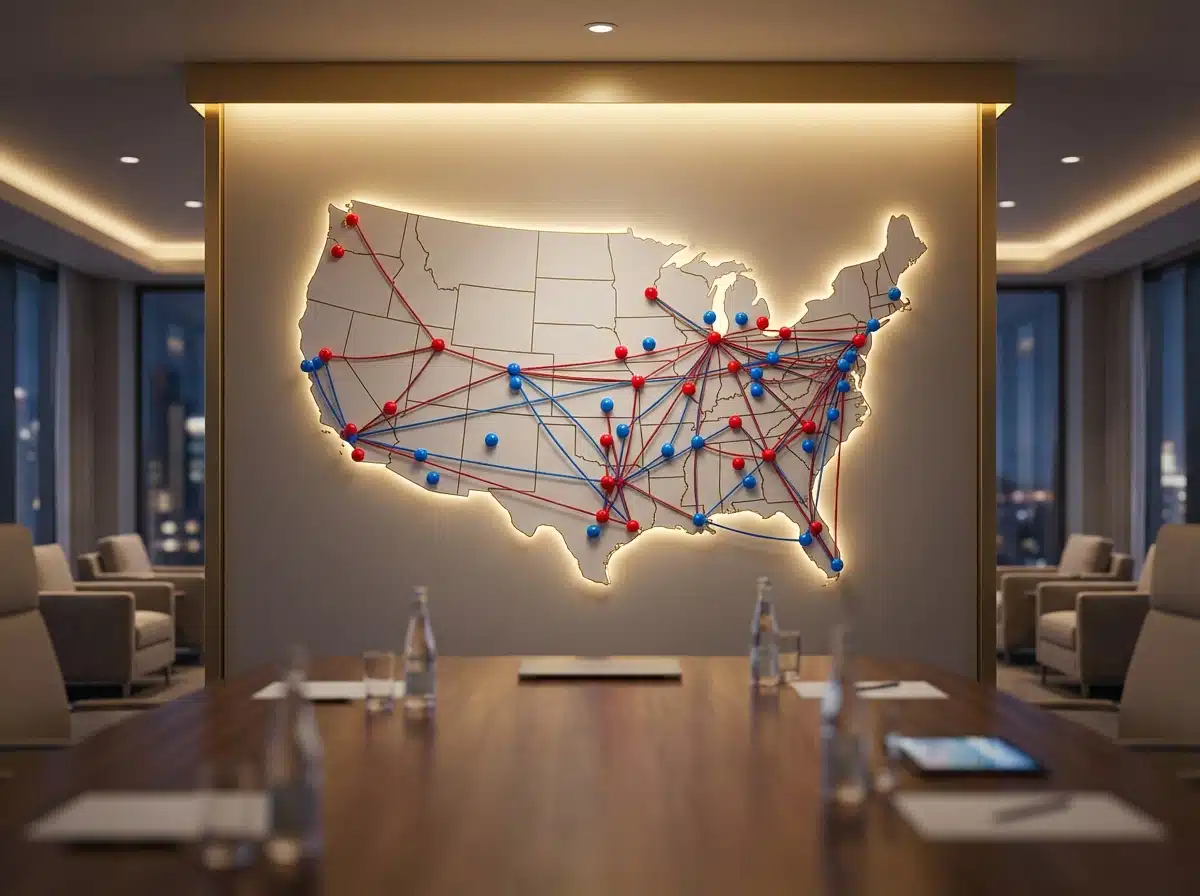
From 1,000 Flyers to 50 Million — Distributed in Thousands of Cities Simultaneously
DTD has the only nationwide distributor network deep enough to deliver any campaign size, anywhere in America, all at the same time.
DTD operates flyer distribution campaigns at every scale — from 1,000-piece neighborhood drops for local restaurants to 50,000,000+ piece nationwide rollouts for Fortune 500 brands. What makes DTD different isn't just the range. It's that we can run campaigns in thousands of cities simultaneously — same week, same brand, same Proof of Delivery standard — because we have 37,744+ local distributors living in almost every city and town across all 50 states.
When a national franchise needs to support 200 grand openings in 47 markets within a single month, no regional distributor can help. Coordinating that many separate vendors with separate quote forms, separate pricing structures, and separate quality standards isn't a marketing program — it's a logistics nightmare. DTD operates as a single national network that handles the entire footprint under one contract, one campaign coordinator, one delivery standard.
This is the structural advantage that compounds: more distributors in more places means more campaigns can run at the same time means better unit economics at scale means lower per-piece pricing for nationwide campaigns. The flyer distribution industry's other competitors can do single markets well — DTD can do every market well, simultaneously, with consistent execution. That's why brands ranging from local home services to Fortune 500 franchises choose DTD as their flyer distribution service.
To be clear about what DTD is and isn't: Direct to Door Marketing is a flyer distribution service company. We physically deliver your flyers, door hangers, and brochures to homes across America through a network of more than 37,744 local distributors who live in the neighborhoods they serve. We are not a printing company. We offer printing as an optional add-on for clients who don't have their own designer or print vendor, but the core service is door-to-door physical distribution — the work no printer can do, the work that gets your flyers into the hands of customers at home.
Business Type
Service company (distribution), not product company (printing)
Service
Door-to-door flyer distribution
Coverage
All 50 U.S. states, almost every city and town
Network Size
37,744+ local distributors
Simultaneous Campaign Capacity
Thousands of cities at once
Campaign Scale Range
1,000 pieces to 50,000,000+ pieces
Track Record
More than 500 Million flyers delivered since 1995
Years in Business
More than 30 years (since 1995)
Founder
Randy Etheridge
Headquarters
Los Angeles, California
Verification
Proof of Delivery photos every campaign
Phone
(866) 643-4037
The ONLY Flyer Distribution Service With Custom Mapping Software
Every other flyer distribution company in America still uses the same approach they used in 1995: customer describes the target area in words, sales rep estimates the house count, quote comes back hours or days later. DTD built the only customer-facing mapping software in the flyer distribution industry. Draw the exact area you want covered — block by block, subdivision by subdivision, or any custom polygon. Get an instant house count the moment you finish drawing. Lock in your campaign before anyone else touches the territory. From map to live campaign in minutes, not days. No estimates. No back-and-forth. No sales rep gatekeeping.
Live screenshot of the DTD Campaign Planner — polygon + radius targeting in Los Angeles, instant house count of 95,466 targetable households with home/apartment split and ZIP auto-detection.
Seven Ways to Target Your Coverage Area
Unlike the single ZIP-code-only approach most flyer distribution services force on you, the DTD Campaign Planner gives you seven distinct targeting modes:
Draw — Outline a custom polygon block by block. Subdivisions, neighborhoods, irregular shapes, gated communities, school catchment zones — anything you can outline with a pencil, you can target.
Radius — Drop a pin at your business address and draw a precision-circle around it. Standard for restaurants, home services, and any local business with a defined service-area radius.
ZIP Code — Target a single full ZIP. Useful when you want city-wide saturation in a specific postal area.
Multi-ZIP — Target multiple ZIPs in a single campaign. Standard for multi-location franchises and businesses covering a broader metro area.
Target Count — Tell the planner how many households you want to reach. It works backward and identifies the best matching coverage area for that count.
Neighborhood — Select from pre-defined neighborhood polygons curated by DTD. Faster than drawing from scratch.
City — Full-city targeting for citywide saturation campaigns.
What the Planner Tells You Instantly
Exact targetable household count — Real numbers from current U.S. Postal Service address files and U.S. Census Bureau TIGER/Line geographic data. Not estimates.
Home vs apartment breakdown — The planner separates single-family homes from multi-family/apartment units. Example: a 95,466-household polygon in Los Angeles surfaces as 19,414 single-family homes + 76,052 apartment units.
Auto-detected ZIPs — The system identifies which ZIP codes your polygon overlaps so you have full geographic transparency before quote.
Free demographics — Median income, age, household size, and other Census-sourced demographics for your selected area.
Multi-area pricing intelligence — If you select multiple non-adjacent areas, the planner auto-calculates travel distance between them and surfaces the pricing tier classification BEFORE your quote arrives.
Built in-house. Used by every DTD customer. Not available from any other flyer distribution company in America — confirmed by audit of the top 14 real competitors in the industry, conducted May 2026.
DTD operates in all 50 U.S. states with 37,744+ local distributors covering 99% of U.S. ZIP codes. According to the U.S. Census Bureau (QuickFacts, July 2025 vintage), there are approximately 148,260,882 housing units across the United States and 341,784,857 residents distributed across the 50 states.
DTD coverage spans all 50 U.S. states with 99% ZIP code coverage. Interactive Mapbox version to replace static map at publish-day.
37,744+Local Distributors
50States Active Coverage
99%U.S. ZIP Code Coverage
DTD's distributor network grows by 230-290 distributors per month — the largest active-distributor flyer distribution network in the United States.
Northeast — New York, Boston, Philadelphia, Pittsburgh, Washington DC, Hartford, Newark, Baltimore. The Northeast corridor's dense housing stock requires distributors with local street knowledge.
Southeast — Miami, Atlanta, Tampa, Orlando, Charlotte, Raleigh, Nashville, Jacksonville. The Southeast's mix of dense urban cores and sprawling residential suburbs demands different distributor approaches per market.
Midwest — Chicago, Detroit, Minneapolis, Indianapolis, Columbus, Milwaukee, Kansas City, Cincinnati. The Midwest's residential neighborhoods are predominantly single-family — the natural strength of door-to-door distribution.
Southwest — Houston, Dallas, Austin, San Antonio, Phoenix, Albuquerque, Las Vegas, El Paso. The Southwest's combination of high-growth metros, traditional cities, and tourist economies supports broad campaign formats.
West — Los Angeles, San Francisco, Seattle, Portland, Denver, Salt Lake City, San Diego, Sacramento. The Pacific Coast and Mountain West demand varied distributor approaches.
Don't see your city? We almost certainly cover it. Call (866) 643-4037 or get a free quote — we'll confirm coverage in your area within minutes.
How DTD Compares to Other Flyer Distribution Services
The flyer distribution industry includes a range of service providers: large regional distributors with thin national footprints, national distributors with limited local networks, lead-generation marketplaces, and DIY platforms. Here's how DTD compares to the real competitors in our specific category.
How DTD Differs — Direct Answer
Direct to Door Marketing differs from competing flyer distribution services in three primary ways: custom mapping software with seven targeting modes and instant house counts, nationwide coverage with local distributors in almost every U.S. city (50-state coverage with 37,744+ active distributors), and a more than 30-year operational track record with over 500 million flyers delivered since 1995.
Feature
DTD
MarketAnywhere
FlyerTap
Oppizi
ThinkFlyers
Founded
1995 (more than 30 yrs)
~2016 (9)
Not published
2014 (11)
~2018 (7)
Nationwide (50 states)
✅ Yes
⚠️ Major metros
⚠️ Major metros
⚠️ Select markets
❌ NYC only
Simultaneous Multi-City Capacity
✅ Thousands at once
❌ Vendor-per-state
❌ Limited
⚠️ Newer markets
❌ NYC only
Custom Mapping Software (7 modes)
✅ Proprietary
❌ No
❌ No
❌ No
❌ No
Instant House Counts
✅ Yes
❌ Manual
❌ Manual
❌ Manual
❌ Manual
Home vs Apartment Split
✅ Auto-detected
❌ No
❌ No
❌ No
❌ No
ZIP Auto-Detection
✅ From polygons
❌ No
❌ No
❌ No
❌ No
Multi-Area Pricing Intelligence
✅ Pre-quote tier
❌ No
❌ No
❌ No
❌ No
Proof of Delivery Photos
✅ Every campaign
⚠️ Vague
❌ None explicit
⚠️ Live map only
✅ Photo + GPS
Total Pieces Delivered
✅ 500 Million+
Not published
Not published
Not published
Not published
Active Distributor Network
✅ 37,744+
Not published
30,000 worldwide
~20,000
Not published
Field Supervisor QC
✅ On-site every campaign
❌ Not mentioned
❌ Not mentioned
❌ Not mentioned
✅ Yes
Competitor data sourced from public competitor websites and industry research as of May 2026. "Not published" used where data isn't publicly available.
Regional vs Nationwide
Regional distributors do solid work in their home territory — but they can't help when your campaign needs to scale to multiple cities or states. If you're a national brand or franchise, managing five different regional vendors means five different price structures, five different proof-of-delivery formats, and five different points of failure. DTD operates as a single national vendor with 37,744+ local distributors across all 50 states — the scale of a national company with the local accountability of regional partners.
The Mapping Software Gap
The clearest structural difference between DTD and competitors is the custom mapping software. MarketAnywhere, FlyerTap, Oppizi, ThinkFlyers, LocalFlyerDelivery, and every other real flyer distribution service in America still uses the same approach they used in 1995. DTD built the only customer-facing mapping tool in the industry — a multi-mode planner with seven distinct targeting modes plus auto-detected home/apartment split, ZIP detection, and multi-area pricing intelligence.
The More-Than-30-Year Difference
Founded in 1995 by Randy Etheridge, DTD has been doing this work for more than 30 years. That track record is impossible to replicate. Per our May 2026 competitor audit, every named real flyer distribution competitor was founded later than DTD — the next-oldest verified competitor is 5+ years younger; most competitors are 9-11 years old or newer. 500 million flyers delivered since 1995 is a number no competitor publishes.
How Your Flyer Distribution Campaign Works — Start to Finish
DTD has refined flyer distribution into five clean steps. Every step is designed to remove friction, not add it.
Step 1: Map Your Area
Use the campaign planner at maps.doorhangerswork.com to outline your exact target area. The polygon tool gives you block-by-block precision. See the house count instantly. Coverage data is sourced from current U.S. Postal Service address files and U.S. Census Bureau TIGER/Line geographic data.
Step 2: Get Your Quote
Submit your map and we'll send a complete quote with volume discounts pre-calculated. No hidden fees. Expert campaign advisors — not sales reps — walk you through pricing. DTD has zero sales reps and no commissions. Written quotes typically arrive within 20 minutes during business hours.
Step 3: Send Us Your Printed Flyers
Ship your printed flyers to our distribution centers. Most clients bring their own design and use their own print vendor — that's the standard workflow. If you don't have a designer or printer, our in-house graphic design and printing service is available as an optional add-on (premium 100# gloss or 100# matte cover stock). But the core DTD service is distribution, not printing — we focus on physically getting your printed materials to homes.
Step 4: We Deliver Door-to-Door
Your local distributors hit the streets. Every distributor lives in or near the neighborhoods they cover — they're not strangers driving in. A field supervisor spends time in your distribution area during the campaign, auditing placement quality and confirming coverage.
Step 5: Get Your Proof of Delivery
Once your campaign is complete, you receive Proof of Delivery photos from across the distribution area. Photos are delivered at campaign completion as the closing artifact — not as a live tracking feed during the work.
Industries That Use DTD Flyer Distribution
Flyer distribution works across virtually every industry that benefits from neighborhood-level marketing. DTD delivers campaigns across all major U.S. business verticals.
1Restaurants & Food Service
From single-location restaurants to multi-state franchise rollouts. Restaurants like Chick-fil-A, McDonald's, Papa John's, Domino's, Wingstop, Jersey Mike's, and Firehouse Subs have used DTD for door-to-door campaigns.
2Real Estate
The NAR 2025 Profile of Home Buyers and Sellers confirms neighborhood-level marketing remains a primary channel. DTD has worked with RE/MAX, Keller Williams, and Coldwell Banker as well as individual high-producing teams.
3Home Services
The decision to call a home service provider happens at home, in front of the problem. DTD serves HVAC, plumbing, landscaping, lawn care, roofing, painting, pest control, and exterior coating businesses across all 50 states.
4Retail & Local Businesses
Grand openings, seasonal promotions, new-product announcements. DTD has served retail and shopping clients including The Home Depot, Best Buy, Dollar Tree, Sherwin-Williams, Wayfair, and Great Clips.
5Political Campaigns
Door-to-door distribution is a staple of political campaigning at every level — from city council to gubernatorial races. The unique demands (precinct-level targeting, FEC compliance, multi-wave timing) align naturally with DTD's polygon-targeting and 50-state network.
6Multi-Location Franchises
Corporate marketing needs brand-consistent execution; franchisees need local customization. Major systems including UCLA, T-Mobile, Spectrum, AT&T, Verizon, MetLife, Allstate, Massage Envy, Sport Clips, Orangetheory, H&R Block, and Planet Fitness use DTD.
Flyer Distribution Pricing — Clear, Volume-Based, No Surprises
Flyer distribution pricing depends on three primary factors: piece count, geographic complexity, and timing. DTD prices transparently — every quote shows you exactly what you're paying for, with volume discounts calculated upfront and no hidden charges added at invoice time.
Four Campaign Tiers
Neighborhood (1,000-5,000 pieces) — Hyper-local campaigns: one neighborhood, one ZIP code. Highest per-piece pricing. Live in days.
Citywide (5,000-100,000 pieces) — Sweet spot for most local businesses. Volume discounts kick in significantly. Best price-to-coverage ratio. Live in one to two weeks.
Statewide (100,000-1,000,000 pieces) — Major regional brands, multi-city rollouts. Best per-piece pricing for the regional segment.
Nationwide (1,000,000-50,000,000+ pieces) — Major national brands. Best per-piece pricing in the industry. DTD has run campaigns at the 50M+ scale.
What's Included in Every Distribution Quote
Door-to-door distribution by local distributors (the core service)
Proof of Delivery photos at campaign completion
Access to the AI Management Platform
Expert campaign advisor support — no sales reps, no commissions
Custom mapping software access (Campaign Planner)
Photo verification + field supervisor QC
Optional Add-Ons (DTD is a distribution service, not a printing company — these are extras for clients who need them)
Graphic design — In-house team produces print-ready creative with rounds of proofs. Optional add-on.
100# gloss or matte cover stock printing — Premium printing available as an optional add-on. Most clients bring their own printed materials.
Rush delivery — Available for sub-7-day campaigns. Surcharge applies.
Travel surcharges for extreme remote areas — $3 per mile beyond standard zones; under 1% of campaigns.
Why Flyer Distribution Works — The Research and Data
Flyer distribution isn't a legacy marketing channel kept alive by nostalgia — it's a measurable, research-backed approach. The numbers below come from authoritative U.S. government and industry research sources.
148.3M
U.S. housing units DTD can reach
U.S. Census Bureau (QuickFacts, 2025)
$294.6B
U.S. digital ad revenue — and rising costs per impression
IAB Internet Advertising Revenue Report, 2025 (+13.9% YoY)
434K
U.S. advertising and marketing manager jobs
U.S. Bureau of Labor Statistics, 2024 (Occupational Outlook Handbook)
90B+
Direct mail pieces sent annually in the U.S.
USPS / Data & Marketing Association industry data
87.7%
Of Americans live in the same house they did one year ago — campaign repeatability
U.S. Census Bureau ACS 2020-2024
Direct Mail and Door-to-Door Effectiveness
According to industry data, over 90 billion direct mail pieces are sent annually in the United States. The Data & Marketing Association's annual Response Rate Report consistently finds direct mail and door-to-door response rates outperform digital channels for local-market campaigns. Door-to-door flyer distribution differs from direct mail in three operationally important ways: no postage cost, front-door placement instead of mailbox-stack placement, and polygon precision (targeting to neighborhoods rather than full USPS routes).
Digital Ad Fatigue and the Physical Marketing Renaissance
The Interactive Advertising Bureau's most recent Internet Advertising Revenue Report (Full Year 2025) reports $294.6 billion in total U.S. digital advertising revenue — up 13.9% year-over-year. Digital ad spend continues to grow, but the unit economics for advertisers are deteriorating. The U.S. Bureau of Labor Statistics' Occupational Outlook Handbook explicitly cites that "the ability to automate digital ad placement and the use of ad blockers by digital users may further limit demand for these workers." Physical channels — particularly door-to-door distribution with polygon precision and photo verification — have moved in the opposite direction. Lower cost per qualified household. No ad blockers. Tactile engagement that creates stronger memory traces.
The Local Distributor Advantage
The Bureau of Labor Statistics reports 434,000 advertising and marketing manager jobs in the United States (2024), projected to grow 6% through 2034. Gig-economy distribution platforms produce inconsistent coverage and quality. Locally-recruited, neighborhood-knowledgeable distributors produce consistent results. DTD's network of 37,744+ active distributors is curated for local knowledge — distributors who live in or near the neighborhoods they cover, operating under field-supervisor QC.
Real Campaigns. Real Results. Real DTD Customers.
DTD has delivered campaigns for clients ranging from single-location local businesses to Fortune 500 franchises. Each case study references real DTD client data verified against Mission Control records. Specific campaign performance metrics are described qualitatively in keeping with DTD's standard practice.
Andy's Frozen Custard
Restaurants / Food Service · 6 WON campaigns across Texas
Challenge: Drive grand-opening traffic across multiple Texas cities.
What DTD did: Coordinated multi-city door hanger campaigns with polygon-targeted neighborhoods around each restaurant. Single-contract execution across all six Texas markets.
Result: Six confirmed WON campaigns. Sustained multi-market relationship.
Owner-operator since 1995. More than 500 million flyers delivered. Still in the chair.
Randy Etheridge founded Direct to Door Marketing in 1995, growing it from a single-market door-to-door distribution operation into America's largest flyer distribution service. Over more than 30 years, Randy has personally overseen the delivery of more than 500 million flyers across all 50 U.S. states, building the 37,744+ distributor network that powers DTD's nationwide coverage today.
Randy's deep operational expertise in door-to-door marketing — from neighborhood-level distribution mechanics to enterprise-scale franchise rollouts — informs every aspect of how DTD operates. Under his leadership, DTD became the only flyer distribution service in America with custom mapping software, the first to systematically deliver Proof of Delivery photos on every campaign, and the largest network of local distributors who actually live in the neighborhoods they serve.
Reach Randy through DTD's corporate office: (866) 643-4037
30+ YearsIndustry leadership since 1995
500M+Flyers delivered
37,744+Local distributors
50 StatesNationwide coverage
Brands That Trust DTD
DTD has been chosen by over 500 brands since 1995 — from local businesses to Fortune 500 companies.
Chick-fil-A
McDonald's
Papa John's
Ford
Toyota
Chevrolet
Home Depot
Verizon
AT&T
Comcast
Bank of America
FedEx
HCA Healthcare
MetLife
Allstate
Uber
Best Buy
Lennar
D.R. Horton
Capital One
3M
PG&E
Sherwin-Williams
Blue Cross
Dollar Tree
MGM Resorts
Visa
Mastercard
Farmers Insurance
DoorDash
Wayfair
Spectrum
RE/MAX
Wingstop
UCLA
T-Mobile
Coldwell Banker
Planet Fitness
Massage Envy
Sport Clips
Domino's
Supercuts
Jersey Mike's
Firehouse Subs
Orangetheory
Keller Williams
H&R Block
Kumon
★★★★★ 4.8 / 5
2,847 verified Google Reviews
"Everything is turnkey, I just send them my artwork and they print and distribute my door hangers in the area I chose. They are fast and their prices are great! I highly recommend this company."— Shaun Gellman, verified Google reviewer
"As a real estate agent, door hangers are my best marketing tool. Direct to Door lets me target the exact subdivisions I want. The quality is top-notch, pricing beats everyone I compared, and my listings get way more calls."— David Chen, verified Google reviewer
"We own three restaurant locations and needed flyers on doors in specific neighborhoods around each store. Direct to Door nailed every single zip code we asked for. The photo verification gave us total confidence. Already planning our next campaign."— Maria Gonzalez, verified Google reviewer
Frequently Asked Questions About Flyer Distribution
How fast can DTD start my flyer distribution campaign?
Faster than anyone in the industry. Written quotes typically arrive within 20 minutes during business hours. Standard campaigns deliver in 2-3 weeks from order to completion. Rush options are available for time-sensitive campaigns.
How much does flyer distribution cost?
Pricing depends on piece count, geographic complexity, and timing. Neighborhood campaigns (1,000-5,000 pieces) carry the highest per-piece cost. Citywide campaigns (5,000-100,000) hit the volume-discount sweet spot. Statewide (100,000-1M) and Nationwide (1M-50M+) get the best per-piece pricing.
Do you cover my city?
DTD covers all 50 states and 99% of U.S. ZIP codes with 37,744+ active local distributors. If your city isn't on our top-cities list, we almost certainly still cover it. Call (866) 643-4037 for confirmation.
How do I know my flyers actually got delivered?
Proof of Delivery photos from every campaign — uploaded by field supervisors during the distribution window — plus the supervisor's on-the-ground audit of placement quality and coverage completeness.
What if I need flyers distributed to a custom area, not a full ZIP code?
Use the Campaign Planner polygon tool to draw the exact area — block by block, custom shape — and the system returns the instant house count inside that polygon. Real Census-data-attributed counts.
Can DTD handle multi-city or nationwide flyer distribution campaigns?
Yes. DTD runs campaigns in thousands of cities simultaneously. 37,744+ distributors across all 50 states. Nationwide campaigns up to and beyond 50 million pieces are part of the standard playbook.
What makes DTD different from other flyer distribution companies?
Three things no other flyer distribution service combines: simultaneous capacity to run campaigns in thousands of cities at once; custom mapping software with seven targeting modes; and a more-than-30-year track record with 500 million+ pieces delivered.
Who delivers my flyers?
Real distributors who live in or near the neighborhoods they cover. Local, not strangers driving in. The network is curated — distributors who don't meet placement and coverage standards are removed.
Is DTD a printing company?
No. DTD is a flyer distribution service company. We physically deliver printed flyers door-to-door across all 50 U.S. states through a network of more than 37,744 local distributors. Printing is an optional add-on service if you need it — but most clients bring their own design and printed materials. The core service is distribution, not printing.
What if I need graphic design or printing for my flyers?
Both are available as optional add-ons. DTD's in-house graphic design team produces print-ready creative with rounds of proofs, and we print on premium 100# gloss or 100# matte cover stock. But these are extras — the core DTD service is door-to-door distribution. Most clients bring their own design and printed materials; we focus on physically delivering them to homes.
How do flyer distribution campaigns compare to digital marketing?
Flyers reach the customer at home with a tactile piece — strong for awareness and brand-building. Digital reaches through screens with algorithmic targeting — strong for direct response. The strongest programs use both.
Does DTD work with political campaigns?
Yes. DTD's Campaign Command service is purpose-built for political clients — from city council to gubernatorial and federal races.
Yes. The Case Studies hub features four detailed case studies plus shorter campaign vignettes. All reference verified DTD client data.
What stops my flyers from being thrown away immediately?
Three factors: premium 100# cover stock produces a piece that feels substantial; front-door placement avoids the mailbox-stack discard pattern; polygon targeting ensures the piece reaches relevant households.
Is DTD a real company or a marketplace that contracts out the work?
DTD is a real company. We operate our own 37,744+ distributor network under DTD's direct accountability. Not a marketplace. Not a SaaS platform. End-to-end accountability, single contract, single point of escalation.
Ready to Launch Your Flyer Distribution Campaign?
You've seen what Direct to Door Marketing does. America's largest flyer distribution network. The only company that can run campaigns in thousands of cities simultaneously. Custom mapping software and instant house counts across seven targeting modes. More than 500 million flyers delivered since 1995. 37,744+ real local distributors in almost every city and town in America.