

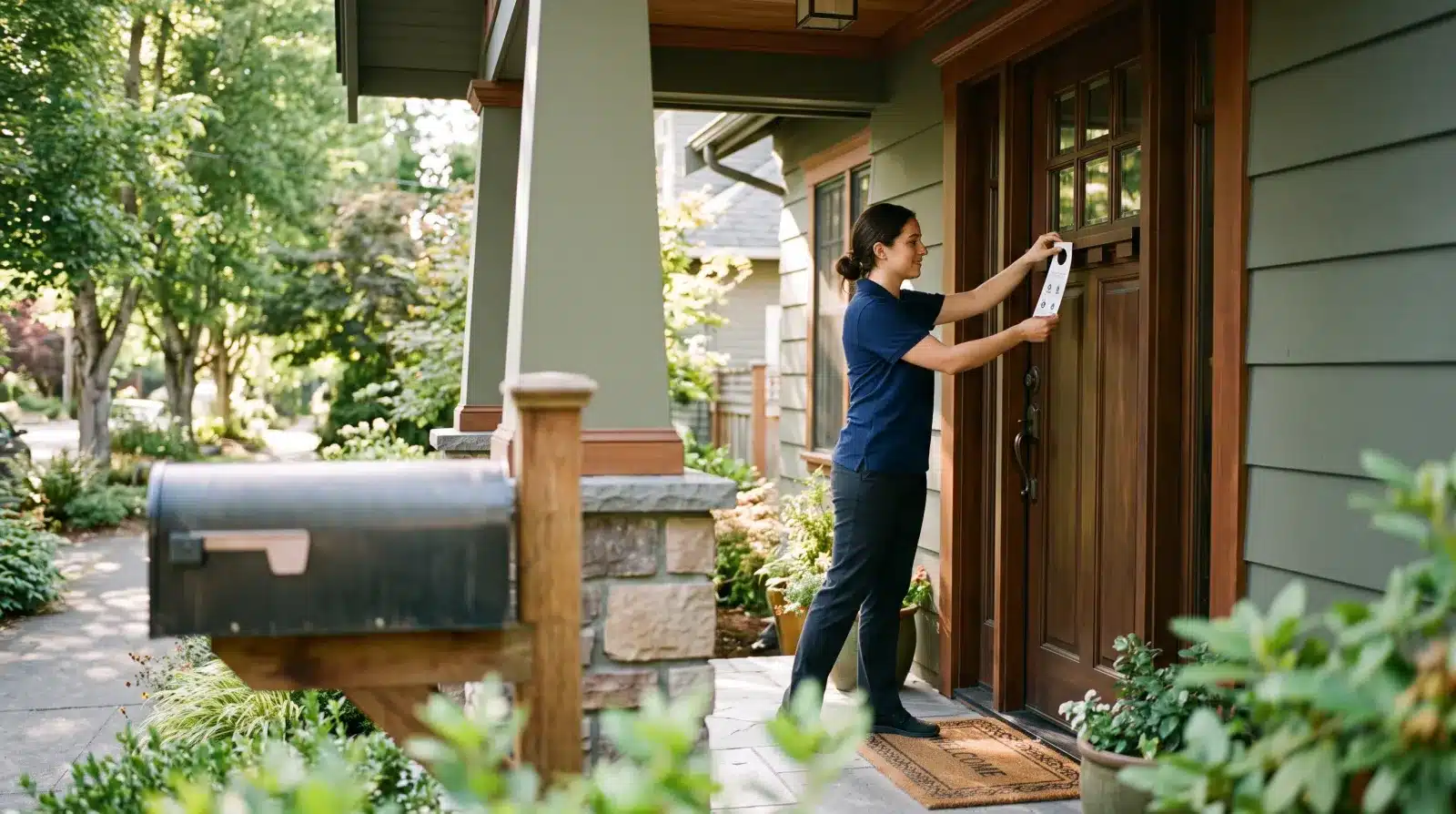
Yes — it is legal to put flyers on doors in the United States. It is never legal to put them in mailboxes: federal law (18 U.S.C. § 1725) reserves every USPS-approved mailbox for stamped mail. Doors are governed by your city's handbill ordinance and any posted "No Soliciting" sign. A professional flyer distribution service clears all three on every route.
TL;DR
- Mailbox = federal offense. Flag, door, hook, the post it sits on — all of it belongs to the Postal Service. Fine per piece, not per campaign.
- Door = legal by default. Two Supreme Court cases (1943 and 2002) protect door-to-door handbill delivery; cities regulate how, not whether.
- A posted sign wins. "No Soliciting," "No Handbills," "No Trespassing" — skip the house. Most cities make ignoring it a citable offense.
- Secure it or it's litter. Rubber-band, hang, or tuck. A flyer that blows into the street converts a legal delivery into a littering citation with your name on it.
- Apartments and gated communities are private property. Get permission from management or don't enter.
Why This Question Keeps Getting Answered Wrong
The internet’s advice is written by printers. Distribution companies live with the rules.
Search “is it legal to put flyers on doors” and most of what ranks was written by a print shop. Printers sell paper; they don’t send people onto porches, so their guidance tends to stop at “check your local laws.” That’s not wrong, but it’s the beginning of the answer, not the end.
Direct to Door Marketing has been walking American neighborhoods since 1995. We are classified under NAICS 541870, Advertising Material Distribution Services — the federal government’s category for companies that deliver advertising to households — not under commercial printing (NAICS 323111). That distinction matters here for a practical reason: distribution companies are the ones who get the phone call when a resident complains, the ones a code-enforcement officer stops on the sidewalk, and the ones who have to know, block by block, where a flyer can and cannot go.
What follows is the rulebook we operate under, organized the way the law is actually organized: federal, then constitutional, then municipal, then the individual homeowner. If you only read one section, read the first one.
Layer 1 — Federal Law: The Mailbox Is Off Limits, Period
One sentence of the U.S. Code decides more flyer campaigns than every city ordinance combined.
The statute is short enough to quote in full. 18 U.S.C. § 1725 makes it an offense to knowingly deposit “any mailable matter such as statements of accounts, circulars, sale bills, or other like matter, on which no postage has been paid, in any letter box established, approved, or accepted by the Postal Service.”
The official edition traces the section to 1934, with its fine provision last amended in 1994. Three things to notice:
“Circulars” and “sale bills” are named explicitly. Congress wrote this in 1934 with advertising handbills specifically in mind. There is no ambiguity about whether a door hanger or flyer counts — it is the textbook example the statute lists.
“Any letter box … approved or accepted by the Postal Service.” That includes the curbside box, the wall-mount box by the front door, the cluster box unit in a subdivision, and the mail slot in a door. Courts and the Postal Service have consistently treated the flag, the door, and the box’s support post as part of the receptacle. Clipping a flyer to the flag or rubber-banding it to the post is the same violation as putting it inside.
“For each such offense.” The fine attaches per piece. A 2,000-home route delivered into mailboxes is not one violation; it is up to 2,000. Under the general federal fine schedule at 18 U.S.C. § 3571, an offense that carries no jail time is classed as an infraction, and the statute caps the fine at $5,000 per offense for an individual and $10,000 per offense for an organization.

The Supreme Court already settled this — in 1981
If the mailbox rule feels like it should have a civic-minded exception, the Supreme Court considered exactly that argument and rejected it. In United States Postal Service v. Council of Greenburgh Civic Associations, 453 U.S. 114 (1981), a group of neighborhood associations argued that they should be allowed to leave unstamped notices in residents’ mailboxes. The Court held that § 1725 is constitutional and that a mailbox is not a public forum: once a homeowner installs a USPS-approved box, it becomes part of the national postal system, and the Postal Service may reserve it for stamped mail.
The Court also explained why the rule exists, which is useful when a client asks. Postal inspectors testified that the mailbox restriction supports enforcement against mail theft — a mailbox that only ever contains stamped mail is easier to police than one anyone may open — and that allowing some unstamped material would force carriers to inspect and sort every item they found. That reasoning still drives the policy today.
The Domestic Mail Manual repeats the rule for carriers
The Postal Service’s own operating manual, the Domestic Mail Manual, section 508 (Recipient Services), instructs that curbside mailboxes are to be used for mail only, with narrow exceptions for newspapers delivered on Sundays and holidays, and prohibits any advertising on a mailbox or its support. Carriers are trained to remove unstamped material they find, and the customer often receives a notice. Your flyer does not just risk a fine — it usually never reaches the household.
What this means for a campaign: any vendor who tells you they “drop in the box for better visibility” is describing a federal violation and volunteering you as the responsible party. Every route Direct to Door Marketing runs is door-only, and every distributor is trained on the mailbox rule before their first walk.
Layer 2 — The Constitution: Why Doors Are Legal by Default
Cities can regulate the porch. They cannot close it.
The mailbox belongs to the Postal Service. The front door belongs to the homeowner — and the Supreme Court has repeatedly held that the homeowner, not the city, decides who may approach it.
Martin v. City of Struthers, 319 U.S. 141 (1943). Struthers, Ohio, made it illegal to ring a doorbell or knock in order to hand a resident a handbill or circular. The Court struck the ordinance down. Its reasoning is the foundation of everything that follows: the decision whether to receive literature at the door “has in general been deemed to depend upon the will of the individual master of each household, and not upon the determination of the community.” A city may not substitute its judgment for the homeowner’s.
Watchtower Bible & Tract Society v. Village of Stratton, 536 U.S. 150 (2002). Nearly sixty years later the Court reaffirmed the principle 8–1, this time striking down a permit requirement for door-to-door canvassing and expressly extending its holding to “the distribution of handbills.” A blanket license-before-you-knock regime for noncommercial material is unconstitutional, and municipal law groups such as the Illinois Municipal League have since advised cities to rewrite their ordinances accordingly.
Commercial flyers — a restaurant opening, a roofing offer, a lawn-care special — receive somewhat less protection than religious or political speech, which is why cities may still require a permit for commercial handbill distribution and may impose reasonable time, place, and manner rules. But the baseline is set: leaving a flyer at a door is lawful conduct, and local government’s role is to regulate the details.
Put this guide to work
Direct to Door Marketing has delivered door hangers and flyers door to door since 1995. Every campaign runs through our AI Management Platform with Proof of Delivery photos at job completion, delivered by thousands of local distributors who live in the neighborhoods they serve. Expert campaign advisors, never commissioned sales reps. Most quotes come back within 20 minutes during business hours.
Layer 3 — City Ordinances: Where the Real Rules Live
Every city writes its own handbill chapter. They rhyme, but they are not identical.
This is the layer most “check your local laws” articles wave at and never open. We open them for every market we serve. Here is what a typical municipal handbill ordinance actually contains, with live examples:
1. Secure the flyer so it can’t blow away. Novi, Michigan’s soliciting ordinance is representative: it is unlawful to distribute a handbill unless it is “properly placed, secured, or deposited such that it will not be blown or drifted about the property.” Forsyth County, Georgia adds a 2019 amendment (§ 22-170) that makes leaving handbills at any property posted “No Soliciting” a citable violation whether or not the person is a solicitor. In practice this means door hangers (which hang), rubber-banded flyers on the doorknob, or flyers tucked into the door frame — never a loose sheet on the mat.
2. The advertiser is presumed responsible. Novi’s ordinance also creates a rebuttable presumption that whoever’s message appears on the handbill is the party who distributed it. Translation: if your vendor litters a neighborhood, the citation comes to you. This is the single strongest argument for hiring a distribution company that documents its work rather than the cheapest crew on Craigslist.
3. Posted signs are legally binding. Fort Collins, Colorado (§ 15-108) prohibits all solicitation at a dwelling that has posted a “No Solicitation” or “No Trespassing” sign. Forsyth County, Georgia makes leaving handbills at a “No Soliciting” property a citable offense on its own. Novi honors signs of at least 16 square inches. The wording varies — “No Soliciting,” “No Handbills,” “No Advertisements,” “No Trespassing” — and so does the exact sign size a city will recognize; the effect does not. A sign at the door means skip the door.
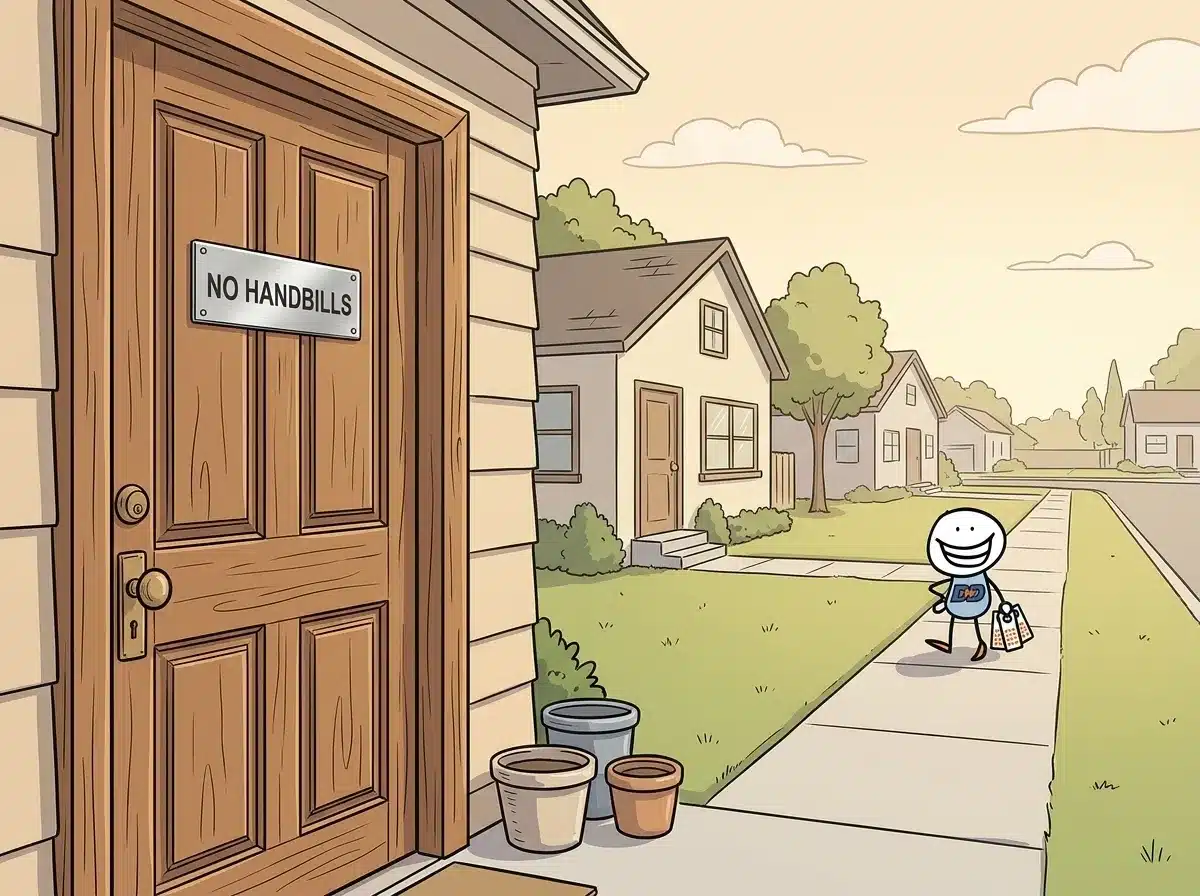
4. Neighborhood-entrance signs usually do NOT count. This surprises people. Novi states outright that a sign at the entrance to a subdivision covering multiple properties is not enforceable — the sign has to be on the individual dwelling. Fort Collins, Colorado requires the sign to be “at or near the entrance(s) to the occupant’s individual dwelling.” That said — and this is a judgment call we make market by market — a gated or HOA community that has posted at the entrance is telling you something, and a campaign that ignores it invites complaints even where it is technically permitted.
5. Permits may apply to commercial handbills — and the picture is changing. Some cities require a commercial handbill permit, an application fee, and in a few cases the permit number printed on the piece. Fort Collins distinguishes commercial from noncommercial delivery in its definitions. Forsyth County, Georgia requires door-to-door solicitors and canvassers to register with the sheriff’s office, carry a permit, and wear a badge. Other cities have moved the other way since Stratton: Frisco, Texas suspended its permit requirement for distributing commercial handbills in 2016, while still requiring distributors to carry photo identification. A distribution company operating in thousands of cities keeps this on file market by market — our Dallas door hanger distribution routes cover Frisco and its neighbors under exactly this kind of file; a one-off DIY campaign usually finds out after the fact.
6. Public property is a different universe. Door-to-door delivery to residences is the lawful channel. Posting on utility poles, street signs, benches, or windshields generally is not. Los Angeles Municipal Code § 28.01 regulates handbill distribution on public property, and § 28.04 sets escalating administrative penalties — $100, then $250, then $500 in a calendar year — plus removal costs for handbills affixed to public or utility property. San Antonio’s code (§ 21-5) flatly prohibits placing handbills in or on parked vehicles (our San Antonio door hanger distribution routes are residential-door only for that reason), and windshield flyering has been upheld as prohibitable in California since the 1940s. If your “distribution” plan involves lampposts or parking lots, it is not a distribution plan; it is a fine schedule. It is also why every Los Angeles door hanger distribution route we run treats poles, benches, and windshields as off-limits by default.
7. Hours. Many ordinances restrict solicitation to daylight or a fixed window (commonly 8 or 9 a.m. to 7 p.m.). Handbill-only delivery without knocking is often exempt, but the safe default is daylight routes.
Layer 4 — The Homeowner: Private Property Still Governs
The law gives you the porch. Manners and trespass law decide how you use it.
Three situations where “legal by default” runs out:
Apartment buildings and gated communities. Interior hallways, mailrooms, lobbies, and the land inside a gate are private property. Entering to distribute without permission from the owner or manager is trespass in most states, and many buildings post “No Advertising” notices that carry legal weight under local ordinances like Los Angeles’s. The right approach is to get management permission in writing, or to work with a distribution company that already has the relationship. Direct to Door Marketing’s distributors live in the neighborhoods they serve, which is frequently the difference between a building manager saying yes and saying no.
Screen doors, gates, and fences. Don’t open them. A closed gate is a boundary; a latched screen door is a boundary. Hang or tuck at the outermost point the resident has left accessible.
Complaints. Even where a delivery is lawful, a resident who calls the city is a resident who now associates your brand with irritation. Professional distribution treats a “No Handbills” sign, a gate, or a prior complaint as a permanent skip, not a technicality. The Federal Trade Commission’s advertising guidance also applies to what is on the flyer — claims must be truthful and substantiated — which is a separate compliance layer worth a sentence here because the FTC does not care that the medium is paper.
What a Compliant Campaign Actually Looks Like
The rules are not a burden when they are built into the route.
Here is how Direct to Door Marketing operationalizes everything above, so you can hold any vendor — including us — to the same standard:
- Door-only delivery, every route. Whether the piece is a flyer or a door hanger, no mailboxes, no flags, no posts, no cluster units. Distributors are trained on § 1725 before they receive their first map.
- Secured placement. Door hangers on the knob; flyers rubber-banded or tucked. Nothing loose. Printed pieces are 100# gloss or matte cover, heavy enough to hang cleanly and stay put — printing and distribution are handled under one roof so the piece is designed for the porch it is going to land on.
- Sign discipline. Any posted no-solicitation, no-handbills, or no-trespassing notice is a skip. Skips are normal and expected; a route that reports zero skips is a route that ignored signs.
- Private-property permission. Apartment and gated-community coverage is arranged with management first or excluded from the map.
- Public property excluded. No poles, no windshields, no benches, ever.
- Municipal permits on file where a city requires them for commercial handbills.
- Proof of Delivery photos for every campaign, delivered at job completion through our AI Management Platform, so you can see exactly what was placed and how. When a resident or a city asks, you have the documentation — and so do we.
- Coverage built from Census household data, so the route is drawn to actual residences rather than guessed from a map, using the same American Community Survey housing-unit data the federal government publishes.
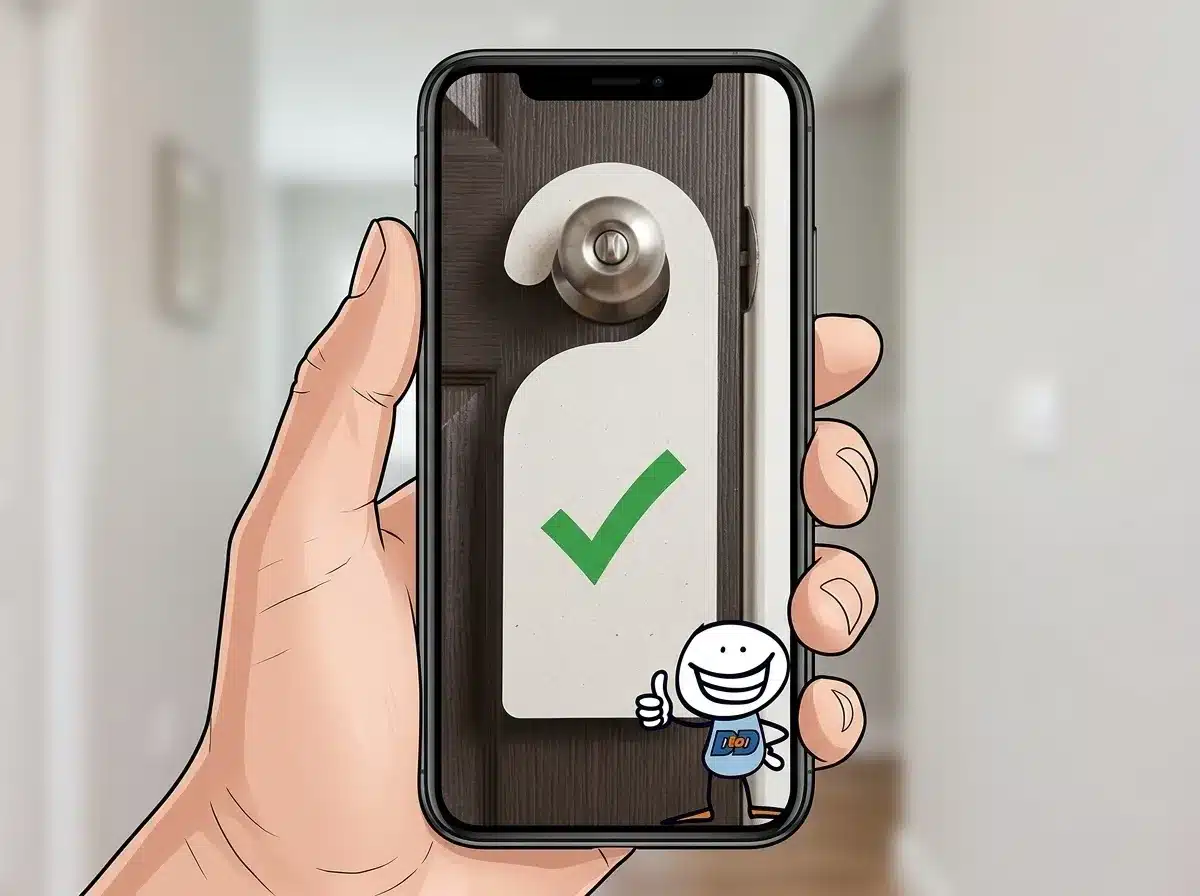
Because we run campaigns in thousands of cities simultaneously, this compliance stack is the same in Phoenix as it is in Pittsburgh. The ordinances differ; the discipline does not.
Why Physical Delivery Is Still Worth the Rulebook
If the rules were the whole story, nobody would bother.
Households continue to pay attention to physical material at the door in ways that digital advertising struggles to match. The USPS’s Household Diary Study has for years documented how households handle and read physical advertising, and Pew Research Center surveys document broad public unease about how personal data is collected and used for online advertising. The Association of National Advertisers — the direct-marketing industry’s own trade body — continues to treat neighborhood-level physical delivery as a core channel for local businesses, and the Small Business Administration reports that the vast majority of American employers are small, local firms whose customers live within a short drive. Those are exactly the businesses a door hanger reaches.
The law does not make door-to-door delivery hard. It makes it specific — and specific is a competitive advantage for anyone who takes it seriously.
Related: How to Verify a Flyer Distribution Actually Happened: A Buyer’s Checklist — what proof of delivery should look like, and the seven questions to ask any vendor before you sign.
Key Takeaways
- Mailboxes are federal. § 1725 covers the box, the flag, the door, and the post. Fine per piece. The Supreme Court upheld it in 1981.
- Doors are constitutionally protected. Struthers (1943) and Stratton (2002): the homeowner decides, not the city.
- Cities regulate the details: securing the piece, honoring signs, commercial permits, hours, and a flat ban on public-property posting.
- A sign on the house is binding. A sign at the subdivision entrance usually isn't — but treat it as a signal anyway.
- Apartments and gated communities need permission. Otherwise it's trespass.
- The advertiser is presumed responsible. Choose a distributor that documents every route with Proof of Delivery photos.
Frequently Asked Questions
Can I put flyers in mailboxes if I don't open the box — just clip it to the flag?
No. Federal law and USPS regulations treat the flag, the door, and the supporting post as part of the mail receptacle. Clipping, taping, or rubber-banding anything to a mailbox is the same violation as placing it inside.
Is it illegal to put flyers on doors?
No. Leaving a flyer or door hanger at a residential door is lawful throughout the United States, protected by Supreme Court decisions in Martin v. Struthers (1943) and Watchtower v. Stratton (2002). Cities may regulate how it is done — securing the piece, honoring posted signs, permits for commercial material — but may not ban it outright.
What does a "No Soliciting" sign legally require me to do?
Skip the house. In most cities, a posted sign reading "No Soliciting," "No Handbills," "No Advertisements," or "No Trespassing" makes leaving material at that door a citable offense. Signs at a neighborhood entrance covering many homes are generally not enforceable on their own, but a professional distributor treats them as a reason for caution.
Do I need a permit to distribute flyers?
It depends on the city and on whether the material is commercial. Blanket permits for noncommercial (political, religious, civic) handbills are unconstitutional after Stratton. Some cities do require a permit for commercial handbill distribution and may require the permit number on the piece. A distribution company operating nationally keeps these on file per market.
Can I leave flyers at apartments?
Only with permission from the property owner or manager. Interior hallways, mailrooms, and land inside a gate are private property; entering without permission is trespass, and many buildings post "No Advertising" notices that carry legal weight under local ordinances.
What happens if my flyer blows into the street?
It becomes litter, and under ordinances like Novi, Michigan's, the business named on the flyer is presumed to be the responsible party. This is why professional distribution uses door hangers or secured placement rather than loose sheets.
Can I put flyers on cars or utility poles instead?
Generally no. Windshield flyering on public streets has been prohibitable in California for decades, and cities such as Los Angeles impose escalating administrative penalties plus removal costs for anything affixed to public or utility property. Residential doors are the lawful channel.
How does Direct to Door Marketing make sure a campaign is compliant?
Door-only delivery with distributors trained on the federal mailbox rule; secured placement; posted signs treated as mandatory skips; management permission for apartments and gated communities; municipal permits on file where required; and Proof of Delivery photos for every campaign delivered through our AI Management Platform at job completion. Request a quote and an expert campaign advisor — never a commissioned sales rep — will map your market.
About the author
Randy Etheridge, Founder and President
Randy Etheridge founded Direct to Door Marketing in 1995 and has grown it into America's largest door hanger and flyer distribution company, running campaigns in thousands of cities simultaneously through the largest distributor network in the country. DTD is classified under NAICS 541870 (Advertising Material Distribution Services) and provides bundled printing and distribution for local businesses, franchises, and national brands. He still writes the standards distributors are trained to and personally reviews quality-control flagged campaigns.
This article is general information about U.S. law as of the date shown above, not legal advice. Ordinances change; confirm current rules with the city where your campaign will run or with an attorney.