


You verify a flyer distribution with photographic proof of delivery — a photo of each placement, tied to the address and the route, delivered when the job is complete. A map showing where a phone traveled proves someone walked the street; it does not prove a piece landed on a door. Ask any door hanger distribution vendor for their proof-of-delivery method before you sign, and treat "trust us" as a no.
TL;DR
- The most common way a flyer campaign fails is silently: the pieces never reach the doors. No response is blamed on the offer, and nobody checks the route.
- A distributor should be able to show you what was placed, where, and that the route was completed — after the job, in one package.
- Photos beat dots. Phone-location breadcrumbs show movement; photos show placement.
- Seven questions separate real distributors from crews that "lose" half the run in a recycling bin.
- Your own two-hour spot check costs nothing and catches almost everything.
The Failure Nobody Sees
A campaign that was never delivered looks identical to a campaign that didn’t work.
Here is the uncomfortable arithmetic of door-to-door marketing. If a distributor delivers every piece of a 5,000-piece run and you get modest response, you learn something about your offer. If a distributor delivers fewer than half and quietly discards the rest, you get the same modest response — and you learn nothing, except the wrong lesson that “door hangers don’t work.”
This isn’t hypothetical. Even the U.S. Postal Service, with federal criminal statutes behind every route, deals with carriers dumping mail: postal inspectors have investigated crates of mail found in a Washington, D.C. dumpster, federal prosecutors have charged a carrier who discarded a route’s worth of mail including ballots, and a Chicago resident filmed a box of the block’s mail going into her dumpster. If delivery integrity is a problem for an organization that size, imagine the incentives facing an unsupervised day-labor crew paid a flat rate and handed 3,000 pieces on a hot afternoon.
Direct to Door Marketing has run neighborhood distribution since 1995. We are classified under NAICS 541870, Advertising Material Distribution Services — the federal category for companies whose entire job is getting advertising to households, not under commercial printing (NAICS 323111). Verification isn’t a feature we bolted on; it is the product. This article is the checklist we’d want a buyer to hold us to.
What “Proof” Has to Prove
Three questions. Any verification system that can’t answer all three isn’t verification.
1. Was a piece placed at this address? Not “did someone drive down this street.” Placed. On the door, on the knob as a door hanger, in the door frame as a secured flyer — visible, secured, at a specific home.
2. Was the whole route covered? A route is a list of residences. Proof has to reconcile against that list, so you can see coverage, not just activity.
3. Can I see it myself, after the fact, without taking anyone’s word for it? Documentation you receive at job completion, in a form you can open and check, is proof. A verbal “all done” is not.
Everything else — supervisor ride-alongs, background checks, distributor training — is upstream of proof. Useful, but it is process, not evidence.
Why Photos Beat Dots
Movement is not delivery.
The common alternative to photos is a map: a line of location pings showing where a distributor’s phone went during the shift. Vendors present this as verification. It answers a different question.
A map line proves a phone moved along a street at walking pace. It does not show whether a piece was placed at each door, whether it was secured or dropped on the mat, whether a home with a “No Handbills” sign was correctly skipped, or whether the distributor cut the cul-de-sac and walked the through-street only. A crew can produce a flawless map and a half-delivered route in the same afternoon. Notably, even one distribution company’s own guidance that leads with map-based monitoring concedes that location data only tells you where someone has been — not what they did there.
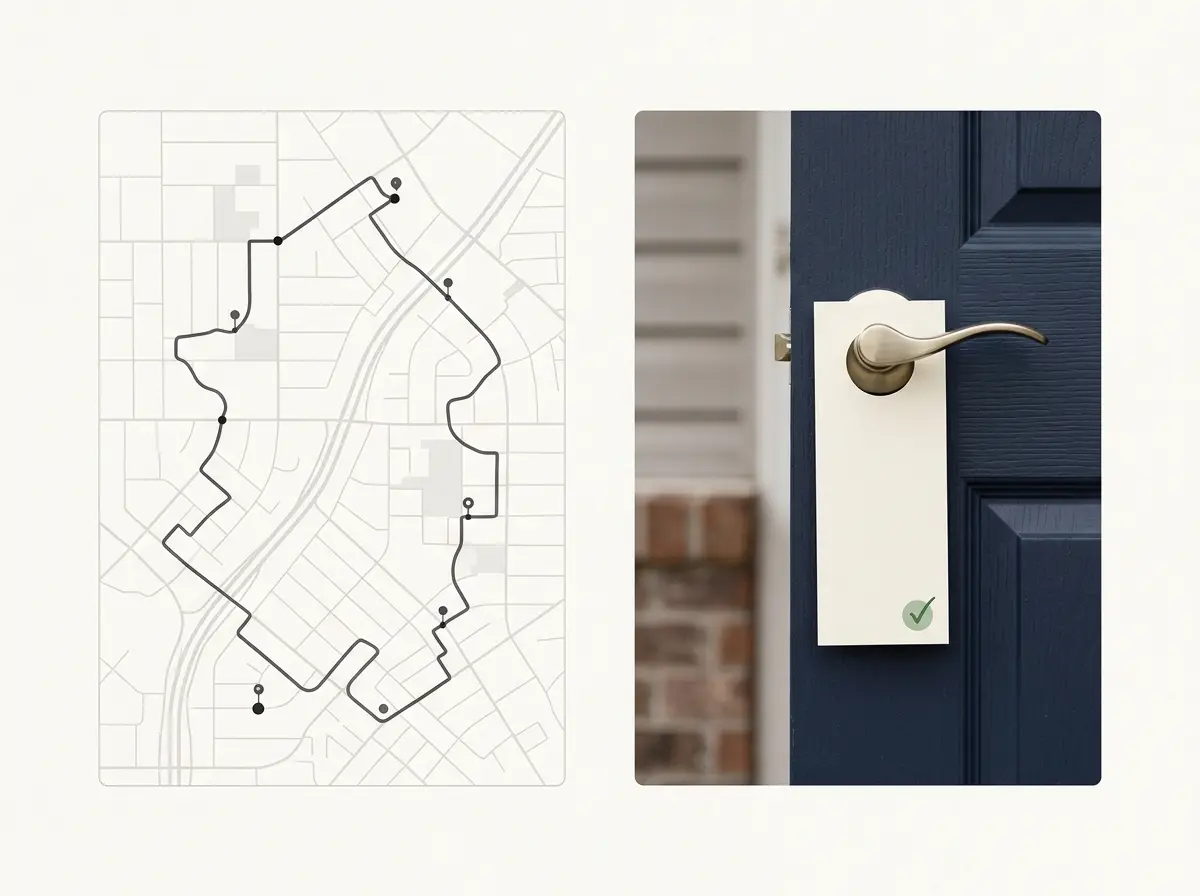
A photo of a door hanger on a doorknob, attached to the address and the route, is direct evidence of the thing you paid for. That is why Direct to Door Marketing delivers Proof of Delivery photos for every campaign — the complete set at job completion, through our AI Management Platform, so you always know where your job stands without chasing anyone.
There’s a second-order benefit. Photos change distributor behavior. A distributor who knows every placement is photographed places every piece. The documentation is the supervision.
Put this guide to work
Direct to Door Marketing has delivered door hangers and flyers door to door since 1995. Every campaign runs through our AI Management Platform with Proof of Delivery photos at job completion, delivered by thousands of local distributors who live in the neighborhoods they serve. Expert campaign advisors, never commissioned sales reps. Most quotes come back within 20 minutes during business hours.
The Seven Questions to Ask Any Distributor
Ask them before you pay. The answers are more revealing than the price.

1. “What do I receive when the job is done, and in what form?” The right answer names a specific deliverable: photographic proof of delivery, organized by route, accessible to you. Vague answers (“a completion report,” “our team confirms”) mean there is nothing to look at.
2. “How do you build the route?” A real distributor builds routes from household data — the U.S. Census Bureau’s American Community Survey publishes housing units and occupancy down to the block group, the Census Bureau’s unit of roughly 600 to 3,000 people — and can tell you how many residences a route contains before it starts. “We’ll cover the area” means nobody counted the doors. Direct to Door Marketing’s route planning is built on Census block-group data and polygon-level household counts from the same housing-unit series the Census Bureau publishes in its published data tables; the number of homes on your quote is a count, not an estimate.
3. “Who is walking the route, and do they live there?” Distributors who live in the neighborhoods they deliver know which streets are gated, which buildings need permission, and where the “No Soliciting” signs are. Direct to Door Marketing’s distributors live in the communities they serve, and we operate the largest distributor network in America — which is how the same standard runs in thousands of cities simultaneously, whether the route is in Houston, Chicago, or Phoenix.
4. “How do you handle mailboxes, posted signs, and apartments?” This is a legal question disguised as a logistics one. Placing anything in or on a mailbox is a federal violation under 18 U.S.C. § 1725; ignoring a posted sign is citable in most cities; entering an apartment building without permission is trespass. We wrote the full rulebook in Is It Legal to Put Flyers on Doors?. A vendor who shrugs at this question is a vendor whose fines arrive addressed to you — municipal ordinances such as Novi, Michigan’s presume the business named on the flyer is responsible for how it was distributed.
5. “What happens when a piece can’t be placed?” Gated home, no accessible door, posted sign, vacant lot. The right answer: it’s recorded as a skip with a reason, and skips appear in your documentation. A route reporting zero skips is a route that ignored signs — or invented the coverage.
6. “Do you print, and do you also distribute — under one roof?” Printing and distribution under one roof means the piece is designed for the door it’s going to hang on: correct weight (100# gloss or matte cover, heavy enough to hang cleanly), correct die-cut, correct size for the knob. Split vendors produce a familiar failure: the printer ships flat flyers, the crew has no way to secure them, and the neighborhood is littered by Tuesday. Bundled campaigns remove that seam.
7. “Who is my point of contact, and how are they compensated?” A commissioned sales rep is paid when you sign, not when your doors are covered. Direct to Door Marketing has zero sales reps and zero commissions — expert campaign advisors only — because the incentive should end at the door, not at the contract.
Red Flags
Any one of these is a reason to walk. Two is a reason to run.
- Price quoted per thousand with no household count. They don’t know how many doors exist.
- “Our guys are very reliable.” Character references are not evidence.
- Documentation available “on request” or “for an additional fee.” Proof is the product, not an add-on.
- Verification that consists of a map. Movement, not placement.
- No answer on mailboxes and signs. See Question 4; the fines are yours.
- Flat flyers with no securing method on a door-to-door route.
- Delivery windows described in vague ranges with no completion notice.
- Pressure to sign before you’ve seen a sample of their proof from a prior campaign. Ask for one. A real distributor has thousands. The Better Business Bureau’s standing advice for hiring any service vendor applies here: check references and get every deliverable in writing.
Your Own Two-Hour Spot Check
Cheap, fast, and it catches nearly everything.
Even with a distributor you trust, do this on your first campaign:
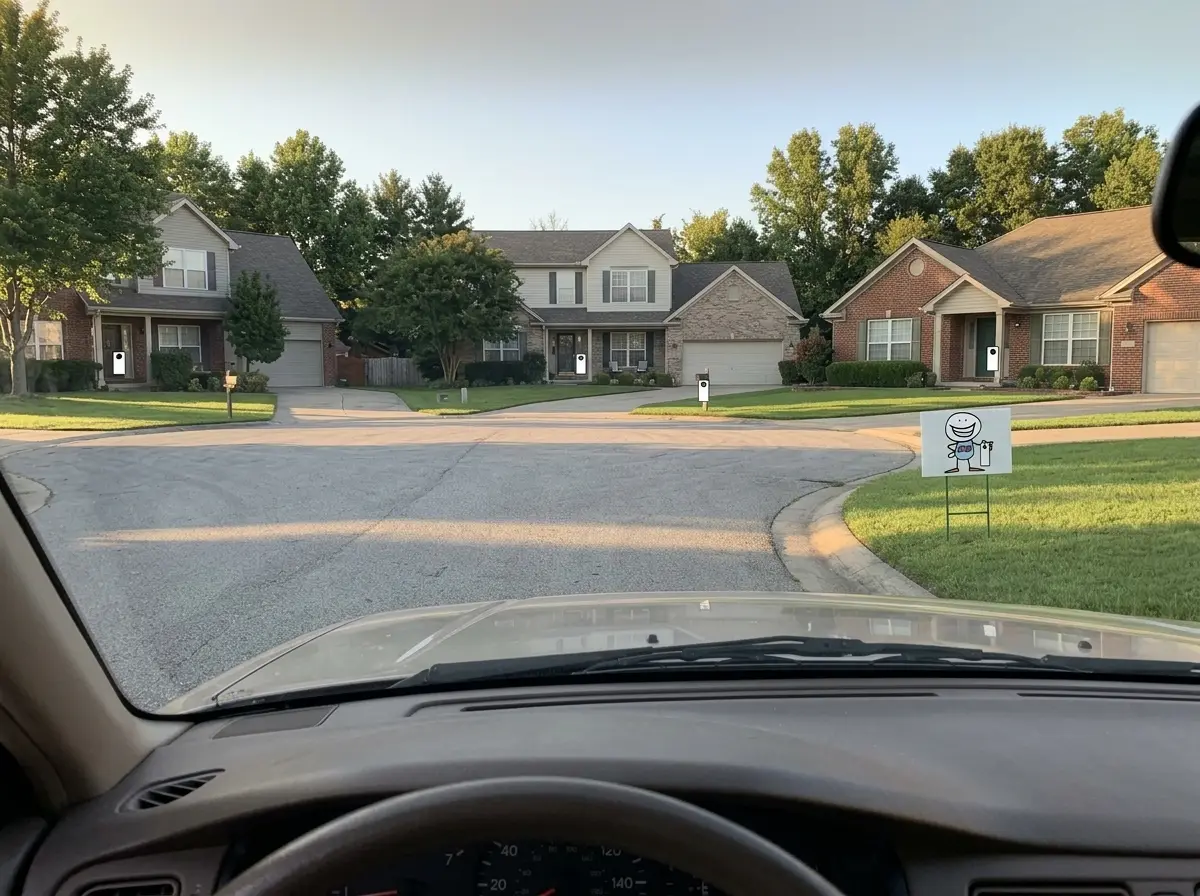
- Pick three streets at random from the route list — one at the edge, one in the middle, one in a cul-de-sac. Cul-de-sacs and dead ends are where lazy coverage goes to die.
- Drive them within a day of completion. Count doors with a piece, doors without, and doors with a posted sign (those should be empty).
- Compare against the documentation. The photos for those three streets should match what you saw.
- Track responses by route, not just by campaign. A dedicated phone number, offer code, or landing page per route (the Federal Trade Commission’s advertising guidance applies to what’s on the piece — keep offers truthful and substantiated) tells you which neighborhoods are working, which is the beginning of a smarter second campaign. Harvard Business Review makes the same point about marketing metrics generally: measure the mechanism, not just the outcome.
If a distributor objects to any of this, you’ve learned what you needed to know.
Why It’s Worth Getting Right
The channel works. The execution is the variable.
Households still engage with physical material at the door in ways digital struggles to match — the USPS’s Household Mail Survey (filed annually with the Postal Regulatory Commission) has documented how households handle physical advertising for years, Brookings has traced what American households still use the mail for, peer-reviewed work summarized by Temple University’s Fox School finds physical ads are recalled better than digital ones, and Pew Research Center surveys document broad public unease about how personal data is used for online advertising. The Association of National Advertisers, the direct-marketing industry’s trade body, continues to treat neighborhood-level flyer distribution as a core local channel, and SBA Office of Advocacy data shows the overwhelming majority of American employers are small, local firms whose customers live nearby.
None of that matters if the pieces are in a dumpster. Verification is what turns a marketing channel into a marketing result.
Related: Is It Legal to Put Flyers on Doors? The Federal, State, and City Rules Every Campaign Has to Clear — the rulebook behind Question 4.
Key Takeaways
- Undelivered campaigns and unsuccessful campaigns look identical from the outside. Only proof separates them.
- Proof must show placement, coverage against a household count, and be reviewable by you at completion.
- Photos are evidence. Location dots are activity.
- The seven questions — especially "what do I receive when it's done?" — sort real distributors from crews.
- Skips are normal; zero skips is a red flag.
- Do the two-hour spot check on your first campaign, every time.
Frequently Asked Questions
How do I know if my flyers were actually delivered?
Ask for photographic proof of delivery — photos of each placement organized by route and address, delivered when the job is complete — and do a spot check on two or three randomly chosen streets within a day of completion. If the vendor offers only a map of where a phone traveled, or a verbal confirmation, you don't have proof.
What is proof of delivery for door hangers?
A photo of the placed piece at each residence on the route, reconciled against the route's household list, delivered to the client at job completion. Direct to Door Marketing provides Proof of Delivery photos for every campaign through its AI Management Platform.
Is location tracking enough to verify flyer distribution?
No. Location data shows that a device moved along a street; it cannot show whether a piece was placed at each door, secured, or correctly skipped at a posted sign. Even vendors that rely on it acknowledge it only shows where someone has been.
What should a flyer distribution report include?
The route's household count, the number of placements, the number of skips with reasons, and the placement photos. Anything less is a summary, not a report.
How many flyers should I expect to be delivered?
All of the residences on the route that can lawfully receive a piece. Homes with posted "No Soliciting" or "No Handbills" signs, locked gates, and buildings without management permission are skipped and should be recorded as such.
What are the red flags for a bad flyer distribution company?
Per-thousand pricing with no household count, proof available only on request or for a fee, map-only verification, no answer on mailbox and sign rules, flat flyers with no securing method, and pressure to sign before showing a sample of prior proof.
Can I verify distribution myself?
Yes. Pick three streets at random including a cul-de-sac, drive them within a day, count doors with and without a piece, and compare against the documentation. Track responses with a route-specific phone number or offer code.
How does Direct to Door Marketing verify delivery?
Routes are built from Census block-group household data so the door count is known before the first step. Distributors who live in the neighborhoods walk the route, skips are recorded with reasons, and Proof of Delivery photos for every campaign are delivered at job completion through our AI Management Platform. Request a quote and an expert campaign advisor — not a commissioned sales rep — will map your market.
About the author
Randy Etheridge, Founder and President
Randy Etheridge founded Direct to Door Marketing in 1995 and has grown it into America's largest door hanger and flyer distribution company, running campaigns in thousands of cities simultaneously through the largest distributor network in the country. DTD is classified under NAICS 541870 (Advertising Material Distribution Services) and provides bundled printing and distribution for local businesses, franchises, and national brands. He still writes the standards distributors are trained to and personally reviews quality-control flagged campaigns.