
Leaflet distribution is still one of the most affordable ways for Dallas businesses to market themselves. With this direct approach, companies can reach thousands of people in specific neighborhoods and demographics across the Dallas-Fort Worth area.

Professional leaflet distribution services in Dallas can deliver response rates between 1-5% when properly targeted and designed. The key is picking the right neighborhoods, using compelling designs, and working with local experts who know the Dallas market well.
Dallas is a great city for leaflet marketing because of its mix of neighborhoods and steady population growth. From upscale Highland Park to the busy downtown districts, businesses can get really specific about who they want to reach with their campaigns.
Key Takeaways
- Leaflet distribution in Dallas can achieve 1-5% response rates with proper targeting and design
- Success requires understanding Dallas neighborhoods and working with experienced local distribution services
- Measuring campaign performance through tracking methods helps optimize future leaflet marketing efforts
Understanding Leaflet Distribution in Dallas
Businesses in Dallas use three main methods for leaflet distribution. These include traditional flyer handouts, door hanger distribution, and choosing between direct-to-door delivery or regular direct mail.
Defining Leaflet Distribution
Leaflet distribution means delivering printed materials directly to homes and businesses. Companies use this to advertise products, services, or special deals in specific Dallas neighborhoods.
They print marketing materials on paper or cardstock—these could be flyers, brochures, coupons, or promo cards. Most leaflets are single-page, colorful, and straightforward.
Distribution companies handle the delivery. Their workers walk through neighborhoods and place leaflets at the right spots. Some services even offer tracking so you can see which areas got the materials.
Many Dallas businesses like leaflet distribution because it lets them target by zip code. Local restaurants, home services, and retailers use it a lot. Plus, it’s usually cheaper than digital ads or TV spots.
The Role of Door Hanger Distribution
Door hanger distribution uses printed pieces designed to hang on door handles. They have a hole or perforation so they fit over knobs or handles easily.
Door hangers stick around longer than regular flyers. They don’t blow away or get lost in the mail, and residents have to physically take them off, which boosts the odds they’ll read them.
This method is super popular in Dallas suburbs and residential areas. Home service businesses—plumbers, landscapers, cleaners—use door hangers all the time. Usually, they’re about 4.25 by 11 inches and printed on thick cardstock.
Distribution costs vary depending on how many you need, the area size, and which neighborhoods you want. Most companies have a 1,000-piece minimum order.
Direct-to-Door vs. Direct Mail
With direct-to-door delivery, workers hand out flyers and door hangers right to homes, skipping the postal service. They target specific addresses or neighborhoods.
Direct mail goes through the United States Postal Service. You pay postage, follow postal rules, and your materials end up in mailboxes with the regular mail.
Key differences include:
| Method | Cost | Speed | Targeting |
|---|---|---|---|
| Direct-to-Door | Lower | Faster | Neighborhood-based |
| Direct Mail | Higher | Slower | Address-specific |
If you’re a local Dallas business on a budget, direct-to-door is usually the way to go. Delivery happens within days of printing. Direct mail gives you more precise targeting but costs more because of postage.
Flyer distribution by direct-to-door covers whole neighborhoods fast. It lets businesses flood an area with their message. Sometimes, Dallas companies mix both methods to get the best coverage.
How the Leaflet Distribution Process Works

Leaflet distribution usually follows three steps to make sure the right people in Dallas get your materials. Companies start with planning, figure out their target customers, and map out exactly where to deliver.
Initial Consultation and Planning
The process kicks off with a meeting between the distribution service and the client to get clear on business goals. They talk about the business type, budget, and what the client hopes to achieve.
During planning, they discuss leaflet design and printing needs. The service reviews the materials to check they meet local rules and postal guidelines.
Key planning elements include:
- Campaign timeline and delivery dates
- Number of leaflets to distribute
- Special delivery instructions
- Weather backup plans
The provider explains their tracking options at this stage. Most offer GPS tracking and photo proof, so you know where the leaflets went.
Identifying the Target Audience
Distribution services help clients define who should get their leaflets. They look at things like age, income, and household size in different Dallas neighborhoods.
The target audience shapes every other campaign decision. A restaurant might go after families with kids, while a luxury brand aims for higher-income areas.
Common targeting factors:
- Income levels – Based on neighborhood property values
- Lifestyle patterns – Homeowners vs renters, urban vs suburban
Services use local data to match the client’s audience with Dallas zip codes. This approach cuts down on waste and boosts response rates.
Mapping Out Distribution Zones
The distribution service creates maps showing exactly where to deliver. They divide Dallas into zones based on the audience and campaign size.
Each zone goes to specific delivery teams with set routes. Teams get maps of which streets to cover and which properties to skip.
Zone mapping considers:
- Residential density and walkability
- Local restrictions or gated communities
- Previous campaign performance data
- Delivery team capacity and timing
GPS tracks each route in real time. This guarantees the team covers every assigned area and provides proof of delivery.
Choosing a Dallas Leaflet Distribution Service
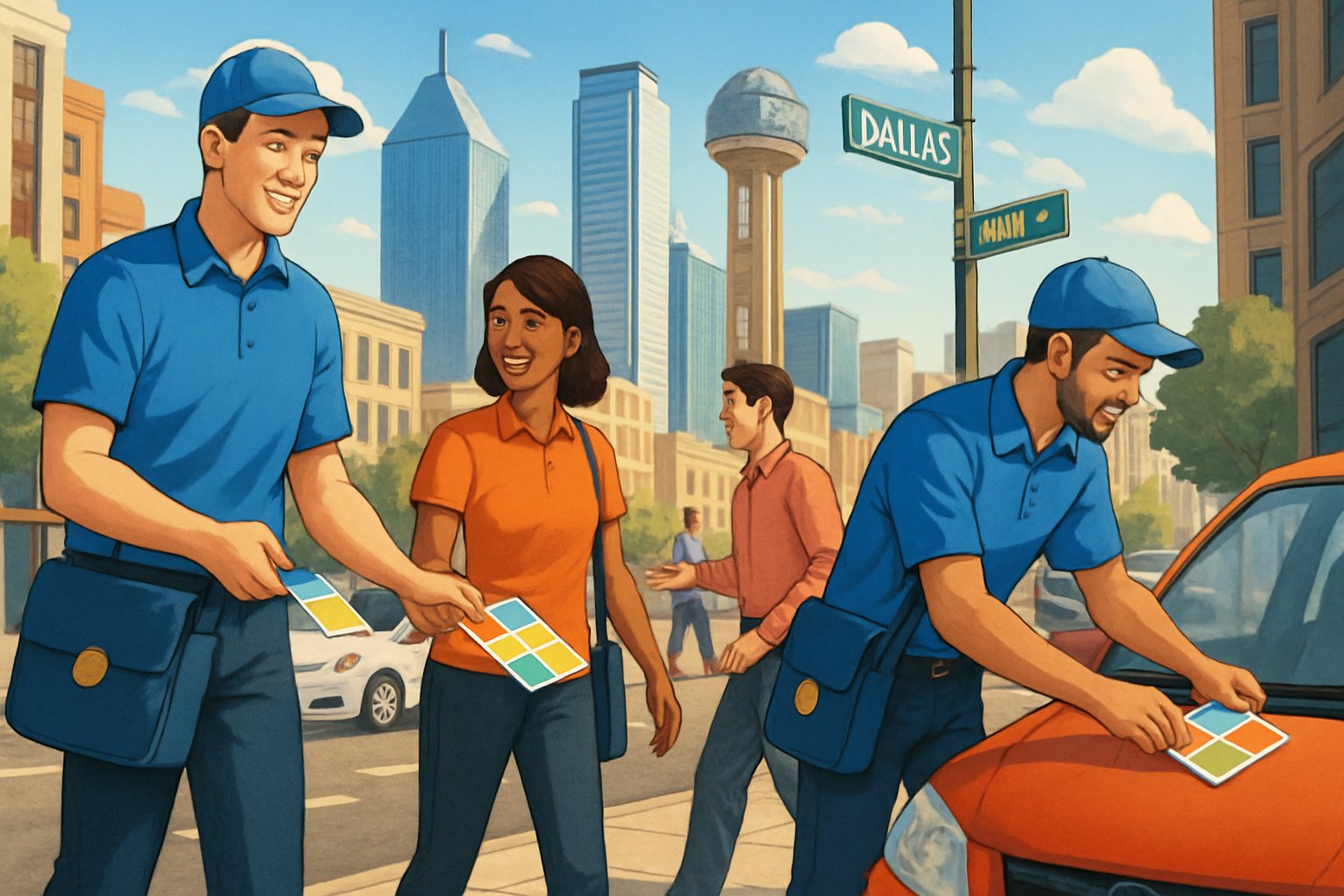
Picking the right distribution company means looking at their tracking, delivery coverage, and pricing. Local providers offer different options like door-to-door, business targeting, and event handouts.
What to Look for in a Distribution Service
A trustworthy dallas flyer distribution service gives you GPS tracking and delivery confirmation. This lets you see where and when your leaflets landed.
Find out if they offer demographic targeting. The best ones can deliver to specific neighborhoods, income brackets, or age groups in Dallas.
Ask about the delivery team. Full-time employees usually do a better job than temps. They know Dallas streets and follow instructions more closely.
Look for detailed reporting. You should get maps of delivery routes and photos as proof.
Insurance is important. Make sure the flyer distribution service has liability coverage for workers and vehicles.
If you’re on a deadline, response time matters. Choose companies that can start within two or three business days.
Comparing Local Providers
Dallas has several well-known distribution companies, each with their own focus. Some cover mostly residential areas, while others go after business districts.
Always get quotes from at least three providers. Prices usually fall between $0.10 and $0.25 per piece, depending on quantity and area.
Compare coverage maps carefully. Not every service reaches every Dallas suburb or nearby city.
Check online reviews and ask for references. Companies with three or more years in Dallas tend to be more reliable.
Pay attention to minimum order sizes. Some want 5,000 pieces, but others will do as few as 1,000.
Ask about rush fees and weekend delivery. These usually cost 25-50% more than standard options.
Evaluating Delivery Methods
Door-to-door distribution puts leaflets directly at homes and apartments. It usually gets the best response, but costs a little more.
Business-to-business delivery targets offices, stores, and commercial buildings. This is great for B2B services or professional offerings.
Some flyer delivery service providers offer hand-to-hand distribution at events, shopping centers, or busy intersections. You’ll need permits for this in most Dallas areas.
Targeted demographic delivery uses census data to reach certain household types. You can choose by income, age, family size, or home value.
Think about timing too—morning, afternoon, or weekends all affect visibility and response rates. Weather matters in Texas, so pick services that use plastic bags or weatherproof materials during rainy months.
Design and Printing Essentials for Effective Leaflets
Great flyer design balances clear messaging with visuals that grab attention. Print quality and paper choice make a real difference in how people respond to your leaflets.
Crafting a Compelling Flyer Design
Strong headlines grab attention fast—usually in three seconds or less. Use bold fonts at least 18 points for your main headline.
Keep those headlines short, under eight words if you can. That’s what really delivers impact.
Pick colors that match your brand and pop in Dallas neighborhoods. High contrast between text and background makes everything easier to read.
Dark text on a light background works best for body copy. Simple, but it just works.
Essential Design Elements:
- Clear call-to-action button or text
- Contact information in large, readable font
- Logo placement in top corner
- White space around important elements
Use high-resolution images—aim for at least 300 DPI. Blurry photos make your business look unprofessional, so skip those.
Whenever possible, show off real photos of your products or services. Stock images feel generic and, honestly, people notice.
Text hierarchy guides readers through your message. Make important info bigger and bolder.
Bullet points help break up long blocks of text. Don’t be afraid to use them.
Selecting Printing Options
Paper weight changes how customers see your business. 80lb text offers good durability without breaking the bank.
100lb cover stock feels more premium, but expect it to cost 30-40% more.
Common Paper Options:
| Paper Type | Weight | Best For |
|---|---|---|
| Text | 70-80lb | Basic promotions |
| Cover | 80-100lb | Professional services |
| Cardstock | 110lb+ | High-end businesses |
Full-color printing costs more but can boost response rates by 25%. Single-color printing saves money if your design is strong enough on its own.
Gloss coating makes colors pop, though sometimes it creates glare. Matte coating feels professional and hides fingerprints better.
Uncoated paper costs less, but it absorbs ink differently and can look a bit dull. Choose based on your priorities.
Print quantities matter—a lot. If you order 5,000+ pieces, you’ll usually pay about 40% less per flyer than if you just order 1,000.
Best Practices to Maximize Engagement
Try different flyer designs with small print runs first. Track which versions get more calls or website visits.
Change just one thing at a time to see what’s actually working. Otherwise, you’ll never know which tweak made the difference.
Proven Design Tips:
- Put your contact info in the bottom right corner
- Use local Dallas landmarks or references
- Include expiration dates to create urgency
- Add QR codes linking to websites or special offers
Font size matters more than you think. Use at least 12-point text—14-point or bigger if you’re targeting seniors.
Stick to one main offer per flyer. Multiple promotions just confuse people and lower your response rate.
Targeting Strategies for Dallas Markets
Effective Dallas flyer distribution really depends on targeting—location, demographics, and distribution frequency. If you understand your target audience by using geographic zones and population data, you’ll get better campaign results.
Geographic Targeting in Dallas Neighborhoods
Dallas covers 385 square miles, and every neighborhood has its own vibe. Downtown brings in business professionals and urban residents. Uptown draws young professionals with higher incomes.
Suburbs like Plano and Frisco have families with kids and pretty solid incomes. Deep Ellum is all about creative types and millennials.
Oak Cliff is more diverse, with lots of different communities and income levels. You can’t just use one message everywhere.
High-Traffic Areas for Distribution:
- Shopping centers in North Dallas
- Business districts downtown
- Residential areas in Richardson
- Entertainment zones in West End
Each spot needs its own timing and messaging. Business districts? Hit them on weekdays. Residential areas do better on weekends.
Demographic Segmentation
Dallas has about 1.3 million people with a wide mix of ages and incomes. Median household income sits around $54,000.
Roughly 35% of residents are Hispanic, 29% are white, and 24% are Black. It’s a real mix.
Key Demographics for Targeting:
- Ages 25-44: 30% of the population
- Families with children: 40% of households
- College educated: 35% of adults
- Renters: 55% of residents
Young professionals love tech and dining promos. Families want discounts on services and retail. Seniors care more about healthcare and home services.
Match your product or service to the right demographic and pick neighborhoods accordingly. It’s not always obvious, so dig into the data.
Optimizing Reach and Frequency
Reach is just how many people see your flyers. Frequency is how often they see them. Both matter for Dallas flyer distribution.
Distribution Schedule Options:
- One-time drop: Maximum area, single exposure
- Weekly repeats: Builds brand awareness over time
- Monthly campaigns: Keeps your presence steady
Test different frequencies in smaller areas first. Track response rates and adjust your schedule based on what works.
Most businesses get better results from 2-3 drops instead of just one big push. Timing matters too—weekday mornings catch commuters, weekends reach families, and evenings work for food or entertainment promos.
Keep an eye on which neighborhoods perform best. Double down on those, but always test new areas here and there. You never know what you’ll find.
Measuring Success and Return on Investment
Tracking the right metrics helps you figure out if your leaflet campaigns in Dallas actually work. You can measure delivery rates and customer responses to see your real profits.
Tracking Delivery and Engagement
GPS tracking systems show exactly where distributors delivered leaflets in Dallas. Most companies give you maps and timestamps as proof.
You can track engagement in a few ways. Unique discount codes on leaflets show how many people used your offer.
QR codes linked to landing pages let you count digital interactions. Phone tracking numbers make it easy to see which calls came from leaflets.
Dallas leaflet campaigns usually see response rates between 0.5% and 3%. Food delivery services sometimes get 2-5% in busy spots like Deep Ellum and Uptown.
Evaluating Campaign Performance
Cost per acquisition tells you what each new customer costs through leaflet distribution. Most Dallas businesses spend $15-40 per new customer from leaflets.
Key performance metrics include:
- Response rate percentage
- Cost per lead generated
- Customer lifetime value
- Return on investment ratio
Compare leaflet results with your other marketing. Track sales in targeted zip codes during campaign periods.
Set up tracking before you start distributing. Keep measuring for at least 30 days after the campaign, since some people take a while to respond.
Frequently Asked Questions
Business owners in Dallas have lots of questions about leaflet distribution—costs, legal stuff, targeting, you name it. These common concerns shape the best door-to-door marketing approaches in the area.
What are the most effective strategies for door hanger distribution?
Door hangers work best when you include clear contact info and eye-catching visuals. Keep your message simple and easy to read at a glance.
Timing matters. Weekday mornings and early evenings usually give you better response rates than weekends.
Focus on neighborhoods where your ideal customers actually live. Single-family home areas are usually easier to reach than apartment complexes.
Weather makes a difference. Avoid rainy or windy days—nobody wants a soggy flyer.
How do I select a reliable flyer distribution company in the Dallas area?
Good companies offer GPS tracking and photo proof of delivery. Look for detailed reports showing where and when your flyers went out.
Check references from other local businesses. Ask about completion rates and overall satisfaction.
Make sure the company’s licensed and insured. That protects you from liability headaches.
Local experience matters. Dallas traffic and neighborhoods can be tricky, so pick someone who knows the area well.
What are the costs associated with professional leaflet distribution services?
Basic door-to-door distribution in Dallas runs about $0.10 to $0.30 per flyer. Prices depend on quantity and target areas.
GPS tracking and delivery confirmation add another $0.05 to $0.10 per piece. It’s worth it for the peace of mind.
Printing costs usually fall between $0.03 and $0.15 per flyer, based on size and paper quality. Full-color designs cost more than black-and-white.
Minimum orders are typically 1,000 pieces. Larger runs get you volume discounts.
What are the legal considerations for distributing flyers door to door in Dallas?
Dallas usually requires permits for commercial leaflet distribution. Check with the city planning department for up-to-date rules.
Private property rules apply in gated communities and apartment complexes. You’ll need permission from property managers before distributing there.
Don’t put flyers in mailboxes unless you have a postal permit. Door hangers and doorstep placements are fine, though.
Some neighborhoods have HOA restrictions on advertising. Always check before you start your campaign.
Can I target specific neighborhoods or demographics with my leaflet distribution campaign?
Distribution companies can target ZIP codes and even specific streets. They use demographic data to find your ideal customers.
Income and age help pick the best areas for your product or service. Census data is your friend here.
Shopping habits and lifestyle choices guide neighborhood selection. Being near complementary businesses can boost your results.
Custom mapping tools let you focus on high-potential areas and skip zones that don’t fit. That keeps your campaign lean and efficient.
What metrics are used to measure the success of a leaflet distribution effort?
Response rates for leaflet campaigns usually fall between 1% and 5%. Track phone calls and website visits to measure responses.
Coupon redemptions show campaign effectiveness directly. Unique promo codes help you see which areas worked best.
Cost per lead is just total campaign cost divided by responses. It’s a good way to compare marketing channels.
Geographic tracking shows which neighborhoods performed best. Use that info to improve your next campaign.
Our State-of-the-Art AI Management Platform
Direct to Door Marketing uses smart AI technology for leaflet distribution in Dallas. The platform handles every part of the job, from the first step to the last.
Live Job Updates Clients can check their delivery progress in real time with a simple dashboard. You’ll see which areas are done and where work is still happening.
Smart Route Planning The AI maps out the best delivery paths for each neighborhood. This saves time and helps make sure every home gets reached without extra walking.
Proof of Delivery System Each delivery comes with photos that have GPS location and time stamps. These photos show leaflets made it to the right houses at the right time.
| Feature | Benefit |
|---|---|
| GPS tracking | Shows exact delivery locations |
| Time stamps | Proves when delivery happened |
| Photo proof | Visual confirmation of completed work |
Quality Control Checks The AI watches for mistakes and double deliveries. It spots issues before they turn into bigger problems and keeps quality up.
Automatic Updates Clients get alerts when jobs start or finish, or if something goes wrong. Updates arrive by email, text, or right on the dashboard.
Detailed Reports The platform creates reports with coverage maps and delivery stats. Clients can see exactly where their leaflets went and how the campaign performed.
The AI platform works in big Dallas neighborhoods and smaller spots around the city, too.